


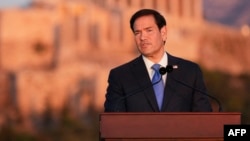
ATHENS -- US Secretary of State Marco Rubio has called for a renewal of the Western alliance based on national sovereignty, military strength, and a commitment to shared values, telling an audience in Athens that the United States and Europe must rediscover the confidence and determination he said once defined Western civilization.
Speaking at Athens's ancient Pnyx, the birthplace of the Athenian democratic tradition, Rubio presented a vision of the West rooted in ancient Greece and extending through European Christianity to the founding of the United States.
But his central message was distinctly contemporary: The West, he said, is at an "inflection point," facing war, great-power competition, terrorism, technological rivalry, and threats to national sovereignty.
Under President Donald Trump, "the United States has made its choice," Rubio said, declaring that Washington would pursue "national power," rebuild its defense capabilities, reindustrialize its economy, secure critical supply chains, and compete aggressively in emerging technologies.
The secretary of state, who arrived from Iceland as part of a European tour, urged Europe to undertake a similar transformation.
"We believe that Europe can awaken from its long slumber and rekindle the fire that was lit here millennia ago," Rubio said, pointing to increased European defense spending and new security partnerships as signs of what he called potentially a "generational shift."
Transatlantic Cooperation Vs. National Sovereignty
Rubio sought to counter the perception that the Trump administration's emphasis on national sovereignty necessarily comes at the expense of transatlantic cooperation.
"Though passions may at times have strained the bonds of affection between the United States and Europe, it must not be allowed to break them," he said.

He pointed to Greece as an example of the kind of ally Washington wants to see playing a larger role in European security. The message comes as Greece remains a frontline NATO and EU member, while Washington simultaneously seeks closer ties with Ankara. That balancing act is being closely watched in Athens.
George Tzogopoulos, a senior fellow at the Hellenic Foundation for European and Foreign Policy, said Greece shares the basic American argument that Western civilization and its democratic traditions need to be protected.
But he cautioned that Athens does not necessarily share Washington's approach on how that should be achieved.
"Greece sees strong transatlantic relations as the core of a strong Western 'front,'" Tzogopoulos told RFE/RL, adding Athens remains cautious about whether such unity can be achieved by "blindly following demands of the Trump administration."
Criticism Of Iran
Rubio cited Iran as an example of the stark differences between what he described as Western traditions of heroism and duty and what he portrayed as the ideology of the Islamic republic.
He criticized Iran's "radical mullahs" and their glorification of martyrdom, accusing the Iranian leadership of celebrating "child suicide bombers as national heroes" and of treating death as an end in itself.
Earlier, Rubio had said Iran will never be allowed to acquire a nuclear weapon, declaring that preventing Tehran from doing so is a red line for Trump.
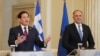
Rubio linked the Iranian challenge to a wider environment of renewed conflict, terrorism, geopolitical competition, and threats to Western security.
Rubio's speech repeatedly returned to the idea that alliances should reinforce rather than diminish national sovereignty.
In his speech, Rubio said that international institutions should not abolish the sovereignty of their members but should help defend it, and said countries do not have to abandon their individual identities in order to pursue common interests.
He cited US-Greek cooperation in defense, energy, technology, and border security as an example of that model.
That argument has particular resonance in Greece, which has supported Ukraine while simultaneously facing long-running security concerns in its own neighborhood.
Analyst Tzogopoulos noted that Greece is already contributing to the defense of the broader Western order through its support for Ukraine and its response to revisionism in its neighborhood.
Yet the Greek perspective also illustrates the potential gap between Washington's increasingly sovereignty-focused vision and the European understanding of the rules-based international system.
Panayotis Tsakonas, a professor of international relations at the National and Kapodistrian University of Athens, told RFE/RL that, for Greece, defending the Western order means defending "international law, territorial sovereignty and the rules-based order against revisionism, hybrid threats and coercion."

