


With Victory Assured, Azerbaijan Now Seeks 'Reintegration' Of Karabakh Armenians
The Russian peacekeeping contingent in Nagorno-Karabakh said it had evacuated more than 5,000 people following Azerbaijan's offensive in the region this week.
As Azerbaijan moves swiftly toward retaking full control of the region of Nagorno-Karabakh, the territory's ethnic Armenian population is facing a deeply precarious future.
The Azerbaijani government has said it has a plan to "reintegrate" the Armenians into the Azerbaijani state following its victory in a one-day offensive and the surrender of Karabakh's de facto ethnic Armenian leadership. But Baku still hasn't offered specifics about what reintegration might mean -- and its promises to protect the rights and security of its possible new Armenian citizens have little credibility among a traumatized and frightened Karabakh population.

Representatives of the central government from Baku and Karabakh Armenians on September 21 began working out the terms of a new arrangement following the Azerbaijani offensive, which Nagorno-Karabakh authorities say has killed at least 200 people, including 10 civilians, and wounded more than 400. (RFE/RL could not independently confirm the casualty figures.) While there were no immediate results from the talks, negotiations are slated to continue.
"A whole host of questions still need to be resolved," David Babaian, an adviser for foreign policy to the separatist government's de facto leader Samvel Shahramanian, told Reuters following the meeting with the Azerbaijanis. "We do not know what guarantee of security our people will get. This needs to be resolved."
WATCH: Security forces have detained more than 80 people amid anti-government protests in the Armenian capital of Yerevan.
In the immediate aftermath of the assault, uncertainty reigned in Karabakh. Many Karabakh Armenians wrote on social media that they had been separated from family members during the offensive. There were sporadic reports of continued fighting. The Russian peacekeeping contingent in the territory said it had evacuated more than 5,000 people from the regions of Martakert, Martuni, and Askeran after Azerbaijani forces advanced into those regions. As of late night on September 21, the peacekeepers said they were hosting 704 displaced people at their base at the airport in Xocali.
Azerbaijan has said six Russian peacekeepers were killed during Baku's military offensive. According to the country's Prosecutor-General's Office, five were killed "by mistake" by Azerbaijani forces and one by Karabakh Armenian fighters.
Azerbaijani forces have not yet moved into the capital of the territory, known as Stepanakert in Armenian and Xankendi in Azerbaijani. Public services and administration are, for now, still being operated by the self-proclaimed Nagorno-Karabakh Republic (NKR), which has governed the territory since the early 1990s, after Armenian separatists defeated Azerbaijan in the first war between the two sides.
A generation of ethnic Armenians in Karabakh has now grown up under the NKR's rule, as it maintained control of the territory with Armenia's backing. Diplomatic efforts to resolve the conflict after the first war brought little progress.
IN PHOTOS: An estimated 10,000 evacuees are seeking shelter without basic living conditions in basements, while others have massed at an airport in hopes of fleeing to Armenia.
Concerns Grow For Humanitarian Situation Of Nagorno-Karabakh Evacuees
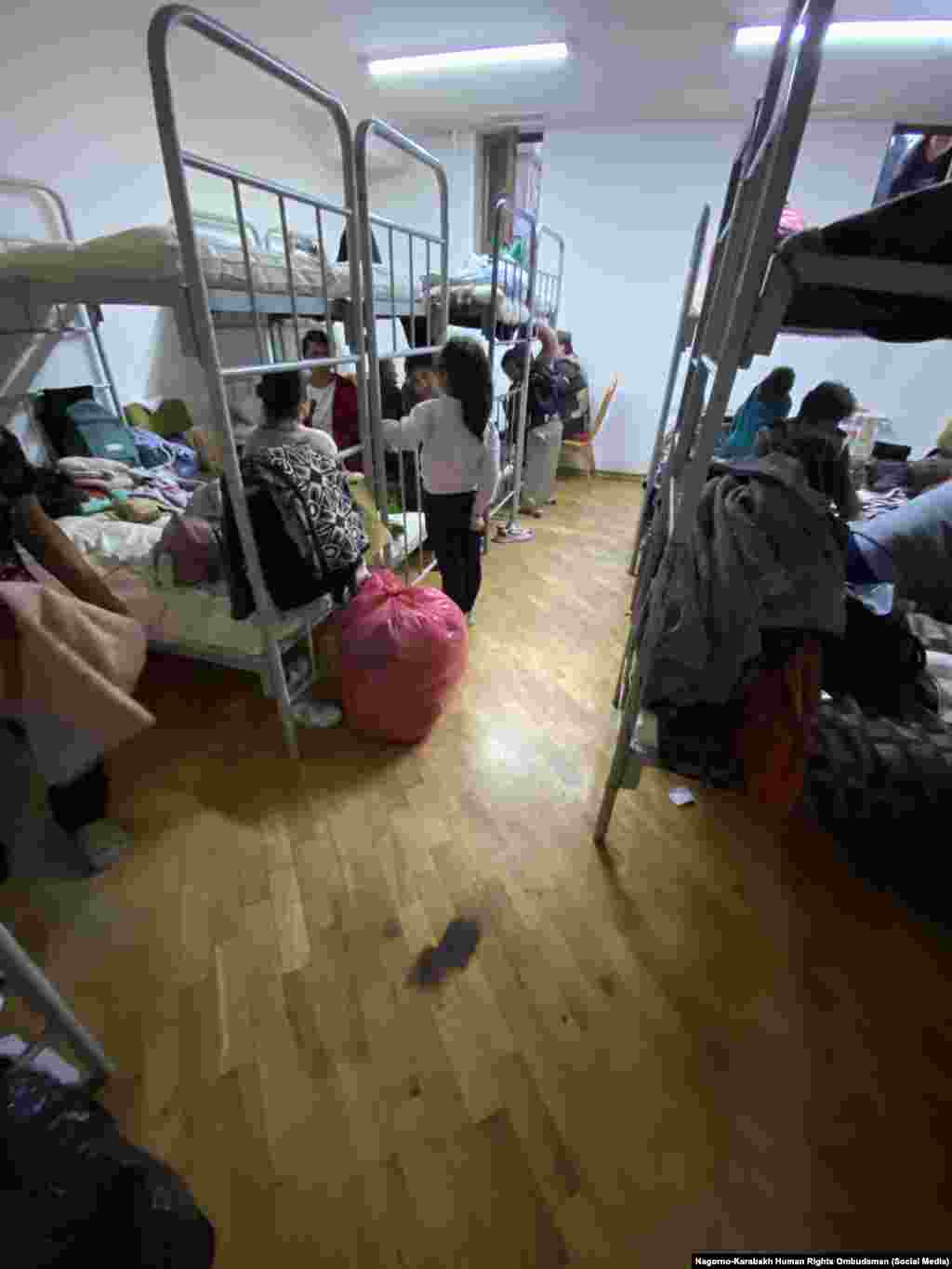
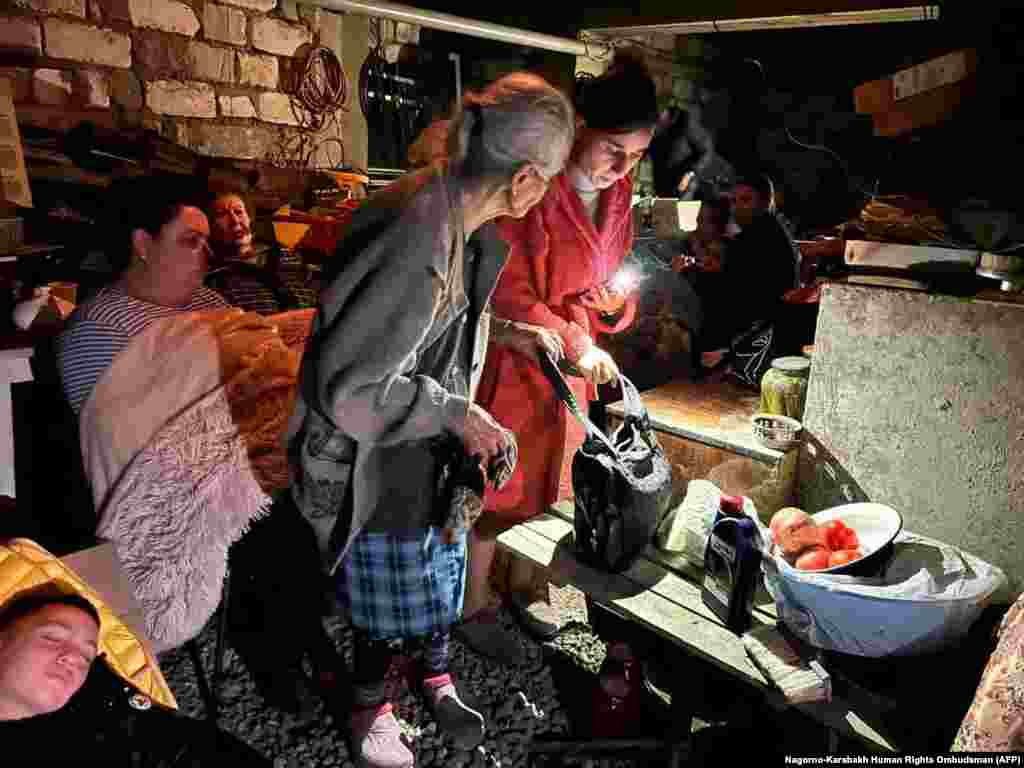
1/10A social media photo dated September 21 from the Nagorno-Karabakh human rights ombudsman reportedly shows Armenian evacuees living in challenging conditions.
"More than 10,000 evacuated people are currently staying in basements without proper food, water, electricity, and all other basic conditions of living. Azerbaijan is committing a genocide in Artsakh (Nagorno-Karabakh) in real time with the tacit consent of the international community," the ombudsman wrote on X, formerly known as Twitter.
Following a lightning military offensive by Azerbaijani forces in the disputed territory of Nagorno-Karabakh, an estimated 10,000 evacuees are seeking shelter without basic living conditions in basements, while others have massed at an airport in hopes of fleeing to Armenia.
2/10Another social media picture is believed to show displaced Armenians waiting to leave on September 21 near the airport in Nagorno-Karabakh's de facto capital, Stepanakert.
Ombudsman Gegham Stepanian said on social media that the streets of Stepanakert were "filled with displaced people [who are] hungry and scared."
Following a lightning military offensive by Azerbaijani forces in the disputed territory of Nagorno-Karabakh, an estimated 10,000 evacuees are seeking shelter without basic living conditions in basements, while others have massed at an airport in hopes of fleeing to Armenia.
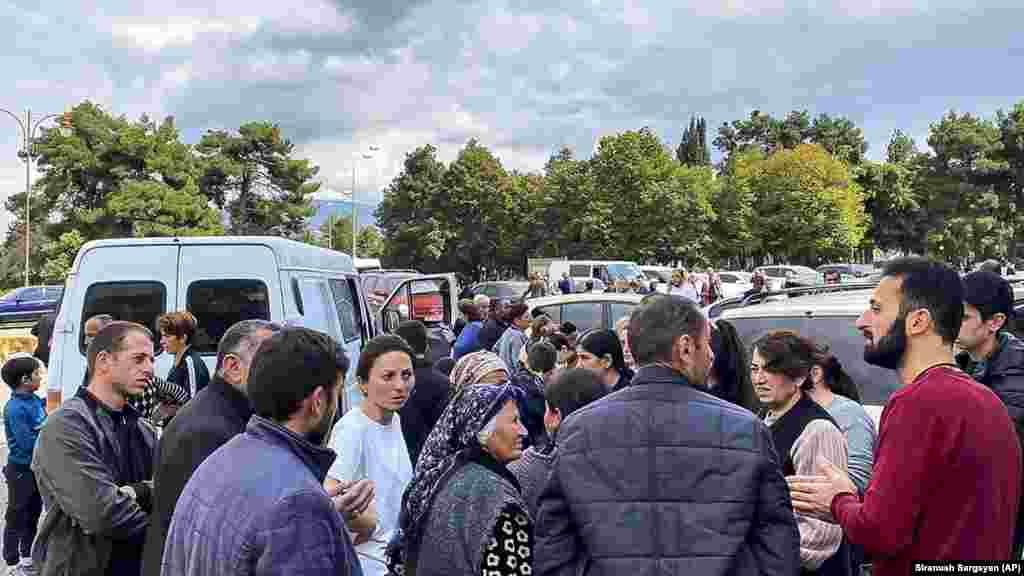
3/10A local government worker (right) tries to calm residents after shooting was heard in Stepanakert.
Following a lightning military offensive by Azerbaijani forces in the disputed territory of Nagorno-Karabakh, an estimated 10,000 evacuees are seeking shelter without basic living conditions in basements, while others have massed at an airport in hopes of fleeing to Armenia.
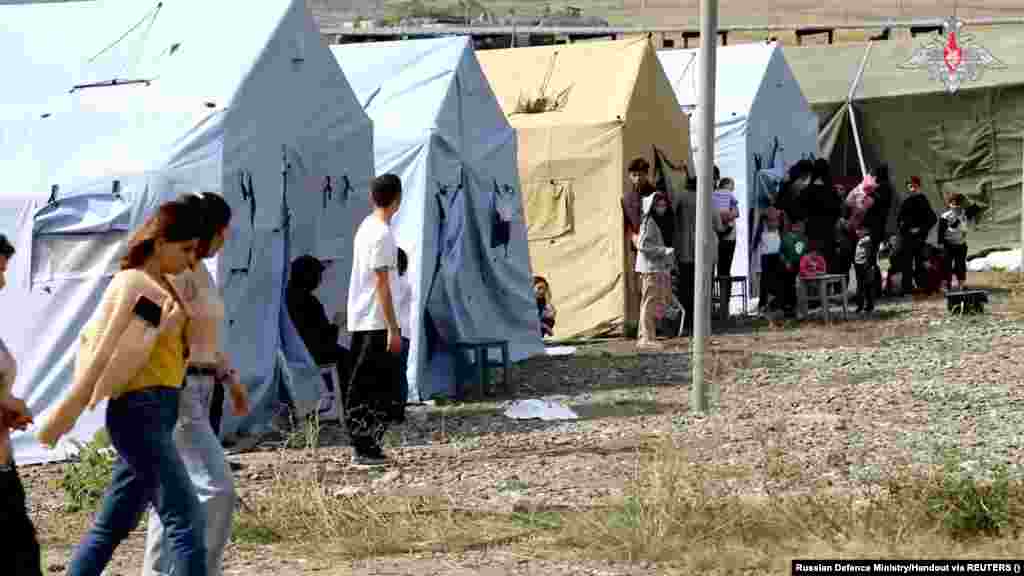
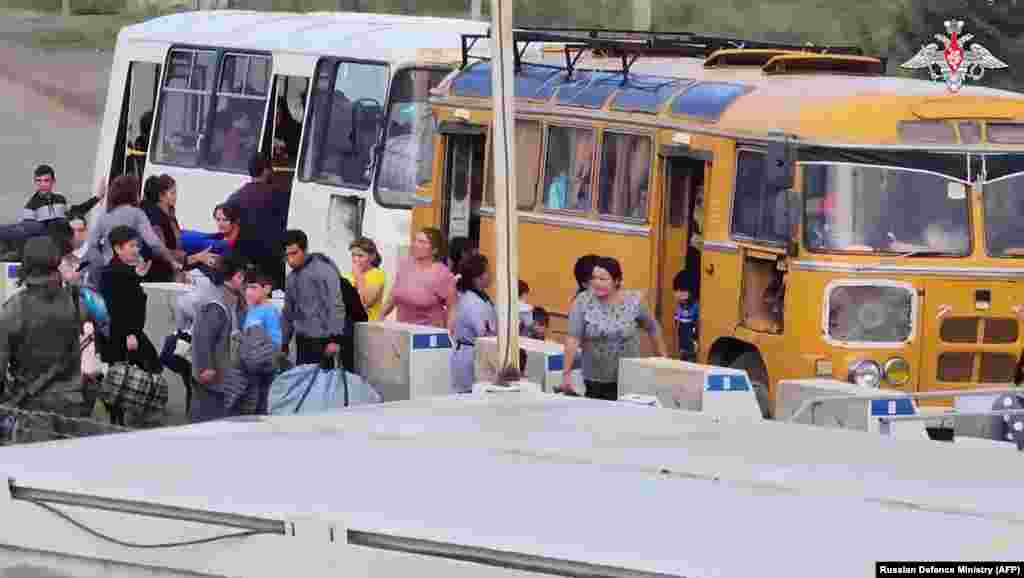
4/10An image released by the Russian Defense Ministry on September 21 reportedly shows civilians evacuated by Russian peacekeepers at an undisclosed location.
Azerbaijan halted its military action in the breakaway region of Nagorno-Karabakh on September 20 after its swift battlefield success forced Armenian separatists to agree to a cease-fire that would see the area fully return to Baku's control.
Following a lightning military offensive by Azerbaijani forces in the disputed territory of Nagorno-Karabakh, an estimated 10,000 evacuees are seeking shelter without basic living conditions in basements, while others have massed at an airport in hopes of fleeing to Armenia.
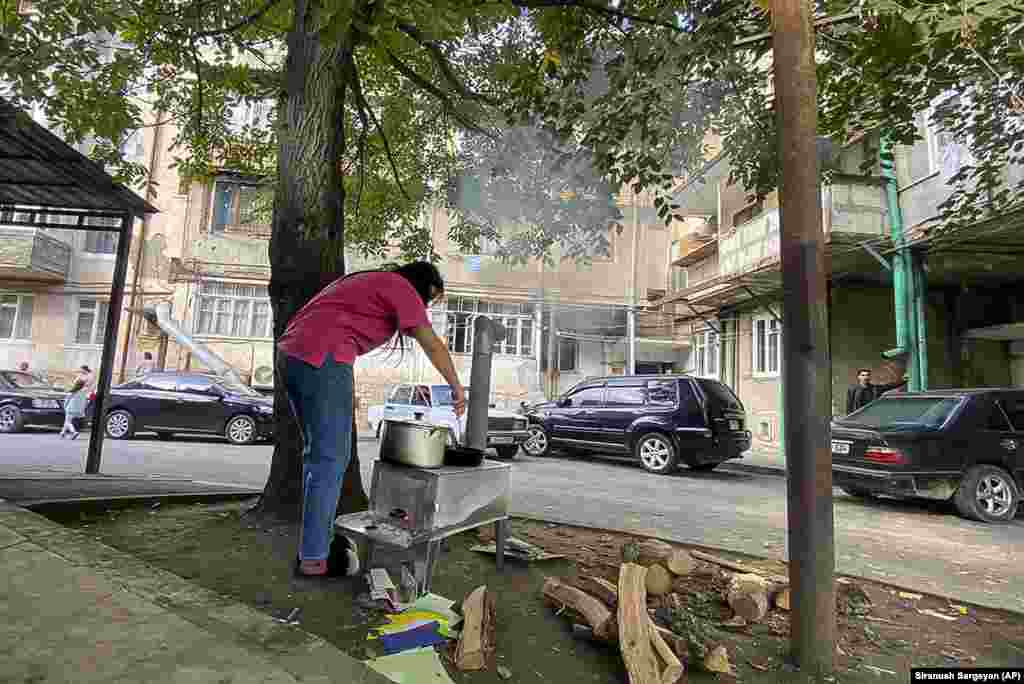
5/10A woman cooks on a makeshift outdoor stove near a street in Stepanakert.
Stepanian has said that at least 200 people were killed and about twice as many wounded during the latest fighting, including children.
Following a lightning military offensive by Azerbaijani forces in the disputed territory of Nagorno-Karabakh, an estimated 10,000 evacuees are seeking shelter without basic living conditions in basements, while others have massed at an airport in hopes of fleeing to Armenia.
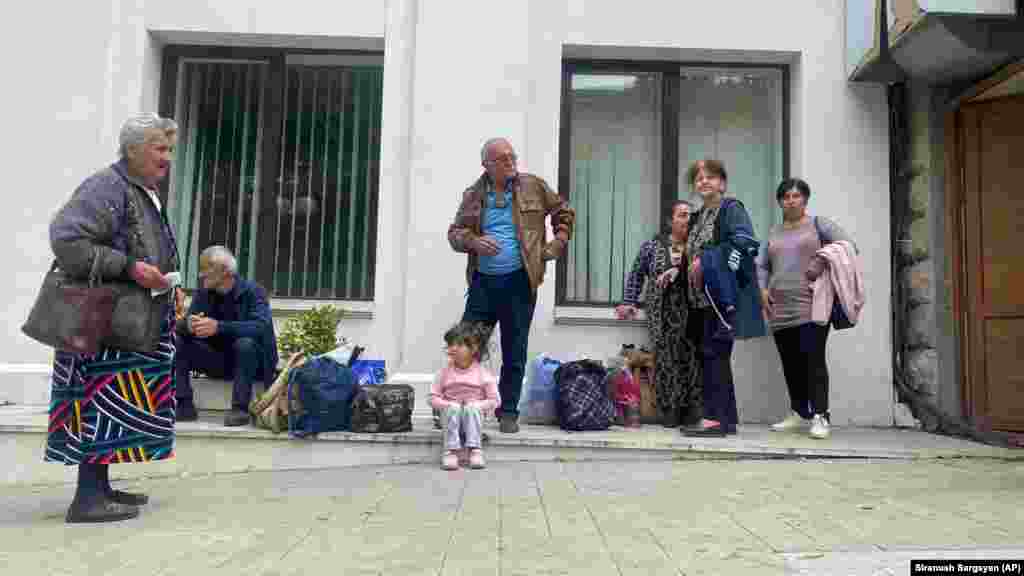
6/10Local residents gather near a local government building after reports of shootings in Stepanakert.
Separatists running the self-styled Republic of Artsakh -- as Nagorno-Karabakh is known by Armenians -- said they had been forced to agree to Azerbaijan's terms -- relayed by Russian peacekeepers -- after Baku's army broke through their lines and seized strategic locations.
Azerbaijan had said it could no longer tolerate a situation it regarded as a threat to its security and territorial sovereignty.
Following a lightning military offensive by Azerbaijani forces in the disputed territory of Nagorno-Karabakh, an estimated 10,000 evacuees are seeking shelter without basic living conditions in basements, while others have massed at an airport in hopes of fleeing to Armenia.
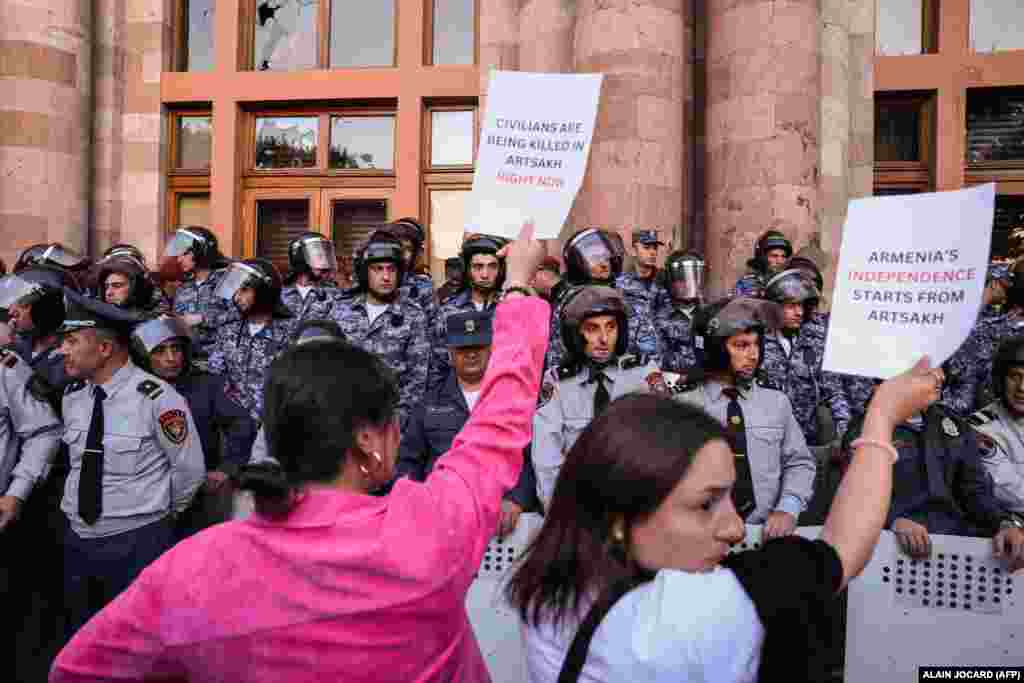
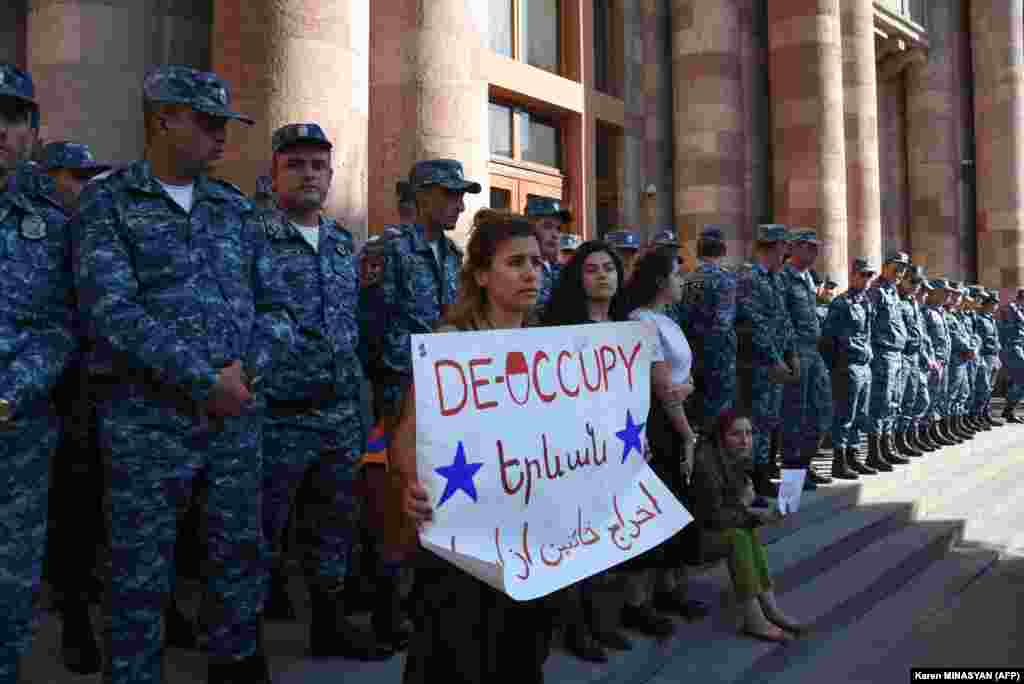
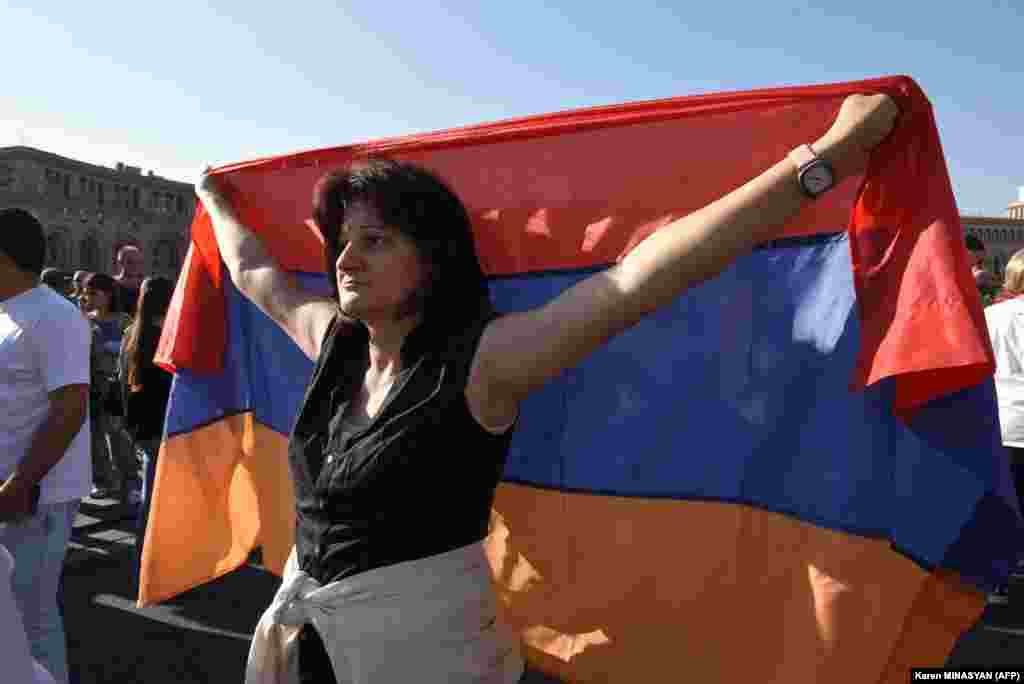
7/10Armenian demonstrators hold placards demanding the resignation of Armenian Prime Minister Nikol Pashinian in Yerevan on September 21.
Nagorno-Karabakh is internationally recognized as part of Azerbaijan and is currently populated by around 120,000 ethnic Armenians. It broke from Baku's hold in a war as the Soviet Union collapsed. It survived for decades with direct support from Armenia thanks to control of a land link known as the Lachin Corridor.
Following a lightning military offensive by Azerbaijani forces in the disputed territory of Nagorno-Karabakh, an estimated 10,000 evacuees are seeking shelter without basic living conditions in basements, while others have massed at an airport in hopes of fleeing to Armenia.
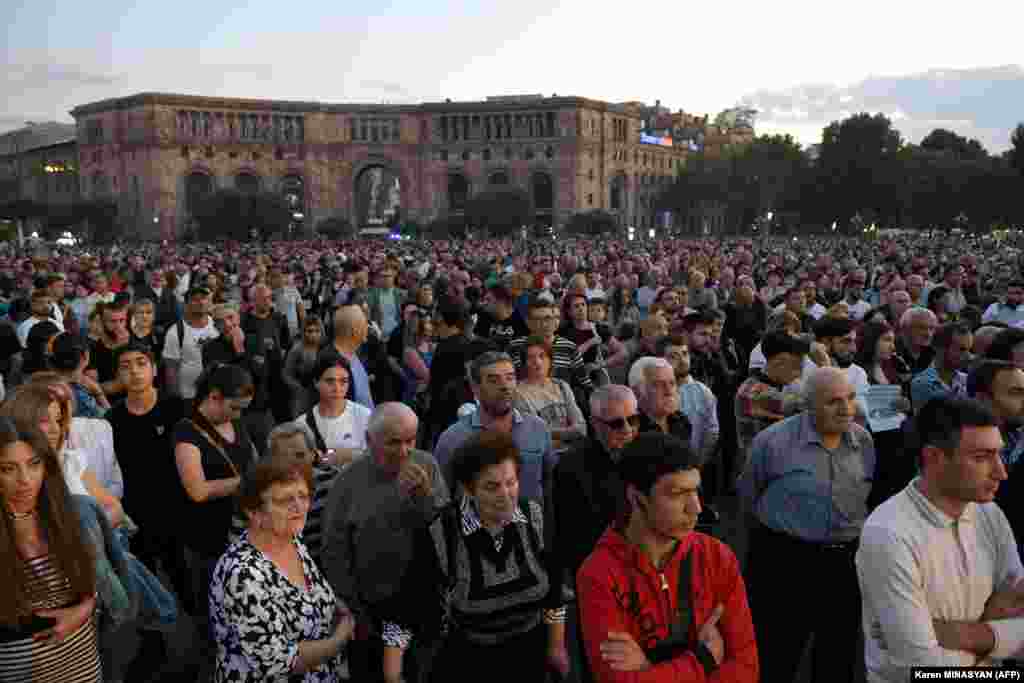
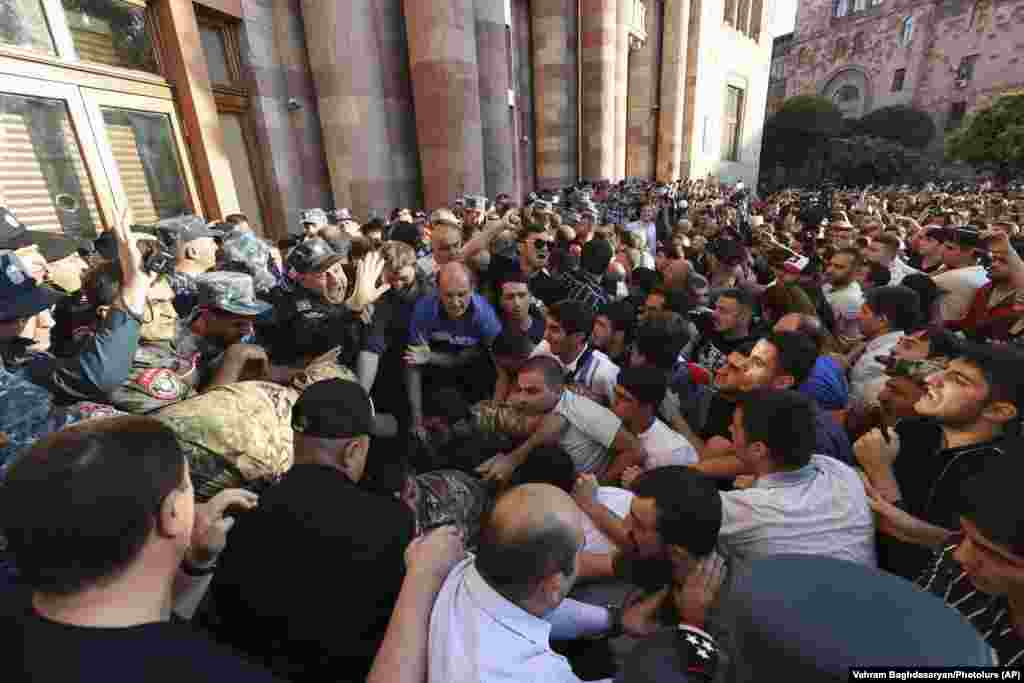
8/10Demonstrators continued to block the streets in Yerevan on September 22, demanding Pashinian's ouster over the surrender of Nagorno-Karabakh. More than 80 people were detained.
Armenia has accused Azerbaijan of blocking the Lachin Corridor, the sole road linking Armenia to Nagorno-Karabakh, since December 2022. Azerbaijan had insisted that aid trucks should go through Azerbaijani territory to ensure no contraband was being shipped.
Following a lightning military offensive by Azerbaijani forces in the disputed territory of Nagorno-Karabakh, an estimated 10,000 evacuees are seeking shelter without basic living conditions in basements, while others have massed at an airport in hopes of fleeing to Armenia.
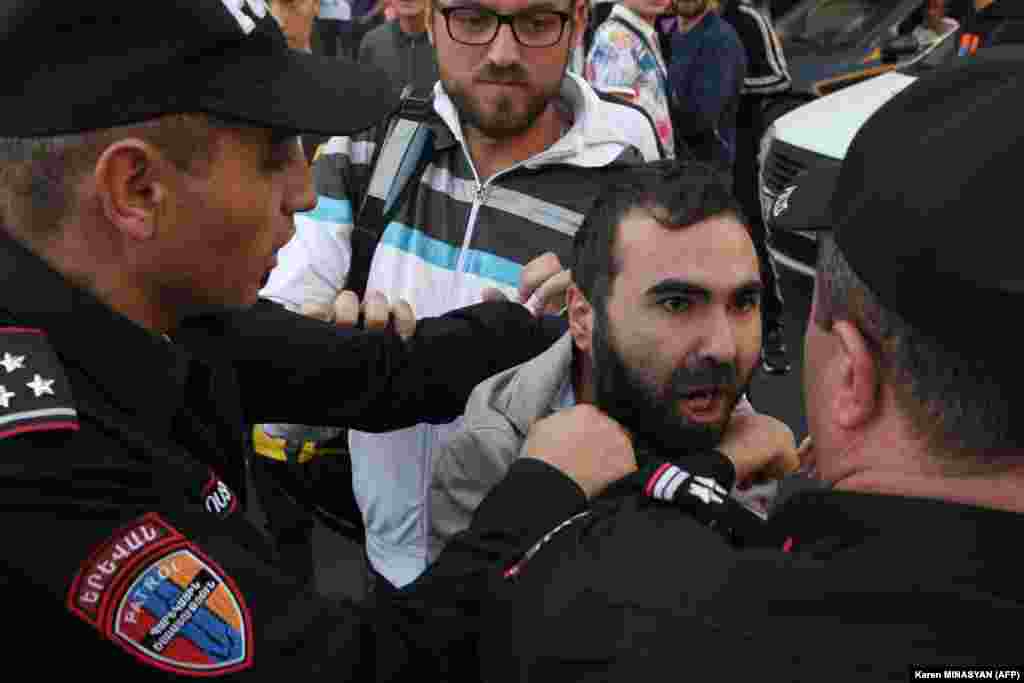
9/10A protester clashes with Armenian police officers in Yerevan on September 21.
A second war in 2020 saw Azerbaijan reconquer territory in and around the mountainous region and Armenia lose control of the corridor, leaving the road policed by Russian peacekeepers until it was blocked last December.
Following a lightning military offensive by Azerbaijani forces in the disputed territory of Nagorno-Karabakh, an estimated 10,000 evacuees are seeking shelter without basic living conditions in basements, while others have massed at an airport in hopes of fleeing to Armenia.
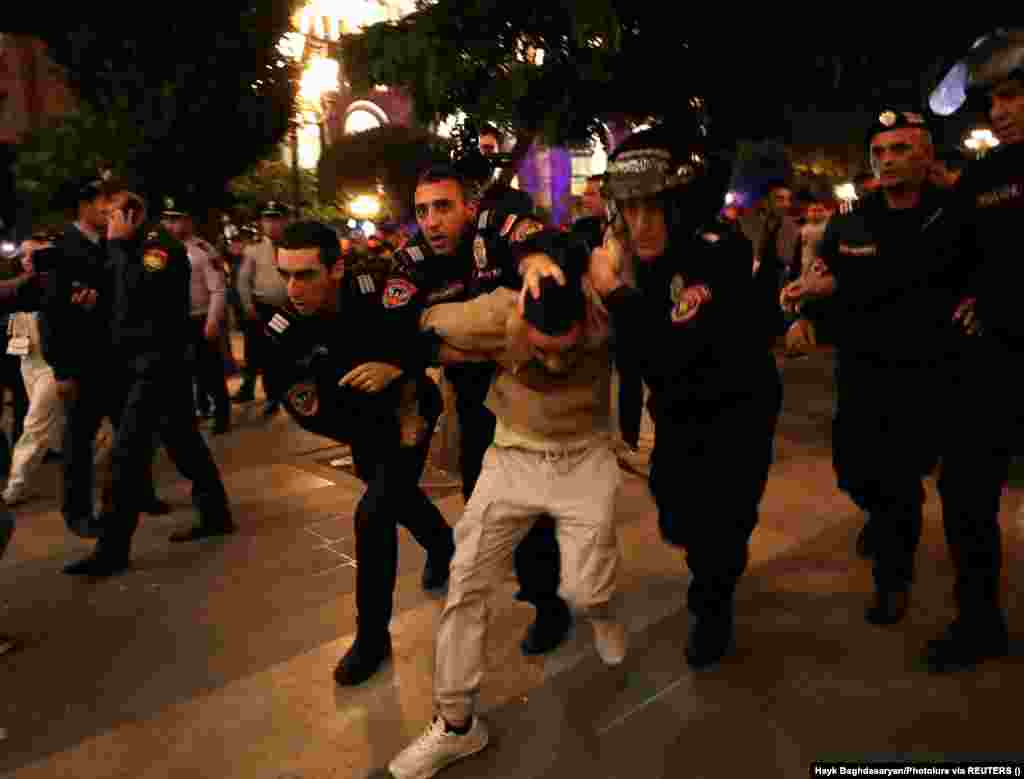
10/10Law enforcement officers detain a protester near a government building in Yerevan on September 21.
Baku says it has plans to reintegrate Nagorno-Karabakh and its ethnic Armenian population back into Azerbaijan. But the Azerbaijani authorities aren't saying what the plan is, and the details remain far from clear. The first session of "reintegration" talks ended on September 21 without any sign of a breakthrough.
Following a lightning military offensive by Azerbaijani forces in the disputed territory of Nagorno-Karabakh, an estimated 10,000 evacuees are seeking shelter without basic living conditions in basements, while others have massed at an airport in hopes of fleeing to Armenia.
Previous slide
Next slide
The two sides fought another war in 2020 that lasted six weeks before a Russian-brokered cease-fire effectively recognized the loss of Armenian control over large parts of the NKR-controlled territory. With its one-day offensive this week, Azerbaijan forced a surrender that included the full disarmament and disbandment of the NKR's armed forces. It is not clear how much longer the NKR itself -- which Azerbaijan regards as a criminal junta -- will survive.
Azerbaijan has promised that the Armenians of Karabakh can continue to live in the territory. But if there is any viable future for the ethnic Armenian population in Karabakh, it would represent an exception to the established pattern of zero-sum territorial control and ethnic cleansing in the Caucasus.
When Armenia won the war in the 1990s, all of the more than 600,000 ethnic Azerbaijanis who had been living in the territory that the Armenians took were forced to flee. Armenians who had been living in the territories Azerbaijan retook in 2020 were also driven out and have not been able to return. In the separatist territories of South Ossetia and Abkhazia there remain only small, beleaguered pockets of ethnic Georgian inhabitants following successive wars there; the large majority of former Georgian residents were also forced to flee.
WATCH: Thousands of ethnic Armenians gathered at Nagorno-Karabakh's only airport seeking protection and possible transit to Armenia.
Until 2020, Azerbaijan repeatedly promised that if Armenia agreed to peacefully return the territories it had taken during the first war, then the Armenians of the region would enjoy "the highest possible autonomy" within Azerbaijan. Baku offered examples like the culturally German Tyrol district of Italy and the culturally Swedish Aland Islands in Finland.
As soon as the 2020 war began, though, the promise was revoked. "We offered them autonomy…but they rejected everything," Azerbaijani President Ilham Aliyev said during the war. Immediately after the fighting ended with Armenia's capitulation, he then vowed, "To hell with the status, the status has gone to the grave, the status has disappeared, it is gone."
Since that 2020 victory, Azerbaijan has refused to publicly discuss what sort of arrangements the Karabakh Armenians could receive under Azerbaijani rule. State-connected think tanks have occasionally proposed models of coexistence, but Azerbaijani officials would say only that the Karabakh Armenians would be treated as any other citizens of Azerbaijan.
Following the recent offensive and the NKR's capitulation, some Azerbaijani officials have spoken more openly about a plan.

Hikmet Haciyev, a senior foreign policy adviser to Aliyev, has said a plan is "ready." Aliyev himself promised the Karabakh Armenians that "all their rights will be guaranteed: educational rights, cultural rights, religious rights, and municipal electoral rights, because Azerbaijan is a free society."
On September 22, Haciyev told Reuters that members of the Karabakh armed forces who lay down their weapons may be given amnesty.
To many observers, though, the promises are too little and too late to be taken at face value. Many suspect the Azerbaijani promises are simply window dressing for what would amount to another ethnic cleansing.
"The Karabakh Armenians are not just any minority. They have a specific history of conflict, and they have very serious security concerns. So, I think a project to reintegrate them into Azerbaijan would require painstaking negotiations, transitional arrangements, real thinking about security guarantees, and so on," said Laurence Broers, an associate fellow at the London-based Chatham House's Russia and Eurasia Program. "What we're seeing is that these negotiations are taking place after very severe and asymmetric episodes of violence."
As a result, "the commitments that Azerbaijan is making are not seen as credible by the wider population in Armenia," Broers added. "The most likely outcome that we'll see in the coming weeks and months is a substantial outflow of people to Armenia."

For now, while some Karabakh Armenians have gone to the airport in Stepanakert seeking protection from Russian peacekeepers and possible transit, many have said they were not allowed. Some have said it is the Russian peacekeepers who are not allowing them to leave. Armenia's government, meanwhile, says it has made preparations for an evacuation but has not deemed such a step necessary.
"We don't want to talk about this, because we believe that the Armenians of Nagorno-Karabakh should live in their homes, in their homeland, in dignified and safe conditions," Armenian Prime Minister Nikol Pashinian said in a video address to the nation on September 21. "At this moment, our assessment is that there is no direct threat to the civilian population of Nagorno-Karabakh."
It is not clear how many Armenians will want to leave Karabakh, either temporarily or permanently. "The overwhelming majority of the people here do not want to live as part of Azerbaijan, [and] I do not know what will happen," Babaian said.
Given the dire humanitarian situation in Karabakh following nine months of a blockade by Azerbaijan that preceded the military offensive, many observers called for people to be allowed to evacuate.
The "next few days will be crucial in determining whether [there] will be a significant outflow of population from the region, if not complete exodus of the ethnic Armenian population," wrote Carey Cavanaugh, a former U.S. negotiator in the Armenia-Azerbaijan talks, on X, the platform formerly known as Twitter. "Those who wish to leave Azerbaijan should be afforded that option. The international community should help facilitate their safe and secure departure from Nagorno-Karabakh and assist with their reception in Armenia."
Armenians should be allowed to at least temporarily leave Karabakh, said Philip Gamaghelyan, a longtime peace activist in the region and professor of Peace Studies at the University of San Diego. "The absolute priority is to provide the opportunity for safe passage for full evacuation of the Armenians of Nagorno-Karabakh at this stage," he said in a September 21 online discussion.
"There has been nothing done for the last three years, and especially the last nine months [of the blockade], to in some form prepare them for integration or coexistence. So, at this point, to believe that they could live safely and with some rights is very hard to imagine." But after a "break" in Armenia, Azerbaijan should be given the chance to "prove [skeptics] wrong" and provide a suitable environment. "And then, yes, we can organize a safe return," Gamaghelyan said.
But a temporary evacuation could turn permanent, warned Lala Darchinova, an activist and a co-editor, along with Gamaghelyan, at the Caucasus Edition journal. "As much as I don't want to see Karabakh without Azerbaijanis, I don't want to see Karabakh without Armenians," she said in the same online discussion. "So, evacuation…is a very big question for me, whether people would be able to come back. But it's a very difficult situation, because in the short term, what is the alternative for these people?"
Protests In Yerevan Follow Azerbaijani Attacks As Karabakh Residents Seek Shelter
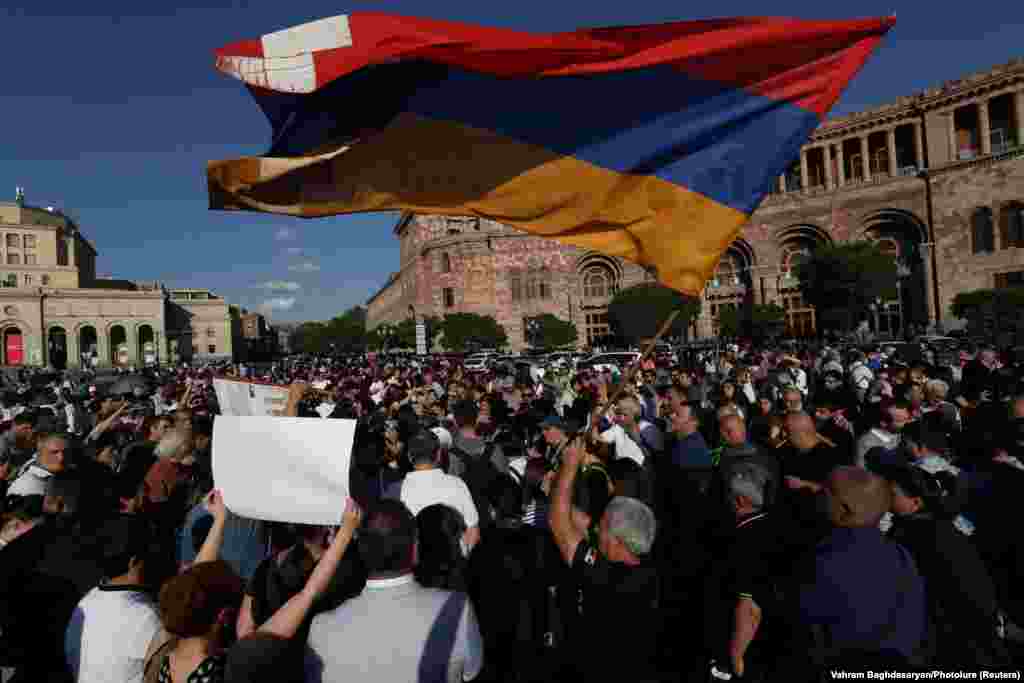
1/17Protesters gather near the government building in Yerevan on September 19.
The Azerbaijani and ethnic Armenian sides agreed on September 20 to an immediate cease-fireon the second day of a major flare-up in fighting over the territory of Nagorno-Karabakh, after the de facto leadership of the mostly ethnic Armenian enclave accepted a proposal by the Russian peacekeeping mission there and agreed to talks on the territory's "reintegration" into Azerbaijan.
Armenians took to the streets to demand Prime Minister Nikol Pashinian resign after Azerbaijan launched what it called an "anti-terrorist operation" targeting ethnic Armenian military positions in Nagorno-Karabakh that left at least 32 people dead and more than 200 wounded.
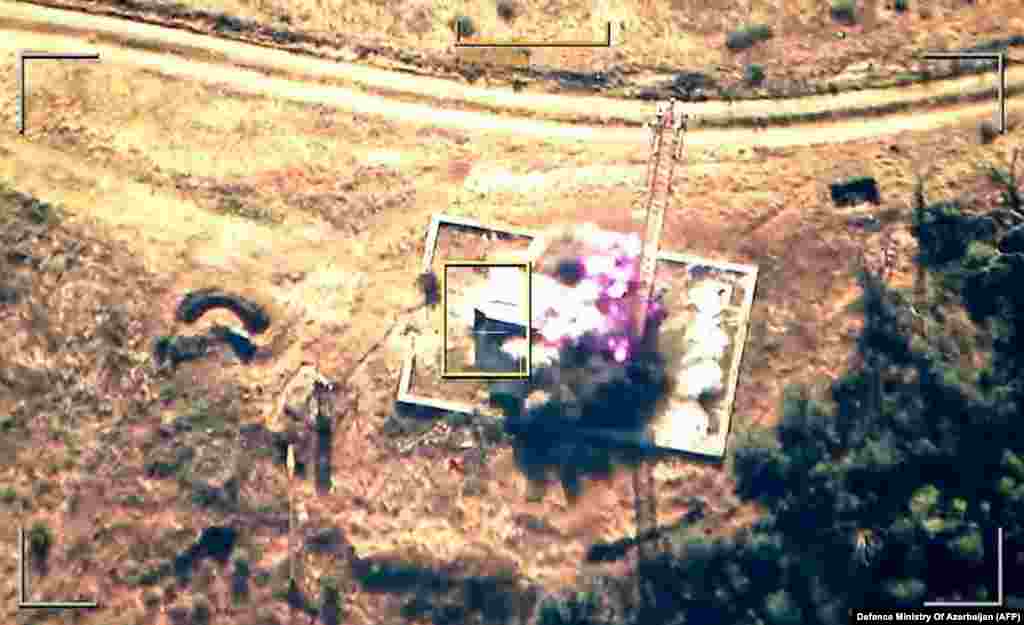
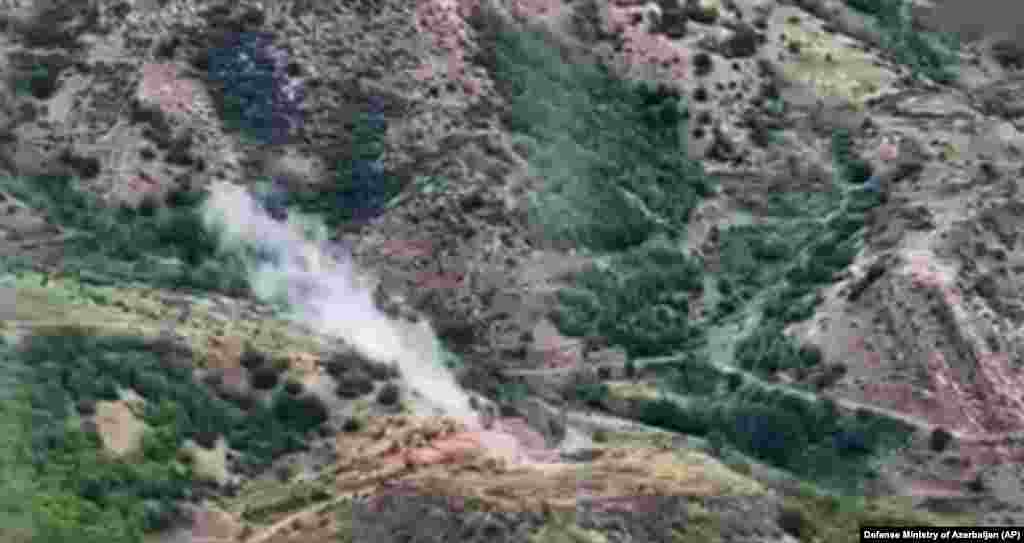
2/17Handout footage released by the Azerbaijani Defense Ministry on September 19 shows an explosion in mountainous terrain that Baku claims to be Azerbaijani forces "destroying positions" used by Armenians in the Nagorno-Karabakh region.
Armenians took to the streets to demand Prime Minister Nikol Pashinian resign after Azerbaijan launched what it called an "anti-terrorist operation" targeting ethnic Armenian military positions in Nagorno-Karabakh that left at least 32 people dead and more than 200 wounded.
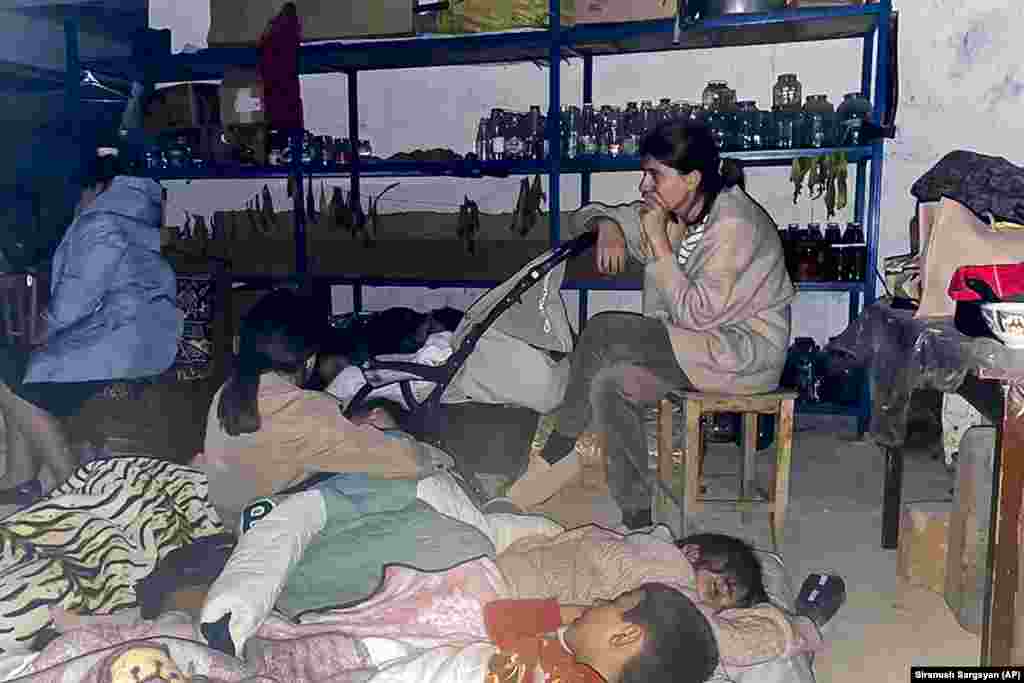
3/17Children sit in a shelter during shelling in Stepanakert, the provincial capital of Azerbaijan's breakaway region of Nagorno-Karabakh, on September 20.
Azerbaijan declared that it had started what it called an "anti-terrorist operation" targeting Armenian military positions in Nagorno-Karabakh, where local ethnic Armenian officials reported heavy shelling.
Armenian Prime Minister Nikol Pashinian said, in a shot at Baku's justification for its offensive, that Yerevan "does not have an army" in Nagorno-Karabakh.
Armenians took to the streets to demand Prime Minister Nikol Pashinian resign after Azerbaijan launched what it called an "anti-terrorist operation" targeting ethnic Armenian military positions in Nagorno-Karabakh that left at least 32 people dead and more than 200 wounded.
4/17In an image released by the Russian Defense Ministry on September 20, Russian peacekeepers help evacuate refugees from Stepanakert.
TASS quoted the ministry as saying its peacekeepers had evacuated more than 2,000 civilians from Nagorno-Karabakh.
In a rare show of agreement with the West, Moscow called on both sides to stop the violence.
Armenians took to the streets to demand Prime Minister Nikol Pashinian resign after Azerbaijan launched what it called an "anti-terrorist operation" targeting ethnic Armenian military positions in Nagorno-Karabakh that left at least 32 people dead and more than 200 wounded.
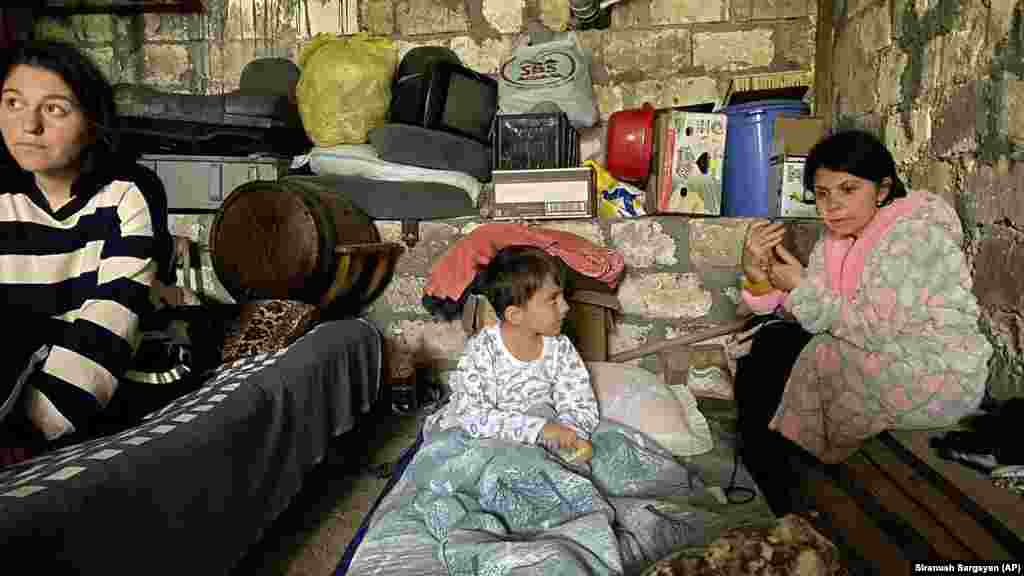
5/17People huddle in a basement in Stepanakert on September 20.
Armenians took to the streets to demand Prime Minister Nikol Pashinian resign after Azerbaijan launched what it called an "anti-terrorist operation" targeting ethnic Armenian military positions in Nagorno-Karabakh that left at least 32 people dead and more than 200 wounded.
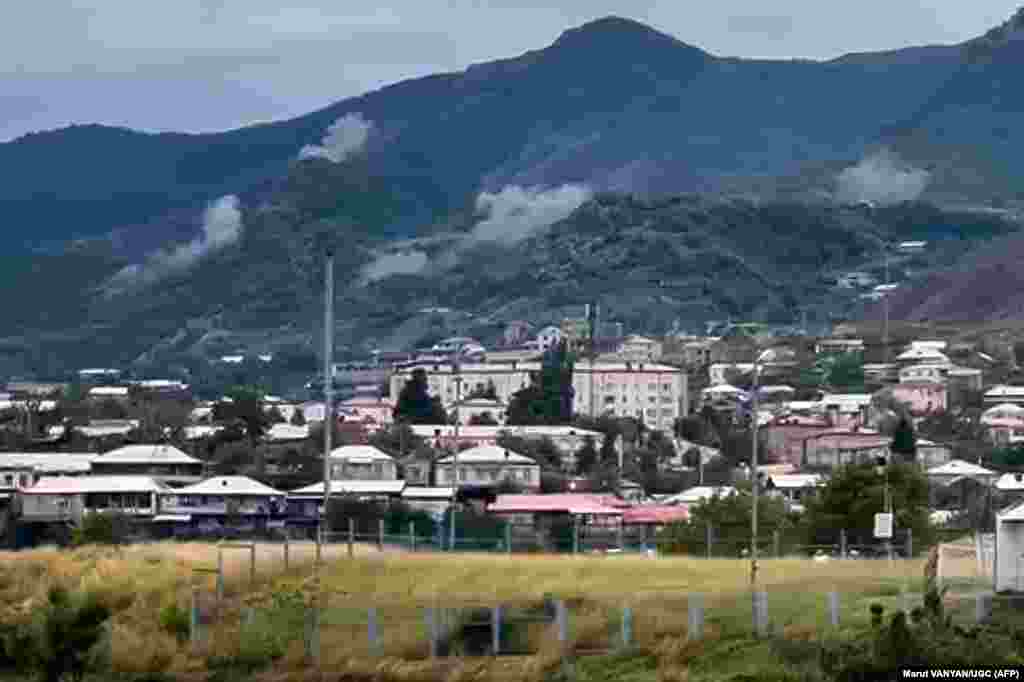
6/17Smoke rises over an area that Azerbaijan claims hosts ethnic Armenian forces' positions in the breakaway territory of Nagorno-Karabakh on September 19.
The expected halt in intense fighting in the decades-old Caucasus hot spot comes as international fears of a widening conflict mounted and as the death toll increased in the deadliest military escalation there in nearly three years.
Armenians took to the streets to demand Prime Minister Nikol Pashinian resign after Azerbaijan launched what it called an "anti-terrorist operation" targeting ethnic Armenian military positions in Nagorno-Karabakh that left at least 32 people dead and more than 200 wounded.
7/17Children sleep in a shelter during shelling in Stepanakert.
Azerbaijan’s Defense Ministry said on September 19 that "only legitimate military targets are being destroyed," and the Foreign Ministry said the only path to peace in the region was the complete withdrawal of Armenian forces from the territory.
Armenians took to the streets to demand Prime Minister Nikol Pashinian resign after Azerbaijan launched what it called an "anti-terrorist operation" targeting ethnic Armenian military positions in Nagorno-Karabakh that left at least 32 people dead and more than 200 wounded.
8/17Armenians protest in central Yerevan on September 19 to urge the government to respond to the Azerbaijani military operation.
After a brief but bloody six-week war between the regional archrivals in 2020, Azerbaijan recaptured much of Nagorno-Karabakh and seven surrounding districts controlled since the 1990s by ethnic Armenians with Yerevan's support.
Armenians took to the streets to demand Prime Minister Nikol Pashinian resign after Azerbaijan launched what it called an "anti-terrorist operation" targeting ethnic Armenian military positions in Nagorno-Karabakh that left at least 32 people dead and more than 200 wounded.
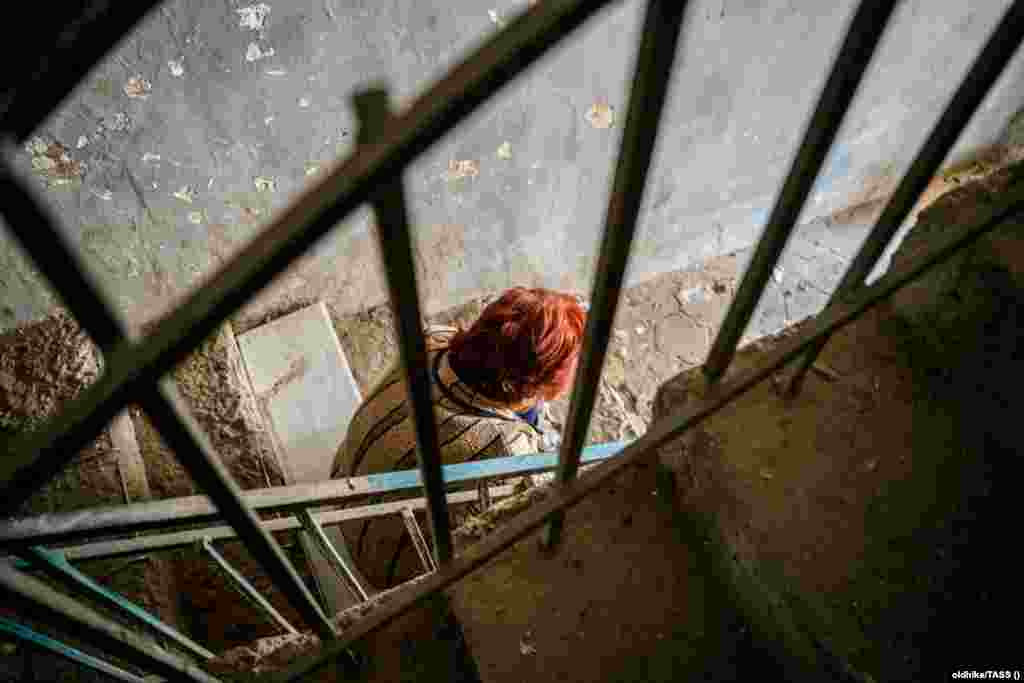
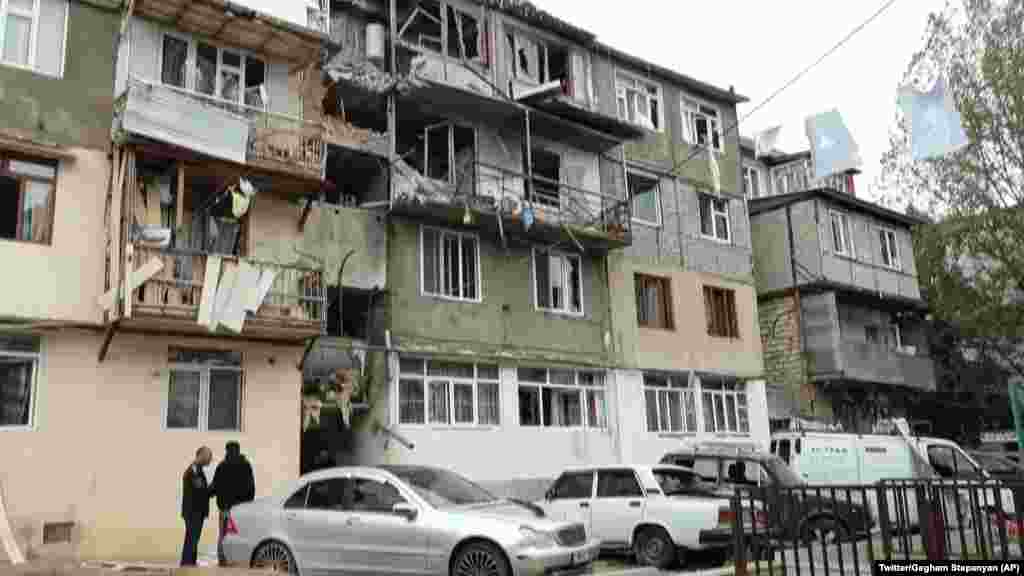
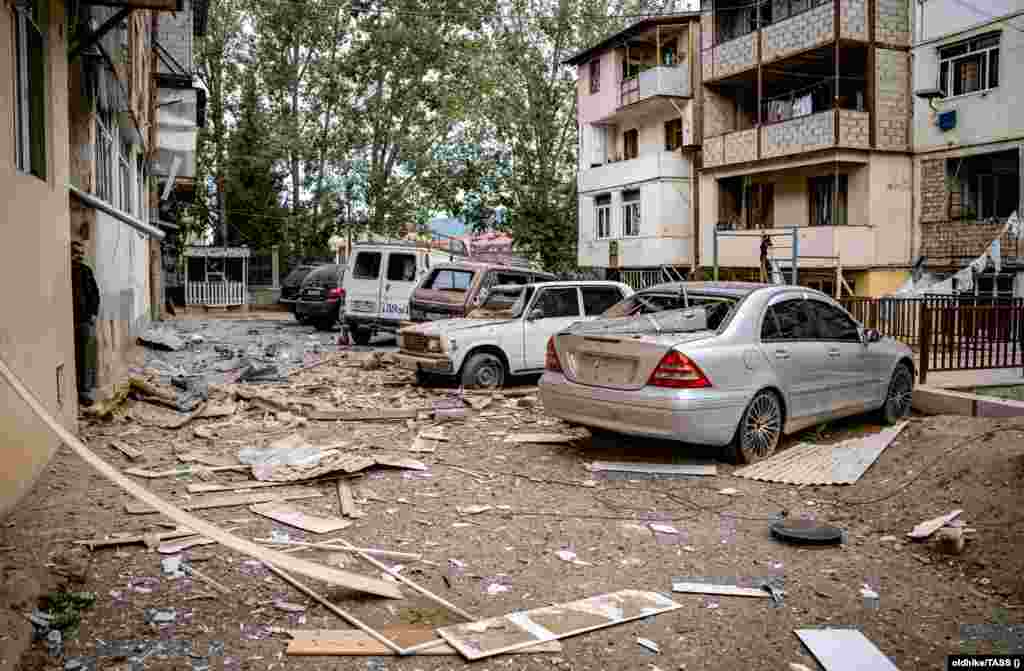
9/17A woman sits on a staircase in a residential building destroyed in a military strike on Stepanakert.
Armenians took to the streets to demand Prime Minister Nikol Pashinian resign after Azerbaijan launched what it called an "anti-terrorist operation" targeting ethnic Armenian military positions in Nagorno-Karabakh that left at least 32 people dead and more than 200 wounded.
10/17A residential apartment building was damaged by shelling in Stepanakert.
The Azerbaijani and the ethnic Armenian sides agreed to talks on September 21 in the Azerbaijani city of Yevlax, about 265 kilometers west of Baku.
Armenians took to the streets to demand Prime Minister Nikol Pashinian resign after Azerbaijan launched what it called an "anti-terrorist operation" targeting ethnic Armenian military positions in Nagorno-Karabakh that left at least 32 people dead and more than 200 wounded.
11/17People rally outside the Armenian government building to protest against Pashinian in Yerevan on September 19.
Pashinian, who was blamed by nationalists and other critics for losses in the 2020 fighting, noted the cease-fire but immediately distanced his government from its terms.
Armenians took to the streets to demand Prime Minister Nikol Pashinian resign after Azerbaijan launched what it called an "anti-terrorist operation" targeting ethnic Armenian military positions in Nagorno-Karabakh that left at least 32 people dead and more than 200 wounded.
12/17Protesters block a road near the government building in Yerevan on September 19.
Angered by what they saw as Moscow's failure to stop Azerbaijan, demonstrators also gathered outside the Russian Embassy in Yerevan, chanting anti-Russian slogans, TASS reported.
Armenians took to the streets to demand Prime Minister Nikol Pashinian resign after Azerbaijan launched what it called an "anti-terrorist operation" targeting ethnic Armenian military positions in Nagorno-Karabakh that left at least 32 people dead and more than 200 wounded.
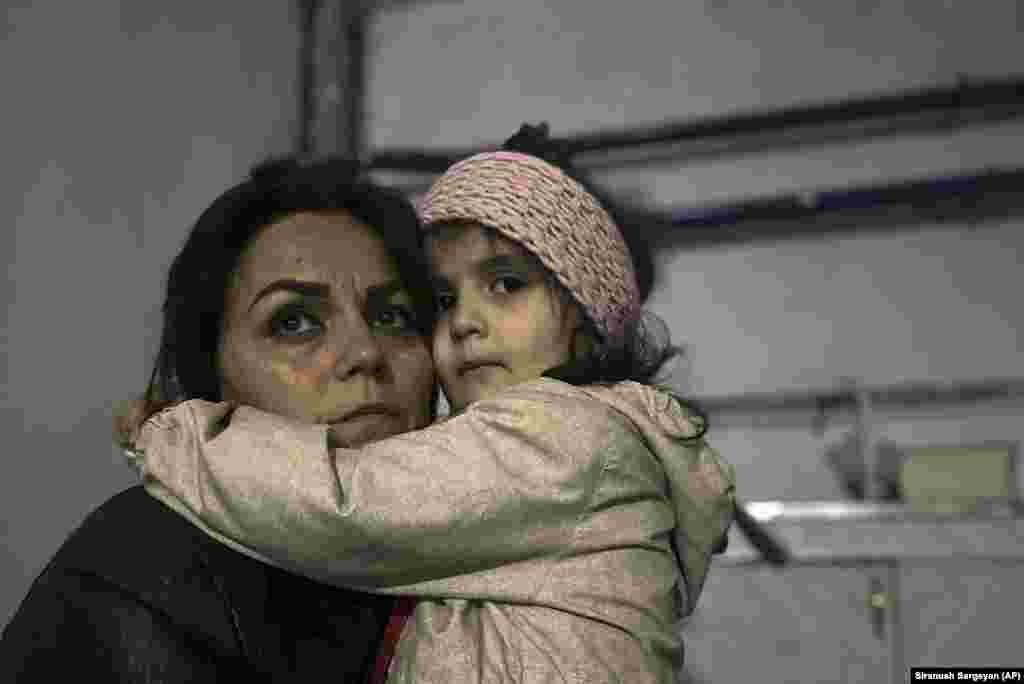
13/17A woman embraces a child in a shelter during shelling in Stepanakert.
U.S. and European leaders had long called for Azerbaijan to ease the transit of humanitarian aid to the beleaguered region, which is experiencing shortages of food, energy, and medicine.
Armenians took to the streets to demand Prime Minister Nikol Pashinian resign after Azerbaijan launched what it called an "anti-terrorist operation" targeting ethnic Armenian military positions in Nagorno-Karabakh that left at least 32 people dead and more than 200 wounded.
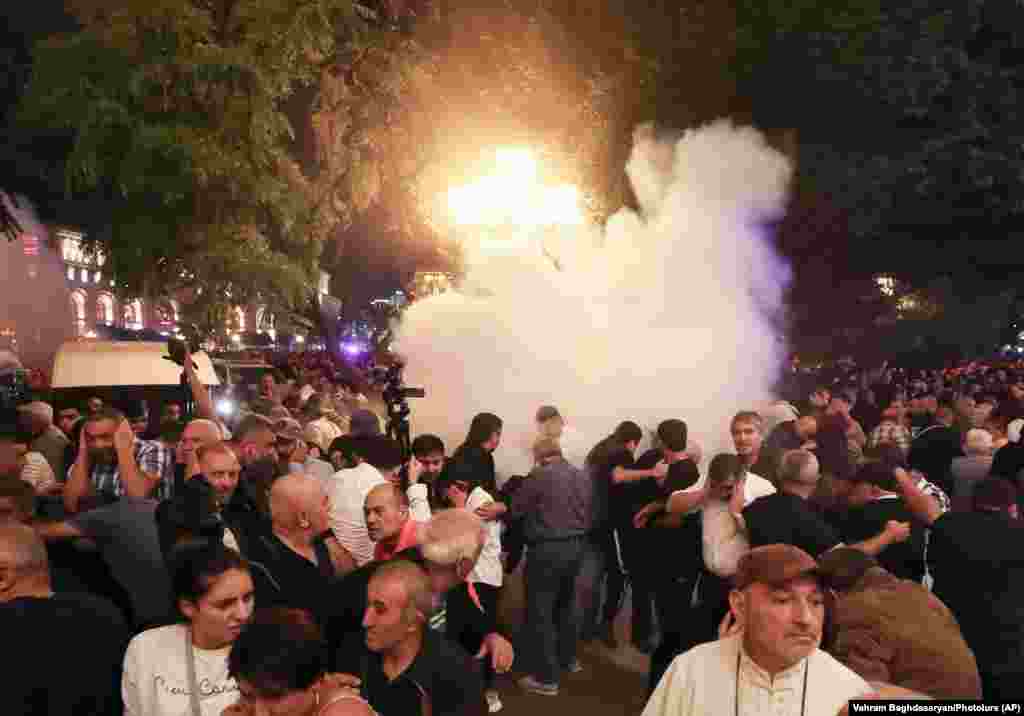
14/17Angry crowds gathered outside government buildings in Yerevan late on September 19, calling for Pashinian to resign.
Armenians took to the streets to demand Prime Minister Nikol Pashinian resign after Azerbaijan launched what it called an "anti-terrorist operation" targeting ethnic Armenian military positions in Nagorno-Karabakh that left at least 32 people dead and more than 200 wounded.
15/17Armenians in Yerevan protest to urge the government to respond to the Azerbaijani military operation.
After weeks of bloody skirmishes and one day after an aid shipment was finally allowed into the area, Azerbaijan launched the major escalation on September 19 with the breakaway region already teetering on the brink of a humanitarian crisis after being essentially blockaded for more than eight months despite international calls for Baku to allow food and other shipments.
Armenians took to the streets to demand Prime Minister Nikol Pashinian resign after Azerbaijan launched what it called an "anti-terrorist operation" targeting ethnic Armenian military positions in Nagorno-Karabakh that left at least 32 people dead and more than 200 wounded.
16/17Damage is seen in a residential area after a military strike on Stepanakert.
The de facto human rights ombudsman in the ethnic Armenian-controlled Azerbaijani region said early on September 20 that 32 people had been killed, including seven civilians, two of them children, and more than 200 wounded as a result of shelling, although some death estimates put the death toll considerably higher.
Armenians took to the streets to demand Prime Minister Nikol Pashinian resign after Azerbaijan launched what it called an "anti-terrorist operation" targeting ethnic Armenian military positions in Nagorno-Karabakh that left at least 32 people dead and more than 200 wounded.
17/17Smoke rises from artillery strikes on a hilltop outside Stepanakert.
The UN Security Council scheduled an emergency meeting for September 21 as the international community sought ways to avoid an intensification of a long-running conflict that has already sparked two intense wars between the post-Soviet Caucasus neighbors.
Armenians took to the streets to demand Prime Minister Nikol Pashinian resign after Azerbaijan launched what it called an "anti-terrorist operation" targeting ethnic Armenian military positions in Nagorno-Karabakh that left at least 32 people dead and more than 200 wounded.
Previous slide
Next slide
One factor that would likely complicate a mass exodus would be Russia.
"Whether Karabakh Armenians remain or not is also unfortunately tied into geopolitical calculations around the continued Russian presence, because if there is no Armenian community remaining in Karabakh, then there is no justification for a Russian peacekeeping mission," Chatham House's Broers said. "It might be in Russia's interests to see some symbolic presence there."
In a September 21 phone call with Aliyev, Russian President Vladimir Putin "emphasized the importance of ensuring the rights and security of the Armenian population of Karabakh," the Kremlin reported.
Broers said many Karabakh Armenians are unlikely to want to move to Armenia, even if their homes come under Azerbaijani control. "For many Karabakh Armenians, resettling in Armenia is not an attractive option," he said, given Armenia's history treating refugee Armenians as second-class citizens. "They're really in a position of choosing between lesser evils."
The near-term future of Armenians in Karabakh is likely to be comparable to that of Serbs in Kosovo, said Shujaat Akhmadzada, a nonresident research fellow at the Baku-based Topchubashov Center, which focuses on international relations and security. That is, "there is antagonism, communities do not visit each other, they have their own symbolism in their own villages. Hopefully there is no violence, but there are occasional, let's say antagonistic, interactions," he said in a separate September 21 online discussion, organized by the online platform Bright Garden Voices.
In the longer term, he said the situation may be comparable to that of Armenians in Turkey or Georgia.
Whatever the Azerbaijani government offers to the Karabakh Armenians it is likely to be merely for show, argued Anna Ohanian, a political science professor at Stonehill College.
"Considering that Azerbaijan is using coercive tactics, coercive strategies, the postwar conditions for Armenians who decide or are able or want to stay in Azerbaijan is not going to be pretty," she said during the Bright Garden Voices event. "There could be some pretense for a while, in the short term, creating some sort of Potemkin villages here and there," she said.