




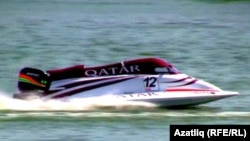
Environmental activists in Kyrgyzstan are opposing plans to stage the UIM F1H2O World Championship on Lake Issyk-Kul this summer, warning that the high-speed powerboat races could harm one of Central Asia’s most sensitive ecosystems.
The event, often described as the equivalent of Formula 1 car racing on water, is scheduled for July 31–August 2 on Issyk-Kul, a high-altitude lake that has been a UNESCO-designated Biosphere Reserve since 2001.
Kyrgyz authorities see the race as a major tourism opportunity but environmentalists are calling it a shot at the heart of the country's waterways.
“Lake Issyk-Kul is the heart of Kyrgyzstan,” according to a petition against the race launched by ecologist Samat Kushbek, a Kyrgyz citizen based in France.
The F1H2O series features single-seater powerboats capable of speeds above 250 kilometers per hour and is staged on closed circuits in lakes, rivers, and coastal waters worldwide. If held in Issyk-Kul, it would be the first such event in Central Asia.
“We are currently building infrastructure so that World Cup stages become annual events,” said Eduard Kubatov, head of the State Agency for Tourism Development.
“Around 300 high-level guests are expected, including sheikhs, wealthy businesspeople and international sports officials. More than 10,000 fans from more than 30 countries could come to Issyk-Kul specifically to watch these Formula 1 races on water.”
Environmental Concerns
Kushbek says he calculates that, in just three days of racing among 23 race boats equipped with 400-horsepower two-stroke engines, between 29 and 43 tons of carbon dioxide -- equivalent to the monthly emissions of 10,000 cars -- would be spewed into the region.
He also alleged that 1.37 tons of toxic hydrocarbons and oil could enter the water, warning that a spill of 207 liters of oil could contaminate 207 million liters of lake water. Meanwhile, underwater noise levels reaching 180 decibels could kill 25 endemic fish species, including the endangered Issyk-Kul trout.

In comments to Azattyk Asia, RFE/RL's Russian unit covering Central Asia, Kushbek criticized what he described as a reliance on environmental compensation measures instead of prevention.
“Oil spills… they pay only an administrative fine, and that’s it,” he said. “They will say they planted a tree… but how does that help us?”
The petition urges organizers to relocate the race or switch to electric-powered alternatives such as the E1 Series.
“We are NOT against tourism or development,” the petition states. “We are against DIRTY technology and illegal actions.”
Debate Over Impact
“These kinds of competitions should not be held,” environmental advocate Gulbara Omorova told Azattyq Asia. She warned that ecological limits of the lake must be prioritized over tourism growth.
“More tourists is not always better… the question is how much the ecosystem can actually withstand,” she said.
Kyrgyz officials have rejected the criticism, saying the event will not harm the lake.
In comments to local media, Kubatov said critics were approaching the project “amateurishly” and insisted that modern technology would prevent oil leakages.
Organizers of the F1H2O championship describe the series as environmentally neutral and say they support conservation initiatives, including tree planting.
The petition calls on UNESCO’s Man and the Biosphere Program to review the project and press Kyrgyz authorities to uphold environmental protections.
“Issyk-Kul is not for sale,” it concludes. “It belongs to our children and to humanity.”