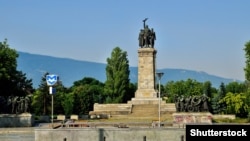
The monument with an expansive pedestal was erected in Sofia in 1954 to honor the Soviet Red Army. (file photo)
SOFIA -- Sofia’s city council has approved a proposal to dismantle the massive monument to the Soviet Army and relocate it to another site in the Bulgarian capital.
According to the March 9 decision, Mayor Yordanka Fandakova must now issue a request to the Sofia City region, which administers the capital, asking that the contentious monument be moved to the grounds of the Museum of Socialist Art a few kilometers southeast.
The monument stands on municipal land south of the capital’s center near the National Palace of Culture and the city’s Central Park, but the towering sculpture is state property and the city council thus does not have the authority to move it without the consent and cooperation of the government.
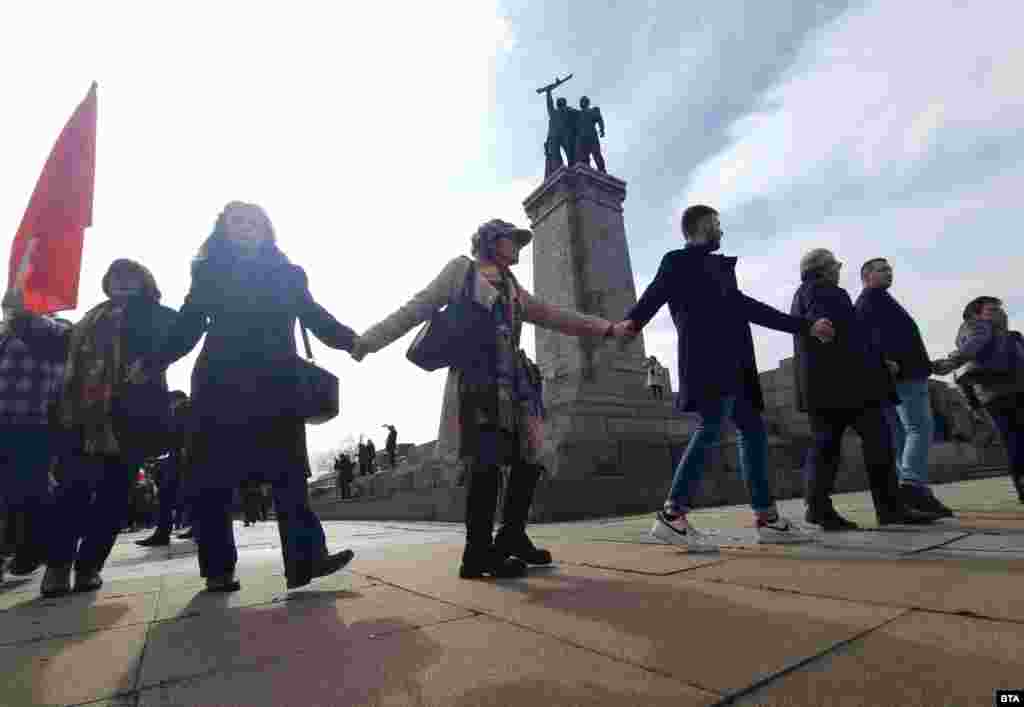
Protests, Human Chain After Soviet Monument In Bulgaria Slated For Removal
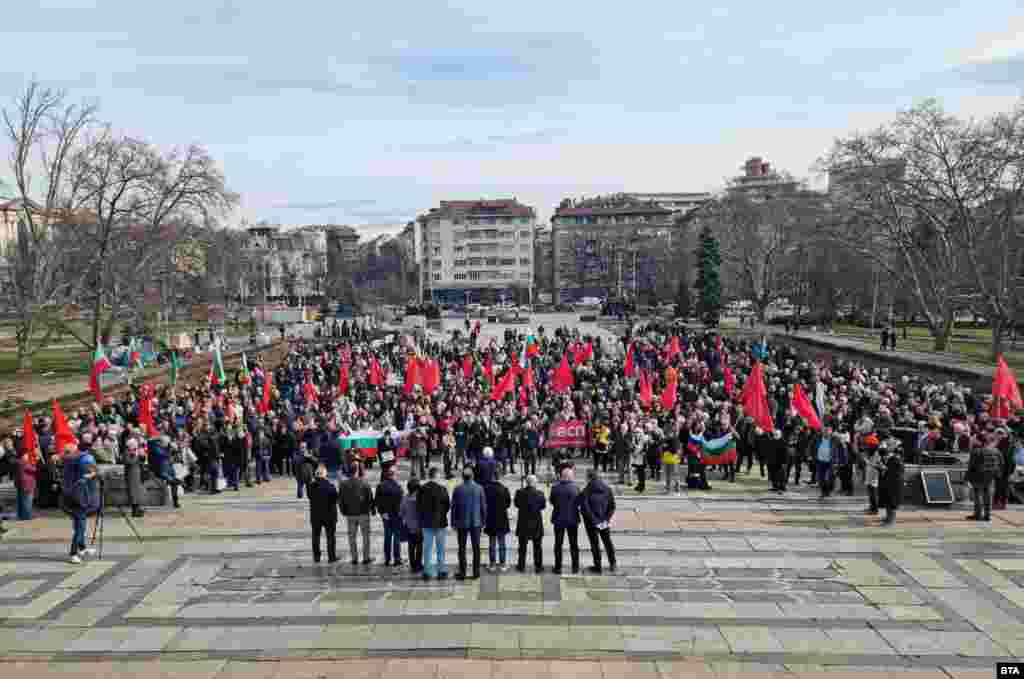
1/9These protesters gathered around Sofia’s Monument to the Soviet Army on March 9 as the municipal council held a vote on whether to remove the landmark from the center of the Bulgarian capital.
A demonstration held on March 9 indicates that a council vote to remove a controversial memorial to Red Army soldiers in Sofia may be easier said than done.
Show moreShow less
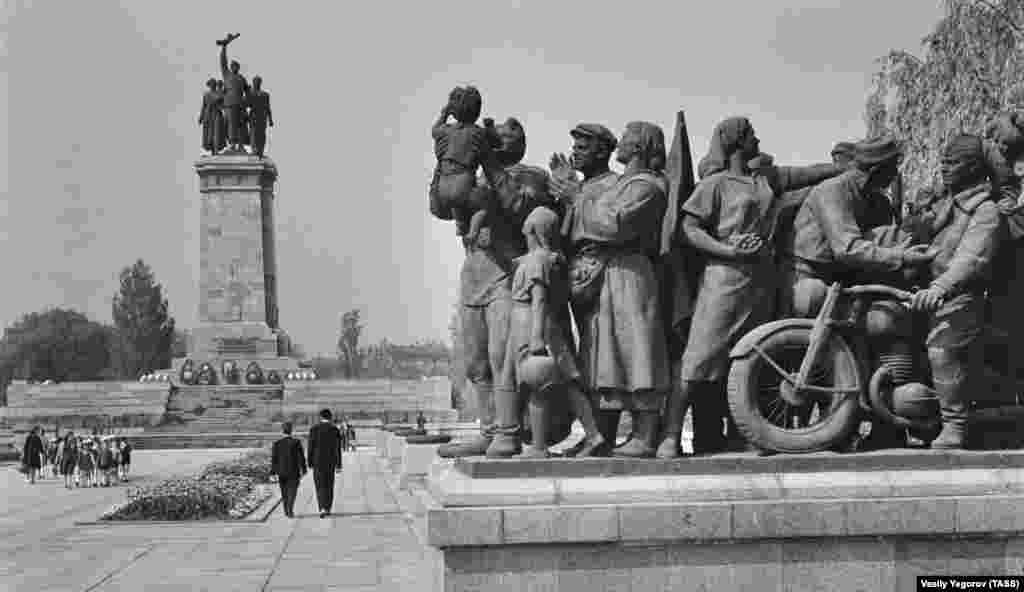
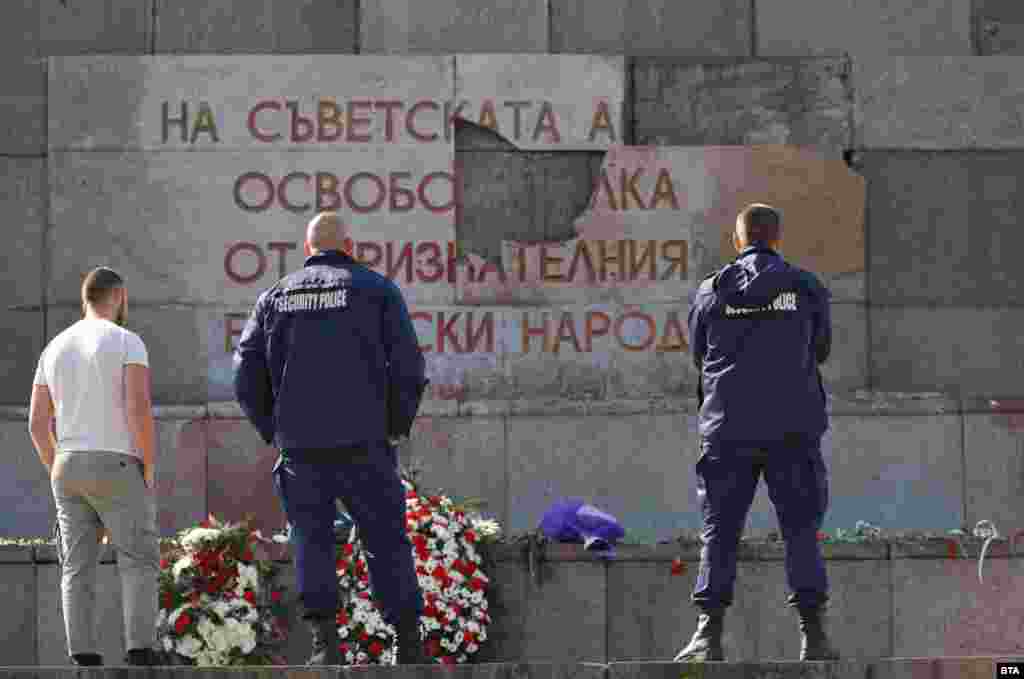
2/9The monument, photographed here in 1970, was installed in 1954 and featured a controversial dedication that read: “To the Soviet Army liberators – from the grateful people of Bulgaria.”
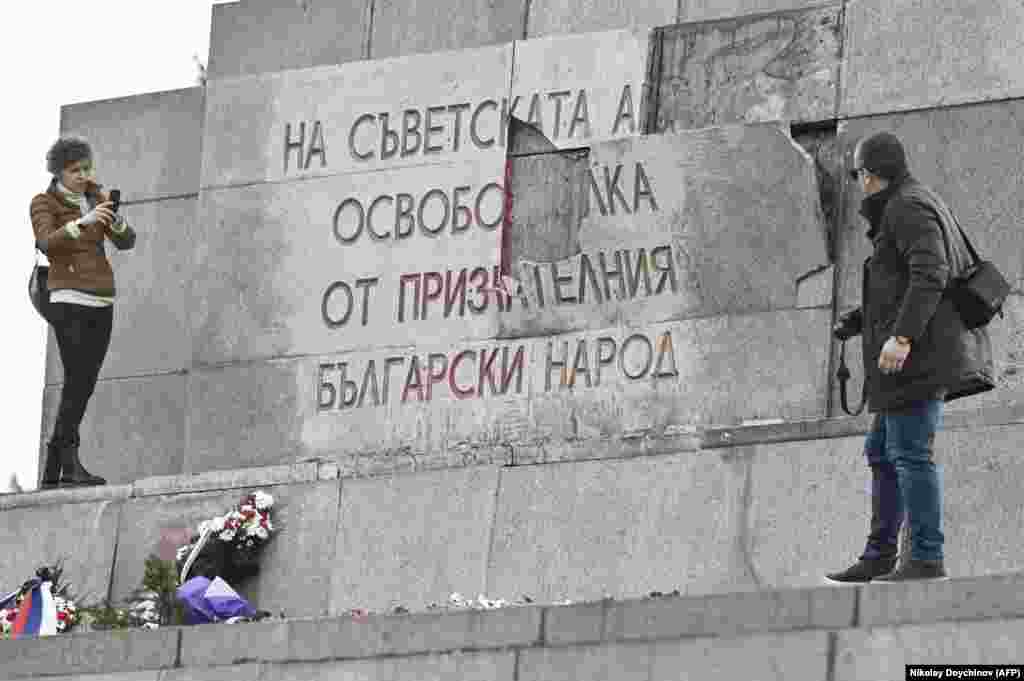
That inscription was smashed with a hammer in late February by a 61-year-old man who was protesting Russia’s invasion of Ukraine.
A demonstration held on March 9 indicates that a council vote to remove a controversial memorial to Red Army soldiers in Sofia may be easier said than done.
Show moreShow less
3/9The severe damage to the monument reignited discussion in Sofia’s local government over whether the often-vandalized monument should remain.
Many other European countries have removed communist-era memorials amid the Kremlin’s ongoing invasion of Ukraine.
A demonstration held on March 9 indicates that a council vote to remove a controversial memorial to Red Army soldiers in Sofia may be easier said than done.
Show moreShow less
4/9Speakers address the protest on March 9.
Sofia’s municipal council voted 41-13, with one abstention, to remove the monument and place it in Sofia’s Museum of Socialist Art or “another suitable state-owned site outside the central urban area of the city.”
A demonstration held on March 9 indicates that a council vote to remove a controversial memorial to Red Army soldiers in Sofia may be easier said than done.
Show moreShow less
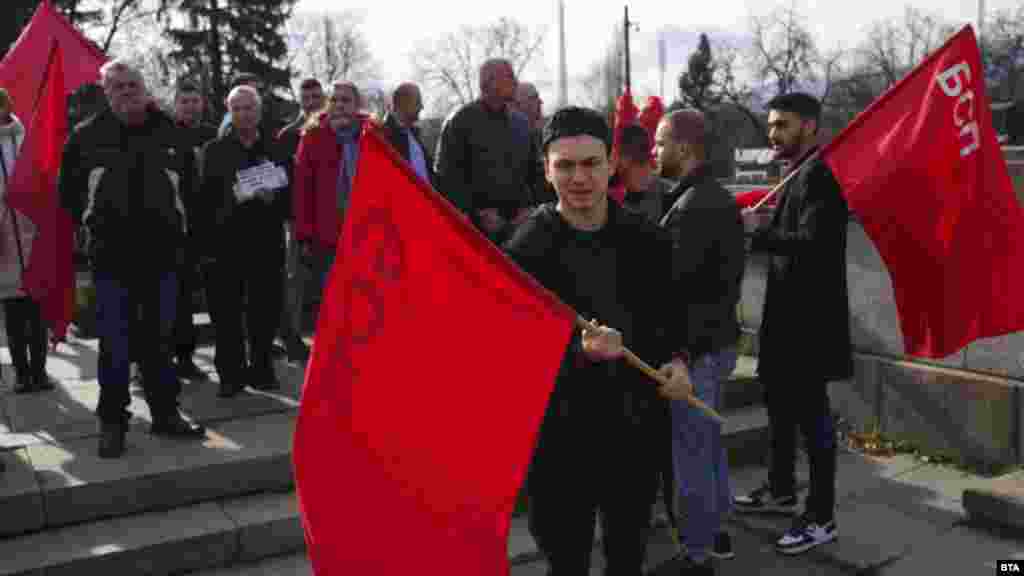
5/9Many protesters in the crowd carried flags of the Bulgarian Socialist Party (BSP), which is the successor of the communist regime that ruled the country from 1946 until Bulgaria won its independence in 1989.
A demonstration held on March 9 indicates that a council vote to remove a controversial memorial to Red Army soldiers in Sofia may be easier said than done.
Show moreShow less
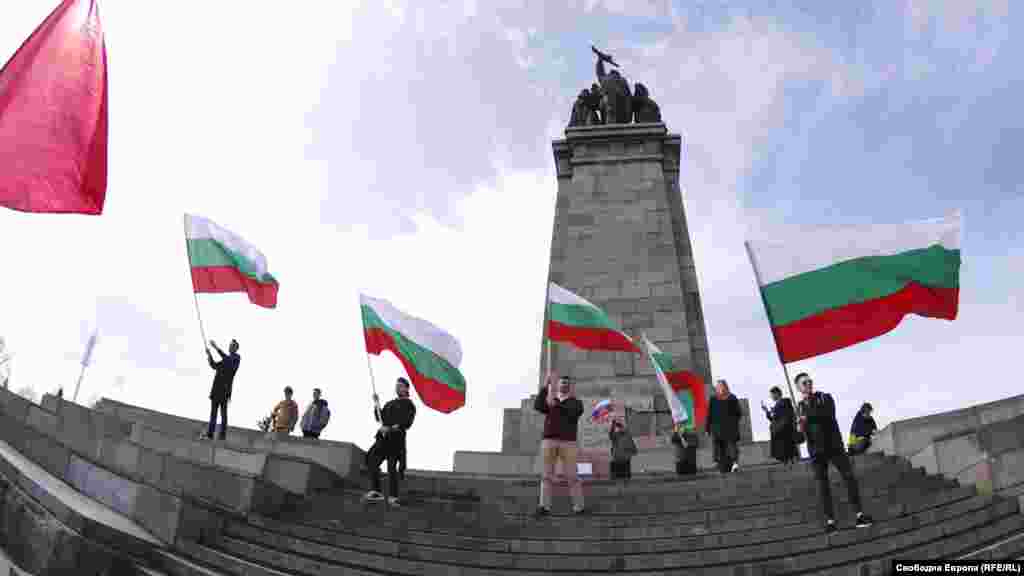
6/9Protesters wave Bulgarian flags during the protest.
The Soviet memorial is the property of Bulgaria’s central government, meaning Sofia’s mayor still needs to make a request to the regional governor to remove the contentious landmark.
A demonstration held on March 9 indicates that a council vote to remove a controversial memorial to Red Army soldiers in Sofia may be easier said than done.
Show moreShow less
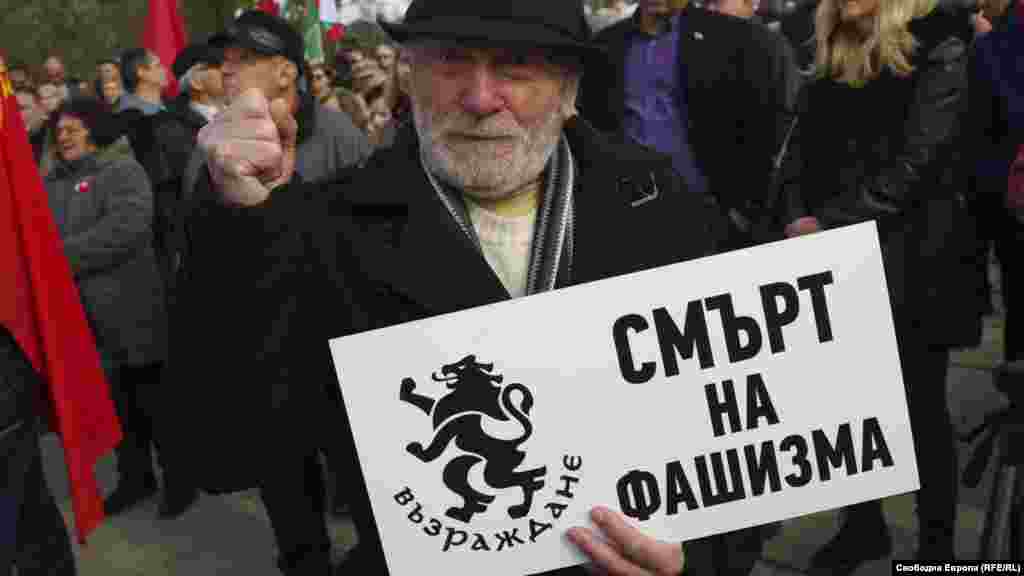
7/9Yolo Denev, who ran for president of Bulgaria in 2021, holds a sign vowing “Death to Fascism” during the protest.
Bulgaria’s acting Prime Minister Galab Donev said any government action on the monument should be taken after the upcoming parliamentary elections on April 2 “so the proper decision can be made in a calm environment.”
A demonstration held on March 9 indicates that a council vote to remove a controversial memorial to Red Army soldiers in Sofia may be easier said than done.
Show moreShow less
8/9Protesters holding Russian and Bulgarian flags.
BSP member Borislav Gutsanov told the crowd, “Let us not allow memory to be erased,” adding, “We will not allow the destruction of this monument."
A demonstration held on March 9 indicates that a council vote to remove a controversial memorial to Red Army soldiers in Sofia may be easier said than done.
Show moreShow less
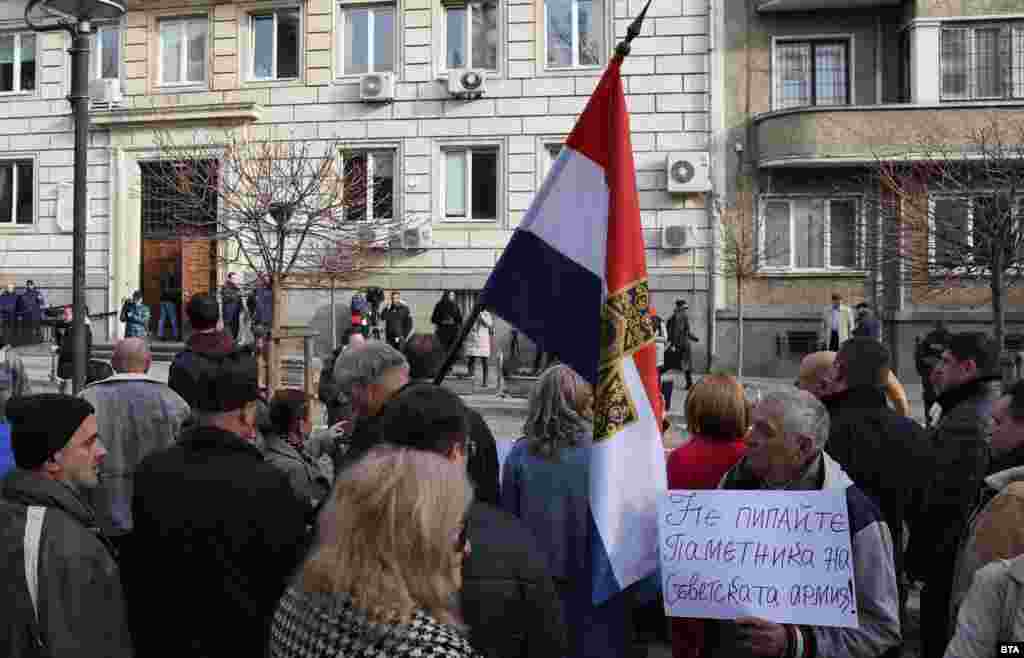
9/9Protesters also gathered outside Sofia’s Municipal Council on March 9. This picture shows one demonstrator holding a Samara flag, referencing the Russo-Turkish War of the 1870s, as another man displays a sign saying, "Don't touch the monument to the Soviet Army."
During the council protest, a man threw a Ukrainian flag that had been flying from the balcony of the council building to the ground. Reactions online to the incident were largely critical, with even those against foreign flags flying from Bulgaria’s official buildings saying it should have been removed respectfully.
A demonstration held on March 9 indicates that a council vote to remove a controversial memorial to Red Army soldiers in Sofia may be easier said than done.
Show moreShow less
Previous slide
Next slide
The monument with an expansive pedestal was erected in 1954 to honor the Soviet Red Army. It has long been a point of contention, with critics arguing that it was built for propaganda purposes to promote the former communist government on the 10th anniversary of the Soviet declaration of war against Bulgaria and of the subsequent coup d’etat that overthrew the Kingdom of Bulgaria in September 1944.
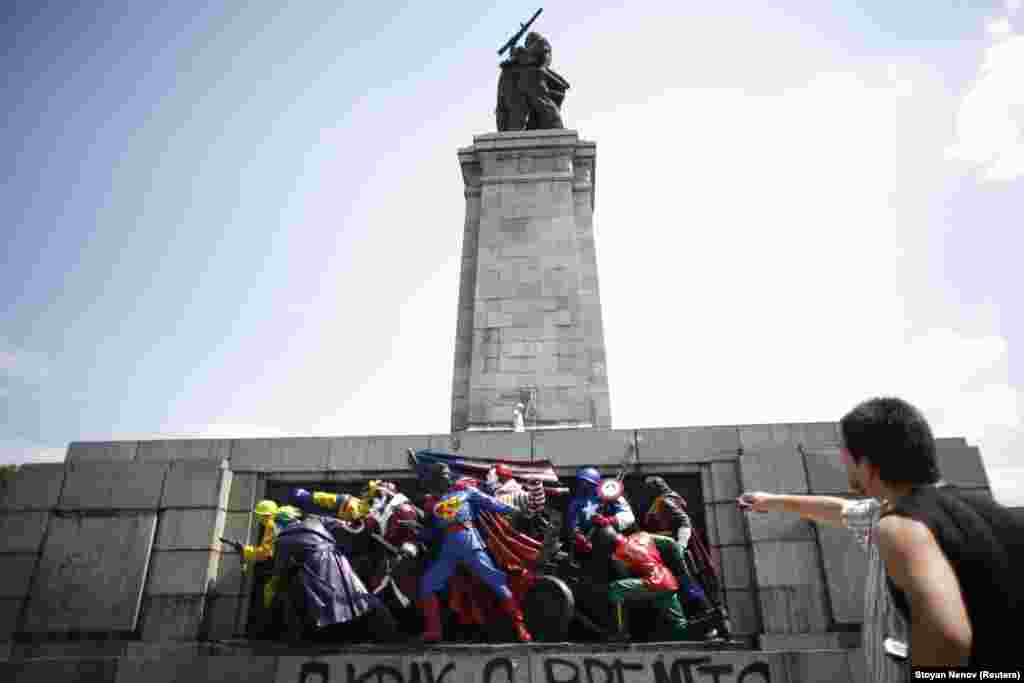
The Monument to the Soviet Army is also known as the Monument to the Red Army of Occupation. Sofia’s city council first voted in 1993 to have the statue removed, but it has remained in place to this day. The monument has been the target of numerous popular protests and forms of artistic expression, including in 2011 when depictions of Red Army soldiers on the site of the monument were painted over as superheroes, Ronald McDonald, and Santa Claus.
The Troubled History Of Bulgaria's Soviet Monument
1/13This damage to the base of the Monument to the Soviet Army in Sofia was photographed on February 23. The destruction shattered some plates of an inscription that reads: "To the Soviet Army liberators -- from the grateful people of Bulgaria." It's the latest damage to Sofia’s most controversial memorial.
Recent vandalism of a famous column to the Red Army in central Sofia is the latest in a string of symbolic anti-Kremlin attacks on the memorial.
Show moreShow less
2/13The monument to the Red Army photographed in 1959.
The memorial complex was installed in 1954, a decade after the Soviet military entered Bulgaria during World War II. The Balkan country’s allegiances during that conflict swung from neutrality, to alliance with the Nazi-led Axis powers and participation in the Holocaust, to finally joining the Allies by the end of the war.
Recent vandalism of a famous column to the Red Army in central Sofia is the latest in a string of symbolic anti-Kremlin attacks on the memorial.
Show moreShow less
3/13The Sofia memorial in 2011.
The centerpiece of the Monument to the Soviet Army is a 37-meter-high pedestal depicting a Soviet soldier flanked by Bulgarian civilians. Several other military-themed compositions are dotted around the park-sized memorial grounds.
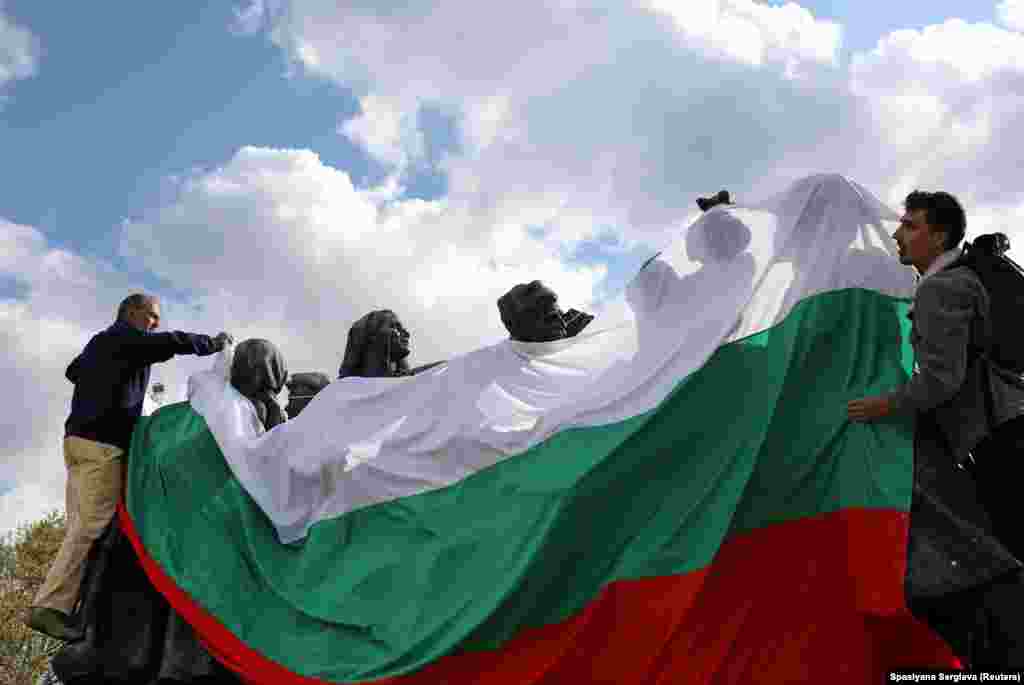
The site has long been a rallying point for far-left activists and, in recent years, the memorial has also become a target for anti-Kremlin activism.
Recent vandalism of a famous column to the Red Army in central Sofia is the latest in a string of symbolic anti-Kremlin attacks on the memorial.
Show moreShow less
5/13In June 2011, a relief on the memorial depicting Soviet soldiers advancing in battle was illegally repainted to portray various Western comic-book characters, as well as Ronald McDonald and Santa Claus. Graffiti beneath the characters read: “Moving With The Times.”
Recent vandalism of a famous column to the Red Army in central Sofia is the latest in a string of symbolic anti-Kremlin attacks on the memorial.
Show moreShow less
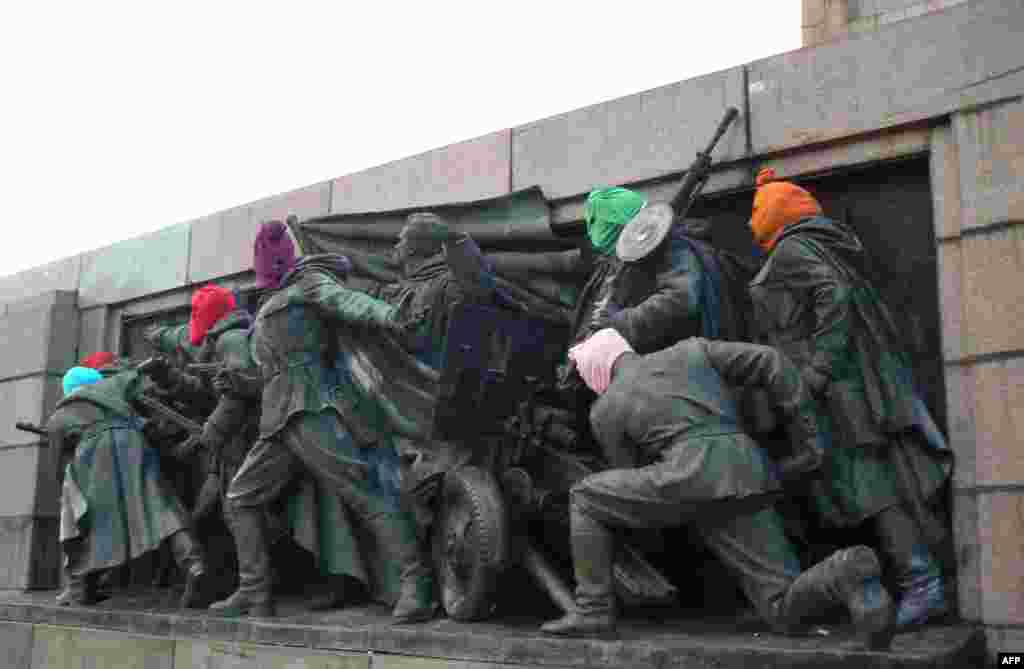
6/13The same relief is seen covered with colorful hoods in August 2012 in a show of support for Pussy Riot. The Russian activist group hit the headlines earlier that year after staging a controversial protest song in Moscow’s Cathedral of Christ the Savior.
Recent vandalism of a famous column to the Red Army in central Sofia is the latest in a string of symbolic anti-Kremlin attacks on the memorial.
Show moreShow less
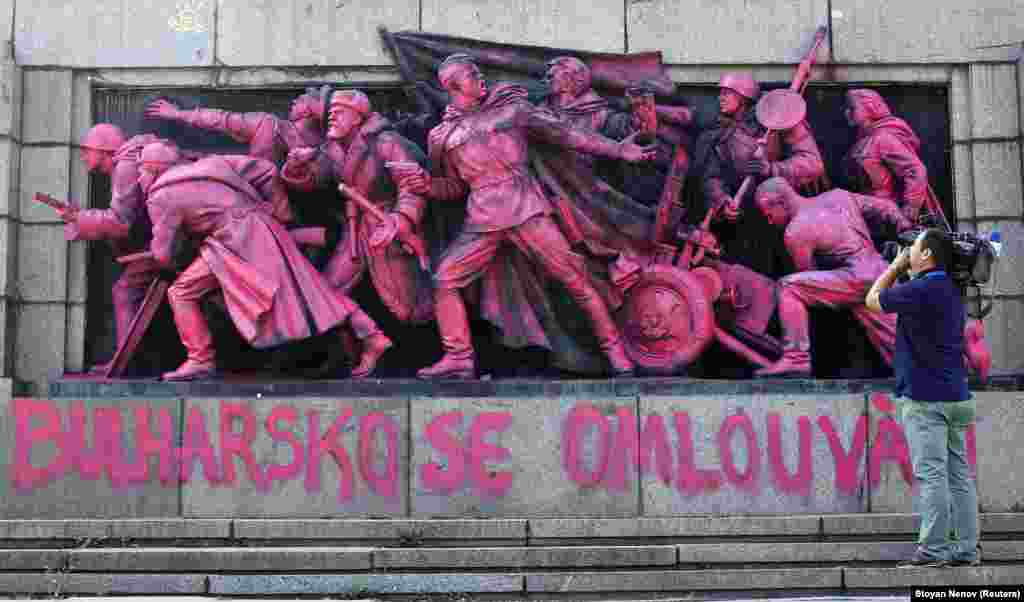
7/13Soviet soldiers were daubed in pink paint with the words “Bulgaria apologizes” in Bulgarian and Czech in August 2013. The vandalism was apparently referencing the Bulgarian communist regime's participation in the Kremlin-led crushing of the Prague Spring 45 years earlier, in 1968.
Recent vandalism of a famous column to the Red Army in central Sofia is the latest in a string of symbolic anti-Kremlin attacks on the memorial.
Show moreShow less
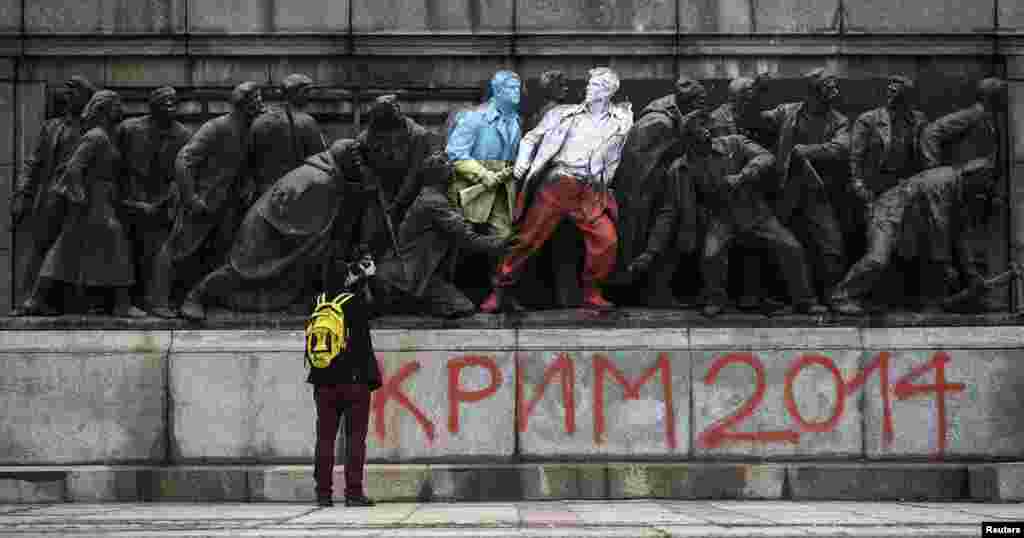
8/13A different panel of the monument was hit in March 2014 by activists who painted two figures in the colors of the Ukrainian and Polish flags. Spray-painted text referenced the Russian takeover of Crimea and the Katyn forest massacre in which the Soviets killed nearly 22,000 captured Poles.
Recent vandalism of a famous column to the Red Army in central Sofia is the latest in a string of symbolic anti-Kremlin attacks on the memorial.
Show moreShow less
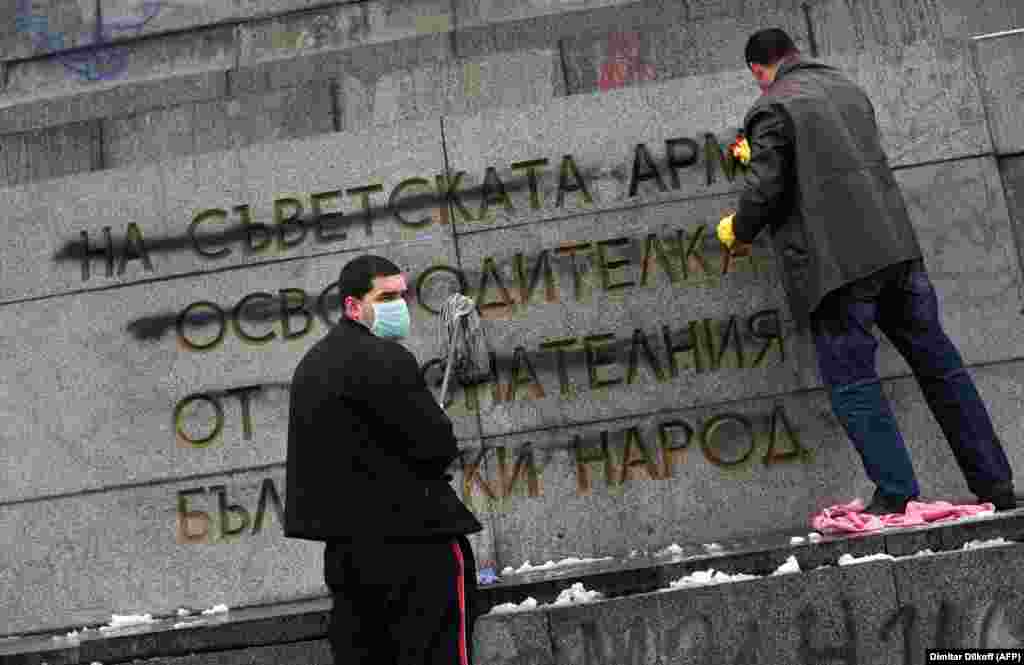
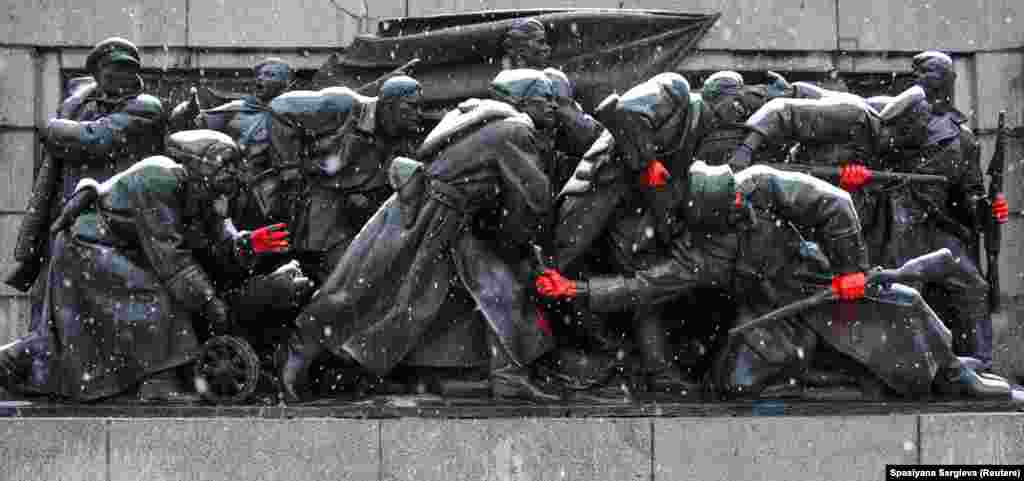
9/13The memorial was given its own security in 2018. But despite the heightened security, since February 24, 2022, when Russia launched its full-scale invasion of Ukraine, the monument has been attacked multiple times. This image, showing Soviet soldiers with their hands spray-painted red, was made on February 27, 2022.
Recent vandalism of a famous column to the Red Army in central Sofia is the latest in a string of symbolic anti-Kremlin attacks on the memorial.
Show moreShow less
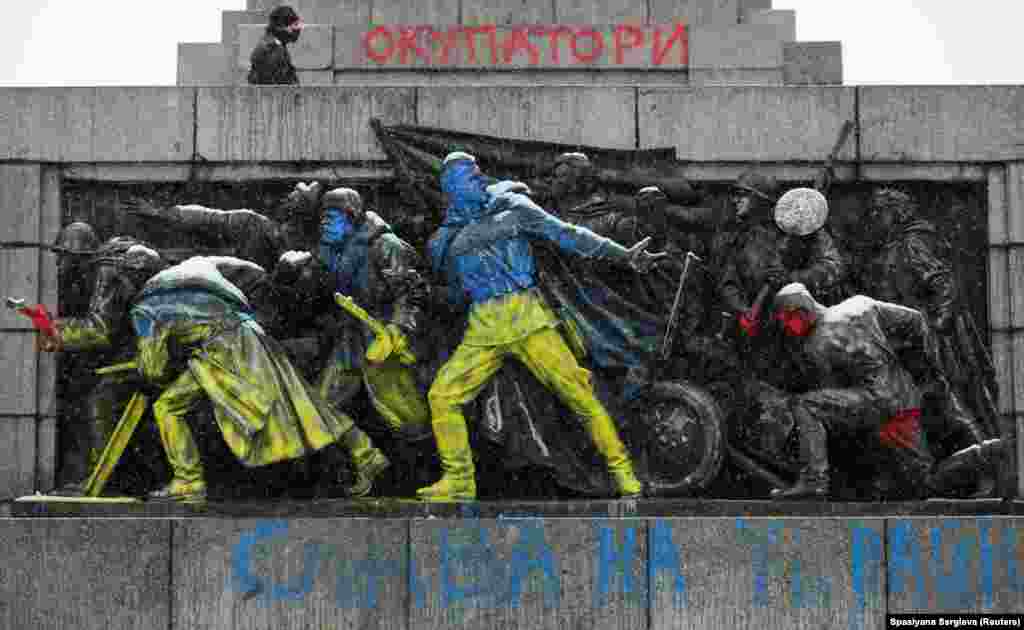
10/13The oft-attacked panel of the Sofia memorial painted in the colors of the Ukrainian flag on February 27, 2022. Graffiti at the top of the image reads: “Occupiers.”
Recent vandalism of a famous column to the Red Army in central Sofia is the latest in a string of symbolic anti-Kremlin attacks on the memorial.
Show moreShow less
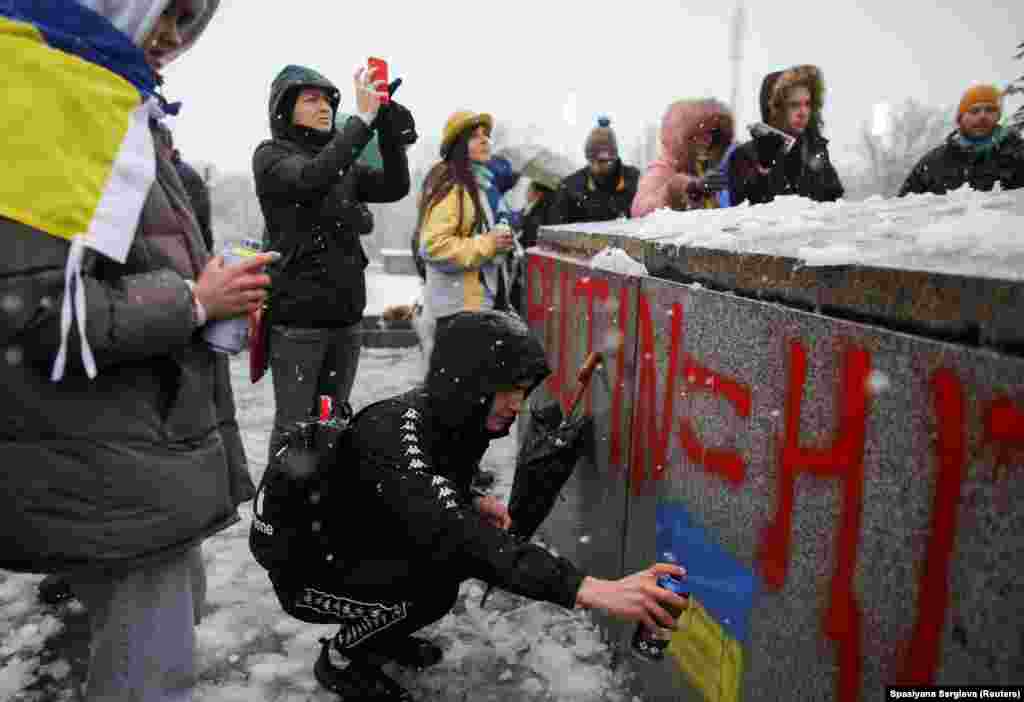
11/13Anti-war activists deface the Soviet monument on February 27, 2022.
Inside Bulgaria, opinions of Russian President Vladimir Putin were mostly positive, at up to 58 percent, between 2020 and 2022, but plummeted to just 32 percent in the days after the Ukraine invasion was launched.
Recent vandalism of a famous column to the Red Army in central Sofia is the latest in a string of symbolic anti-Kremlin attacks on the memorial.
Show moreShow less
Previous slide
Next slide
In February, the issue of removing the monument heated up when several plaques on its facade were destroyed and the city authorities determined that they posed a danger to passersby.
Svetlozar Rayanov, a 61-year-old retired scientist, was detained for 24 hours for destroying the plaques. He later told journalists he had damaged the monument as an act of protest against Russian aggression.
"My main protest is against the war that Russia is waging against Ukraine, but the date also coincided with Red Army Day, which is celebrated on February 23, and now it is Defense of the Fatherland Day," Rayanov said at the time.
City councilors from the pro-European coalition Democratic Bulgaria, former Prime Minister Boyko Borisov’s GERB party, and the Patriots for Sofia voted in favor of relocating the monument on March 9 after several hours of debate.
Representatives of Bulgaria's Socialist Party (BSP) opposed the proposal, and pledged to appeal the decision if it passed.
Acting Prime Minister Galab Donev also commented on the issue, suggesting that decisions about the monument should be made after early parliamentary elections scheduled for April 2.
"Politicians should leave this topic for after the elections so that the most correct decision can be made in a calm environment," Donev said.
The BSP, Revival (Vazrazhdane), and other pro-Russian parties have protested the relocation of the monument, including throwing eggs and paint at the municipal building housing the city council as the measure was debated.
On March 7, the city council’s Committee on Education and Culture ruled in favor of relocating the monument, based on a proposal submitted by the Democratic Bulgaria coalition in 2020.
RFE/RL’s Bulgarian Service relaunched in 2019 after a 15-year absence, providing independent news and original analysis to help strengthen a media landscape weakened by the monopolization of ownership and corruption.