



Elections are still held across Central Asia. Political parties remain on the ballot. Presidents continue to claim democratic mandates. But in much of the region, genuine political competition has become increasingly rare.
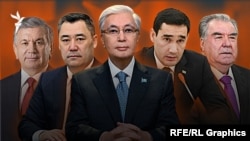
Tajik President Emomali Rahmon has ruled the country since 1992, making him one of the world's longest-serving leaders. In Turkmenistan, Serdar Berdymukhammedov succeeded his father, Gurbanguly Berdymukhammedov, as president in 2022, while the former leader continues to hold significant influence.
In Kazakhstan, constitutional changes allowed Qasym-Zhomart Toqaev to seek another term in office, despite earlier reforms that introduced a single, nonrenewable seven-year presidential term. And throughout the region, governments have steadily narrowed the space for opposition challengers through bans, prosecutions, imprisonment, and exile.
Yet the virtual disappearance of opposition parties does not necessarily mean the disappearance of political dissent.
"Activism has not disappeared entirely...it has merely taken different forms," said Edward Lemon, president of the Washington-based Oxus Society for Central Asian Affairs.
Today, experts say political opposition in Central Asia increasingly functions outside traditional party structures: through social media campaigns, local protests, civic activism, and opposition movements operating from abroad.
The question is whether these fragmented forms of dissent can ever again develop into meaningful political alternatives.
Different Political Landscape
The region's current political landscape contrasts sharply with the early years after independence following the breakup of the Soviet Union.
A former university professor in Dushanbe, who spoke on condition of anonymity due to security concerns, said that during this period, several Central Asian countries had genuine political competition.
"Most Central Asian countries, particularly Kyrgyzstan, Tajikistan, and Kazakhstan, had vibrant opposition movements, various independent groups, and truly independent media," he said.
"The opposition did not necessarily win elections -- by becoming president or securing a parliamentary majority -- but its participation made elections genuine, at least to some extent. Elections meant people had a choice," he added.
That political space has since dramatically narrowed.
In Uzbekistan, opposition leaders were forced into exile years ago. In Tajikistan, authorities banned the Islamic Renaissance Party of Tajikistan (IRPT) in 2015, effectively removing the country's most powerful organized opposition force from legal politics.
Many young people in countries such as Turkmenistan and Uzbekistan have grown up without ever seeing a genuine opposition party operate openly, making competitive politics an increasingly distant concept for a new generation.
Even Kyrgyzstan, long considered Central Asia's most politically competitive country after a series of popular uprisings that reshaped the country's leadership beginning in 2005, has seen its political space shrink in recent years.
Critics say pressure has expanded from opposition politicians to activists, journalists, and bloggers.
Kyrgyz journalist Adil Turdukulov told RFE/RL's Kyrgyz Service that authorities had gradually "cleared the political field," sending a message that even expressing critical views could lead to prosecution.
Turdukulov also pointed out that even a limited parliamentary opposition could serve as a safety valve by giving citizens a way to express grievances within the political system rather than outside it.
Why Governments Feel More Confident
Analysts say several factors have allowed Central Asian governments to tighten political control while facing relatively limited consequences.
"Central Asian governments see internal political stability as a core tenet of national security," said Mario Bikarski, senior Eastern Europe and Central Asia analyst at risk intelligence company Verisk Maplecroft.
"The region is positioned at the crossroads of fierce geopolitical and geoeconomic competition. Any internal destabilization would create an opportunity for external actors to expand their influence into the region."
Bikarski said governments in Kazakhstan and Uzbekistan, in particular, have relied on economic growth and rising living standards to reduce wider public discontent while strengthening political control.
At the same time, international pressure has weakened. "External scrutiny over democratic processes has weakened in recent years, as Central Asia has become a more geopolitically relevant region and commands major reserves of sought-after raw materials," he said.
Limits Of Exile
For many of Central Asia's most prominent opposition figures, exile has become the only option.
Some have fled to Europe, Turkey, and the United States, where they attempt to remain politically active.
But for exiled movements, the central challenge is not only political survival -- it is remaining connected to the societies they hope to change.
Muhiddin Kabiri, chairman of Tajikistan's banned IRPT, now renamed the Islamic Renaissance of Tajikistan, said exile makes it extremely difficult for opposition movements to influence developments inside their own countries.
Kabiri said the lack of political support and grants from Western countries has also limited the ability of Central Asian opposition groups abroad to operate effectively.
"There is no such support for the opposition movements of Central Asia," he told RFE/RL, comparing their situation with opposition movements from countries such as Belarus, Russia, Iran, and Afghanistan.
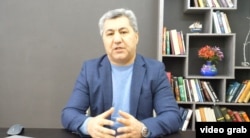
Maintaining contacts inside Tajikistan has also become increasingly difficult, he said.
The government has used intimidation, imprisonment, and other methods to discourage people from communicating with opposition figures abroad, Kabiri said.
"It also made us refrain from contacting people inside the country, fearing that it would endanger their lives," he said.
He pointed to cases in which people were imprisoned for interacting with opposition-related content on social media or maintaining contacts with opposition figures.
New Forms Of Dissent
Despite the decline of formal opposition parties, Lemon said political activism has adapted.
"We aren't seeing the kinds of nationwide protests we saw in Kazakhstan after the 2019 transition of power or at the time of the 2020 elections in Kyrgyzstan," he said, referring to the protests that followed Kazakhstan's presidential succession and Kyrgyzstan's disputed parliamentary elections that led to political upheaval.
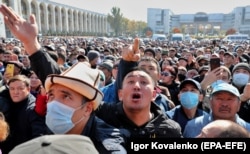
Those movements could happen again, the Central Asia expert said, but activism has increasingly shifted toward smaller-scale protests focused on local issues such as utilities, housing, and property rights.
Such activism is less threatening to central governments because it does not directly challenge national leadership, Lemon told RFE/RL.
The challenge for opposition movements is whether these scattered forms of activism can eventually become organized political alternatives.
Stability Or Hidden Risks?
The weakening of the opposition may provide governments with short-term political stability, but analysts warn it can also create longer-term risks.
"Constraining formal opposition movements and the marginalization of certain segments of society allows for the silent build-up of discontent over the long term," Bikarski told RFE/RL.
He pointed to unrest in Kazakhstan, Tajikistan, and Uzbekistan in 2022 as examples of how unresolved economic and social grievances can eventually erupt.
The absence of formal opposition also creates risks for policymaking, he said, because governments receive less feedback from society.