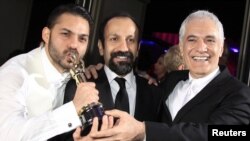
Asghar Farhadi (center), director of the Iranian film "A Separation," poses with actor Peyman Maadi (left) and director of photography Mahmud Kalari at the 84th Academy Awards in Hollywood after winning the Oscar for best foreign-language film in 2012.
When Ayatollah Ruhollah Khomeini took power in Iran 35 years ago on February 11, Iran's filmmakers had good reason to worry.
The strict code of censorship ushered in by the Islamic Revolution convinced many that creativity and film were no longer compatible in Iran.
Yet today, despite the continuing strict censorship rules governing them, Iran's artistic films -- as opposed to the country's commercial-release films -- are universally acclaimed as among the most innovative and important participants in international film festivals.
The filmmakers' ability to overcome the suffocation of censorship, while still working under it, is one of the rare successes in the daily struggle ordinary Iranians wage to have greater personal freedom under an authoritarian regime. At the same time, the battle against censorship has had a great influence in forging the look and style of Iranian art films, which have earned a place of distinction in the eyes of film lovers worldwide.
Many authoritarian governments impose strict political restrictions on artists. But the Islamic republic's censorship code is unusually strict because it includes social restrictions as well. The social restrictions particularly limit how relationships between men and women -- one of the most fundamental subjects of the arts -- can be depicted.
The red lines forbid almost all physical gestures of romantic love, limit the kinds of issues that can be discussed, and bar women from singing or dancing on screen. They also require actresses to wear the hijab -- clothing that masks the figure and covers the hair -- for indoor as well as outdoor scenes, even though in reality Iranian women generally dress at home as they wish and don't cover their hair.
Jafar Panahi poses with his "Jury Grand Prix" silver bear for his movie "Offside" at the 56th Berlinale Film Festival in Berlin in 2006. Panahi is now banned from making films in Iran.
Jamsheed Akrami, a professor of film at William Paterson University in New Jersey, says that the censorship code is so burdensome that the first talent any serious filmmaker must possess is the ability to get around it.
"Whenever you are under strict restrictions, you try to find out ways of getting around them to still communicate your messages. To the credit of the Iranian filmmakers, they have become very adept at skirting the censorship codes," Akrami says. "In fact, as an Iranian filmmaker your most prized possession is your ability to undermine the censorship codes and find ways of getting around them. Your artistic gift is like a secondary requirement."
The Art Of Allusion
One way to get around censorship is to allude to subjects rather than address them directly. Akrami -- whose own recent documentary "A Cinema of Discontent" explores how Iranian directors such as Jafar Panahi (maker of "The Circle," an independent film banned from public screening in Iran ), Bahman Ghobadi (maker of "No One Knows About Persian Cats," an underground film never screened in Iran ), and the Oscar-winning Asghar Farhadi operate under censorship -- says the art of allusion has become the hallmark of Iran's art cinema.
"Iranian movies in film festivals are praised for their minimalist approach, for their aesthetics of omission, how they say things by not saying them, how they show things by not showing them. But we can never be sure that those approaches are decisions that are made consciously by the filmmakers or whether they are the results of the censorship," Akrami explains. "You don't know if a filmmaker who is using a minimalist approach is doing it [because he chooses to] or because he can't be more open in his communication with the audience."
One technique many filmmakers have successfully used is to discuss the difficult subject of adult romantic love by viewing it through the innocent eyes of children. Another is to use traditional village life as a setting for discussing urban social themes. Both children and village life are generally viewed by censors as posing no threat to the Islamic republic's strict moral codes or to its political stability.
What art films from the Islamic republic might look like without the burden of censorship is impossible to know. But Akrami, who has interviewed dozens of Iranian filmmakers, says they unanimously believe they could make better films if the censorship were lifted.
Making films in Iran is an activity that not only tests artists' ingenuity. It also can bring heavy punishment if the artist is deemed too independent.
The best-known filmmaker to suffer punishment recently is Panahi, who was arrested in 2010 after years of conflict with the authorities over the content of his films. Panahi received a six-year jail sentence, which was suspended after an outcry from the international community, and is banned from making films for 20 years.
Within The System, Or Without
The easiest course is to simply cooperate fully with the state cinema authorities, who provide directors with loans to fund films and offer some free equipment if the initial script is approved. Fully cooperating also means guaranteed approval for the film to be shown in domestic cinemas or on television.
Filmmaker Behrouz Ghobadi, younger brother of Bahman, following his release from prison on security charges. Amnesty International led a campaign calling for his release.
The directors who cooperate make commercially successful films that simply accept the incongruities imposed by the state censors. That includes the absurdity of showing women wearing the hijab as they sleep at home and the careful avoidance of volatile social topics such as attraction outside marriage or high unemployment among young people.
But directors who want to make artistic films -- the kind that go to international festivals -- have only two ways to do so. They can still try to make serious films within the state system, but at the risk of seeing their films banned if they are caught breaking censorship rules.
Or they can try to make underground films at their own cost and without state approval. The films made outside the state system may get to global film festivals but they cannot be shown in Iran's cinemas and can only be distributed illegally through black-market copies or via Internet download.
Both Iranian underground films and those made within the state system have won critical acclaim at film festivals.
Mohammad Abdi, a London-based film critic and author, says underground films have dominated Iran's success at festivals during most of the last decade. "If you look at the films in the Cannes, Berlin, Venice, and many other festivals during the last 10 years, especially during the [Mahmud] Ahmadinejad presidency, you see that most of them were made without permission and actually they are illegal in Iran and they have no opportunity to be shown in the [domestic] cinema," he says.
However, the Iranian film to have the greatest recent success internationally is not an underground film but one made by working within the censorship system. It is Farhadi's film "A Separation," which won an Academy Award for Best Foreign Language Film in 2012, the first Iranian film to ever do so.
Abdi says Farhadi has proved to be unusually adept at working within and around the censorship restrictions to produce films that both gain permission for domestic showing in Iran and gain international acclaim for their depth of content and innovative storytelling.
PHOTO GALLERY: Iran's 1979 Revolution
Anniversary: Iran's 1979 Revolution
1/13Protesters hold a portrait of Ayatollah Ruhollah Khomeini during the 1979 revolution.
Thirty-five years ago, the monarchy of the Shah Mohammad Reza Pahlavi was toppled and replaced by a government led by Islamic cleric Ayatollah Ruhollah Khomeini. On February 11, 1979, revolutionary forces and rebel troops seized control in Iran, paving the way for Khomeini's elevation to power.
Show moreShow less
2/13Iranian demonstrators in Tehran show support for the return of Ayatollah Ruhollah Khomeini.
Thirty-five years ago, the monarchy of the Shah Mohammad Reza Pahlavi was toppled and replaced by a government led by Islamic cleric Ayatollah Ruhollah Khomeini. On February 11, 1979, revolutionary forces and rebel troops seized control in Iran, paving the way for Khomeini's elevation to power.
Show moreShow less
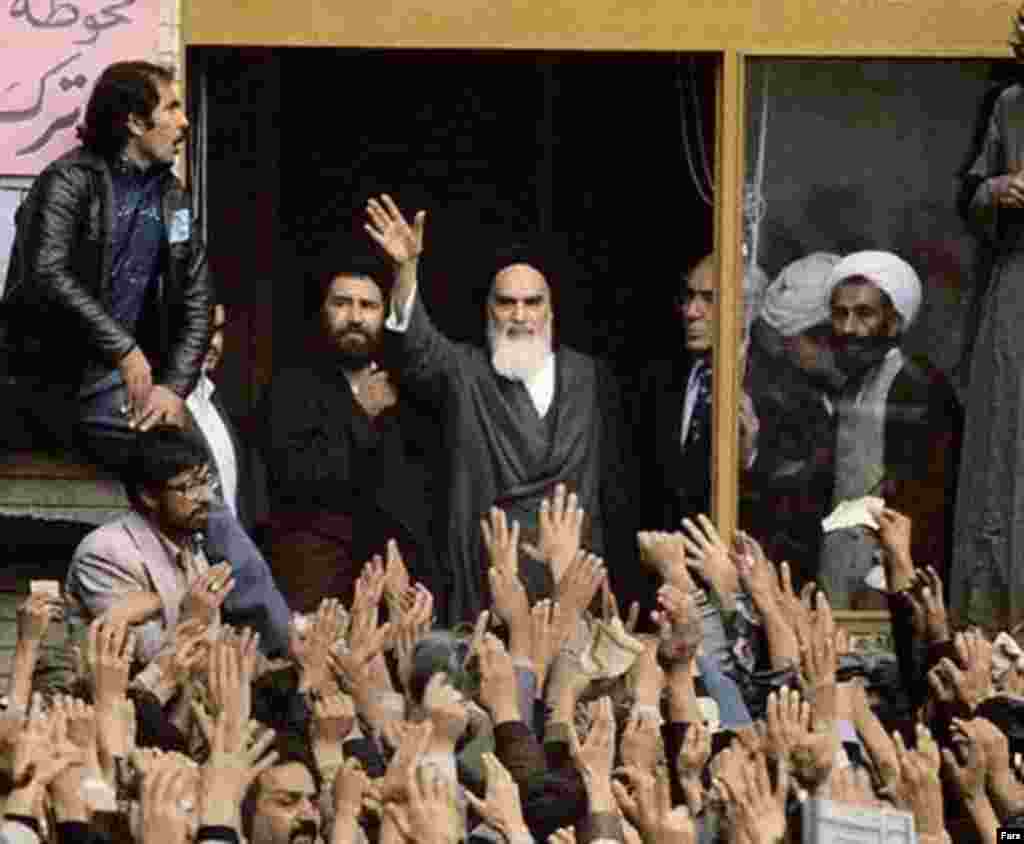
3/13Khomeini greets supporters on February 1, 1979, the day of his return from exile in France.
Thirty-five years ago, the monarchy of the Shah Mohammad Reza Pahlavi was toppled and replaced by a government led by Islamic cleric Ayatollah Ruhollah Khomeini. On February 11, 1979, revolutionary forces and rebel troops seized control in Iran, paving the way for Khomeini's elevation to power.
Show moreShow less
4/13Supporters of the Islamic revolution demonstrate in Tehran, February 1979.
Thirty-five years ago, the monarchy of the Shah Mohammad Reza Pahlavi was toppled and replaced by a government led by Islamic cleric Ayatollah Ruhollah Khomeini. On February 11, 1979, revolutionary forces and rebel troops seized control in Iran, paving the way for Khomeini's elevation to power.
Show moreShow less
5/13Khomeini at the Behesht Zahra cemetery on the day he returned from Paris, February 1, 1979.
Thirty-five years ago, the monarchy of the Shah Mohammad Reza Pahlavi was toppled and replaced by a government led by Islamic cleric Ayatollah Ruhollah Khomeini. On February 11, 1979, revolutionary forces and rebel troops seized control in Iran, paving the way for Khomeini's elevation to power.
Show moreShow less
6/13Some one million people gather in Freedom Square in Tehran as the Iranian Revolution begins in 1979.
Thirty-five years ago, the monarchy of the Shah Mohammad Reza Pahlavi was toppled and replaced by a government led by Islamic cleric Ayatollah Ruhollah Khomeini. On February 11, 1979, revolutionary forces and rebel troops seized control in Iran, paving the way for Khomeini's elevation to power.
Show moreShow less
7/13Women hold portraits of Khomeini in 1979.
Thirty-five years ago, the monarchy of the Shah Mohammad Reza Pahlavi was toppled and replaced by a government led by Islamic cleric Ayatollah Ruhollah Khomeini. On February 11, 1979, revolutionary forces and rebel troops seized control in Iran, paving the way for Khomeini's elevation to power.
Show moreShow less
8/13Supporters of the Islamic revolution demonstrate in Tehran in 1979.
Thirty-five years ago, the monarchy of the Shah Mohammad Reza Pahlavi was toppled and replaced by a government led by Islamic cleric Ayatollah Ruhollah Khomeini. On February 11, 1979, revolutionary forces and rebel troops seized control in Iran, paving the way for Khomeini's elevation to power.
Show moreShow less
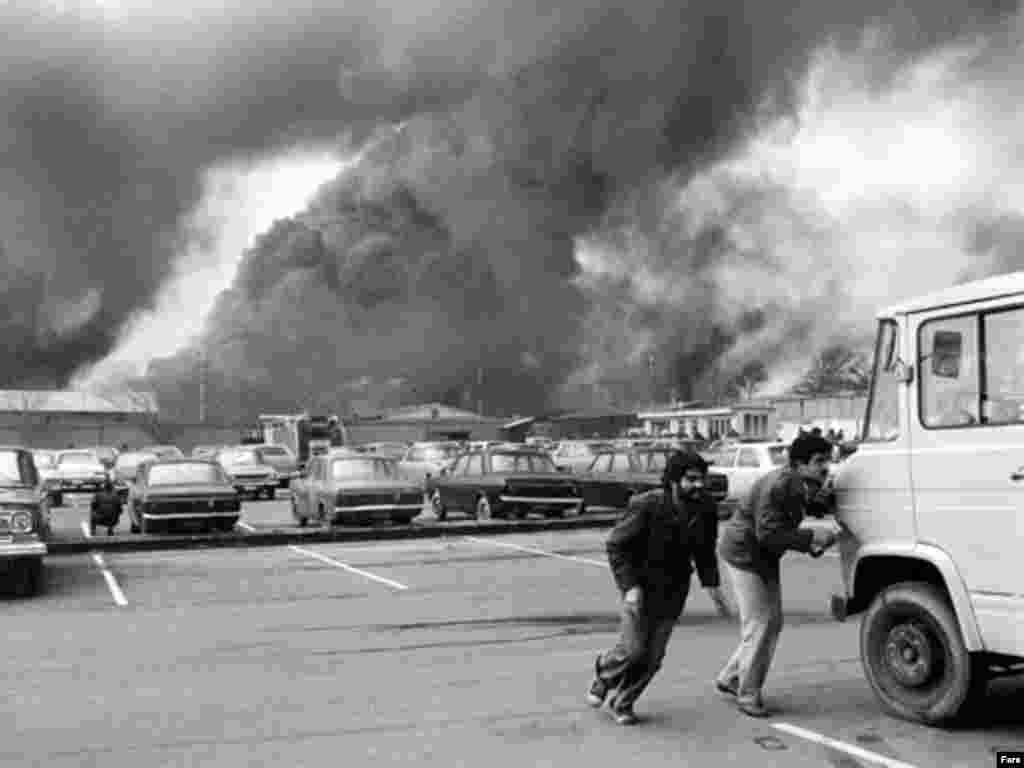
9/13Large fires erupted in Tehran during the fall of Shah Reza Pahlavi's regime in February 1979.
Thirty-five years ago, the monarchy of the Shah Mohammad Reza Pahlavi was toppled and replaced by a government led by Islamic cleric Ayatollah Ruhollah Khomeini. On February 11, 1979, revolutionary forces and rebel troops seized control in Iran, paving the way for Khomeini's elevation to power.
Show moreShow less
10/13Islamist students take over the U.S. embassy in support of the Iranian revolution in November 1979.
Thirty-five years ago, the monarchy of the Shah Mohammad Reza Pahlavi was toppled and replaced by a government led by Islamic cleric Ayatollah Ruhollah Khomeini. On February 11, 1979, revolutionary forces and rebel troops seized control in Iran, paving the way for Khomeini's elevation to power.
Show moreShow less
11/13American hostages in Iran during seizure of the U.S. embassy by Islamist students.
Thirty-five years ago, the monarchy of the Shah Mohammad Reza Pahlavi was toppled and replaced by a government led by Islamic cleric Ayatollah Ruhollah Khomeini. On February 11, 1979, revolutionary forces and rebel troops seized control in Iran, paving the way for Khomeini's elevation to power.
Show moreShow less
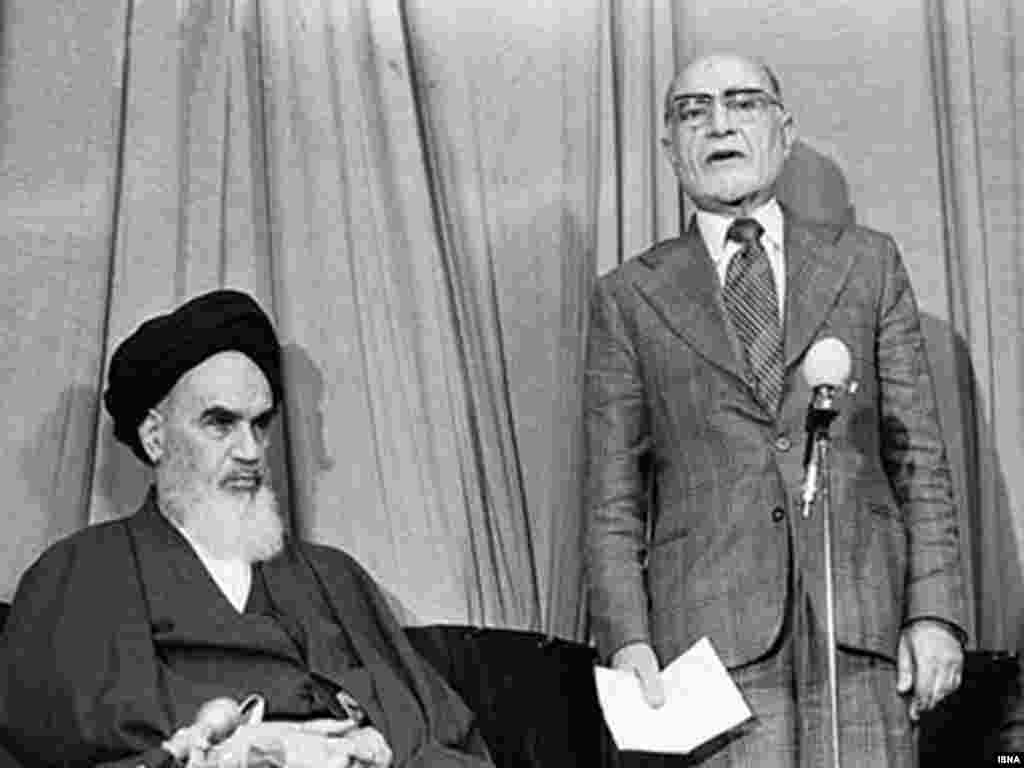
12/13Khomeini introduces Mehdi Bazargan as interim prime minister during the Islamic revolution in February 1979.
Thirty-five years ago, the monarchy of the Shah Mohammad Reza Pahlavi was toppled and replaced by a government led by Islamic cleric Ayatollah Ruhollah Khomeini. On February 11, 1979, revolutionary forces and rebel troops seized control in Iran, paving the way for Khomeini's elevation to power.
Show moreShow less
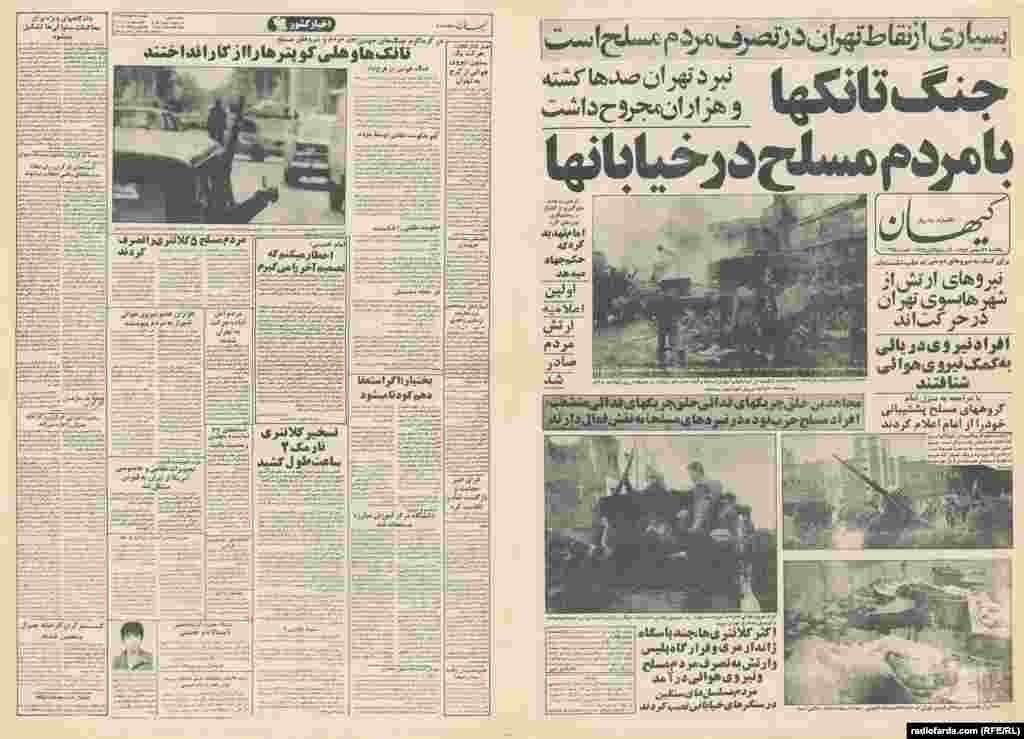
13/13The front page of the "Kayhan" newspaper on February 11, 1979, dedicated to Iran's revolution.
Thirty-five years ago, the monarchy of the Shah Mohammad Reza Pahlavi was toppled and replaced by a government led by Islamic cleric Ayatollah Ruhollah Khomeini. On February 11, 1979, revolutionary forces and rebel troops seized control in Iran, paving the way for Khomeini's elevation to power.