


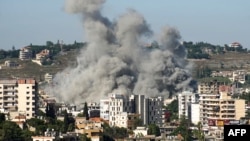
A wave of Israeli strikes that killed dozens of people in southern Lebanon this week has exposed a deepening rift inside Iran's political establishment, with hard-liners demanding that Tehran respond to what they call a blatant violation of the US-Iran memorandum of understanding (MOU).
The interim agreement was announced on June 15 after it was signed electronically following talks mediated by Pakistan. It was then signed, remotely, by US President Donald Trump and his Iranian counterpart, Masud Pezeshkian, on June 17.
The agreement's first clause calls for an end to the fighting "on all fronts, including Lebanon." Instead, Israeli air strikes killed at least 47 people, including a soldier, according to Lebanese health authorities, while Hezbollah said its fighters killed four Israeli soldiers in clashes near the Ali Taher hill, claiming to have destroyed three tanks.
Iran-backed Hezbollah, a militant group and political party that controls much of southern Lebanon, is considered a terrorist organization by the United States, while the European Union has blacklisted its armed wing but not its political branch.
Israel retaliated with strikes on the Bekaa Valley, with far-right National Security Minister Itamar Ben Gvir declaring that "all of Lebanon must burn."
The violence forced the postponement of a high-level Iran-US meeting in Switzerland on June 19 to begin talks on a permanent deal, and prompted France to publicly urge Washington to "exert all necessary pressure" on Israel to respect the agreement.

Hard-liners in Iran have been criticizing the agreement since it was announced and demanding tougher terms. Now, they feel the developments in Lebanon are giving them enough leverage to force the government to act.
Conservative parliamentarian Mahmud Nabavian warned that letting the violation slide would doom the rest of the deal.
"If you retreat on the [Lebanon] clause and ignore this blatant violation, and the enemy sees your weakness, then realizing the other clauses -- sanctions relief, unfreezing of funds and so on -- will certainly become impossible," he wrote on X.
Fellow MP Meysam Zohurian made a similar argument, tying Lebanon directly to Iran's other major point of leverage: the Strait of Hormuz.
"Any opening in the strait before a complete cease-fire is established in Lebanon -- and an Israeli withdrawal -- means Iran has accepted to prematurely implement the MOU," he wrote.

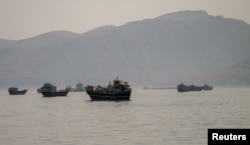
As part of the agreement, Iran is allowing toll-free transit of commercial ships through the strait, while the United States has lifted its blockade of Iranian ports.
One of the sharpest critiques came from commentator Nezamoddin Mousavi, who explicitly invoked Supreme Leader Mojtaba Khamenei's own reservations about the deal to pressure Iran's negotiators.
In a statement on June 18, Khamenei distanced himself from the agreement, saying he had authorized Pezeshkian's government to sign the MOU despite holding "a different opinion" himself and that Pezeshkian "explicitly accepted responsibility" for the outcome.
Seizing on that framing, Mousavi wrote: "Now the very first clause of the agreement -- 'end of war in Lebanon' -- is the first test of your commitment. This clause has been formally violated. What is your plan?"
It's a pointed line for Pezeshkian's government: Having staked its credibility on a deal that Khamenei was lukewarm about from the start, it now has to answer for that deal's first failure on his terms.
Not all of the criticism is coming from the hard-line camp typically associated with the Paydari Front, which has staged demonstrations against the MOU since it was first announced.
Cleric Jalil Mohebbi, who is close to chief Iranian negotiator Mohammad Baqer Qalibaf, offered a blunt assessment, writing in a short post on X, "Israel's renewed attacks on Lebanon won't leave any agreement intact."
Axios reported on June 20 that White House special envoy Steve Witkoff is traveling to Switzerland to meet Iranian Foreign Minister Abbas Araqchi, indicating the postponed talks might be back on track, albeit at a lower level than initially planned.
Still, the rumored meeting has its detractors. Tasnim news agency, an affiliate of the Islamic Revolutionary Guards Corps (IRGC), charged that there is "no justification" for meeting Witkoff given what's happening in Lebanon, and called on the authorities to again close the Strait of Hormuz.
"The negotiators must not only suspend all talks; they must also completely close the Strait of Hormuz before it is too late," Tasnim wrote. "While the enemy has failed to meet its commitments, relieving the pressure on them by keeping the strait open would be an irreparable strategic mistake."