





WASHINGTON -- As Washington and Tehran test the limits of a fragile interim understanding, the diplomacy around Iran has become increasingly complex -- and increasingly indirect. What began as expectations of direct US-Iran talks in Doha has shifted into shuttle diplomacy through Qatar, while tensions in the Gulf remain dangerously high.
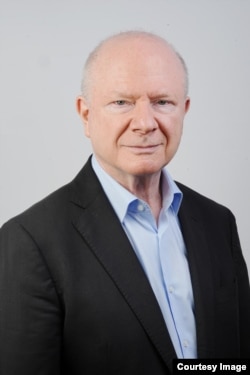
To unpack the latest developments, RFE/RL spoke with Marc J. Sievers, a former US diplomat based in Abu Dhabi who has served across the Middle East, including as US ambassador to Oman, deputy chief of mission in Cairo, and senior diplomatic postings in Baghdad, Tel Aviv, and Riyadh.
RFE/RL: What was initially presented as possible direct US-Iran talks in Doha now appears to be indirect, Qatar-mediated diplomacy. What does that tell you about how fragile this process really is?
Marc Sievers: I saw a statement by an Iranian spokesperson saying there will be no direct talks. I find that a bit surprising, but I can’t confirm exactly how that works. It doesn’t seem worth the effort to send US negotiators to Doha if they’re not going to speak to the Iranians directly. But again, that’s the White House’s call.
It doesn’t speak well to the status of the MOU [memorandum of understanding] at this point, particularly after the exchange of fire in the Gulf, the Iranian attacks on shipping in the Strait of Hormuz, and the US military reaction. So, it’s a delicate situation diplomatically.

RFE/RL: If the Americans are in one room and the Iranians in another, with Qatar carrying messages between them, does that suggest both sides still want de-escalation -- but without the political risk of direct engagement?
Sievers: It’s hard for me to read what the Iranians want, because you seem to have a bifurcated regime at this point. The political leadership does seem to want a deal, but it’s not at all clear to me that the IRGC [Islamic Revolutionary Guards Corps] does.
Because if they did, why would they be sending attack drones against shipping? Even if they want to assert that they still have some control, that’s contrary to the commitments made by their negotiators. So, it’s a bit puzzling to read what Iran wants at this point.
RFE/RL: If there are no face-to-face talks yet, what does success actually look like? Is it simply about preventing another military flare-up in the Gulf?
Sievers: I think success means reaching an understanding -- first and foremost on the Strait of Hormuz -- because that was supposed to have been done when the MOU was signed, and clearly it hasn’t come into effect the way it was understood.
There are also differences over Lebanon. The signing of the MOU in Washington between the Israeli and Lebanese delegations under US auspices was a big achievement. But the Iranians are opposed to it and say it violates their understanding with the United States, which is not the US view.
The Risk Of Regional Spillover
RFE/RL: Bahrain and Kuwait have come under Iranian strikes in recent days. From your time in Oman, how alarming is it when the conflict starts spilling directly onto Gulf soil?
Sievers: This is the first direct Iranian attack of this kind. During the June war last year, there was a one-off Iranian strike on the US base in Qatar, but the damage was minimal, and they didn’t attack civilian facilities.
But from day one, on February 28, the Iranians have been attacking all of their neighbors -- especially the UAE, Bahrain, and Kuwait -- focusing on energy infrastructure, tourist centers, and civilian facilities, nothing related to US military sites. That shocked everyone. It’s unprecedented.
RFE/RL: When we talk about Hormuz, we’re also talking about the economic lifeline of Gulf states. How nervous do you think countries like Oman and its neighbors are about prolonged disruption there?



Sievers: Oman is outside the Strait of Hormuz, so it’s not directly affected, although it affects the overall market here and the wider environment. Oman was also hit a couple of times by the Iranians.
Oman has been working with Iran on some kind of understanding about how to regulate traffic in the Gulf, and that has been a source of disagreement between Oman and the United States. The latest statements suggest the Omanis may be pulling back from coordinating their position with Iran, but I don’t really know the current status.
Other Gulf states are looking for alternatives. The UAE and Saudi Arabia have alternative pipelines that can move oil through other routes. Kuwait is more exposed because of its geography, and Iraq to some degree as well.
Over time, this may push the region toward alternative routes and multilateral shipping arrangements. But freedom of navigation has global implications. It is incredibly important not to cede to Iran the right to attack shipping in international waters. That is a fundamental pillar of international energy markets.
RFE/RL: Does this crisis force the Gulf Cooperation Council closer together strategically -- or expose deeper differences in how each capital wants to deal with Tehran?
Sievers: That’s a very interesting question. Initially, I would say it brought them together. But as the war went on for several weeks, they seemed to diverge a bit, with different countries adopting somewhat different positions. At this point, it depends on how it all ends -- and we’re not there yet.
Nuclear Questions And Sanctions Waivers
RFE/RL: Beyond Hormuz, the technical talks are also expected to cover sanctions waivers and Iran’s stockpile of highly enriched uranium. Which of those is the harder issue to solve -- money, shipping, or the nuclear file?
Sievers: It all combines -- they’re all linked together. Even Vice President [JD] Vance, who has been very optimistic about the MOU, was clear that there won’t be broader sanctions relief until Iran makes the appropriate commitments on the nuclear file.
There’s been talk about licenses to sell Iranian oil during this 60-day period -- that’s a concession. There are Iranian funds frozen in Qatar and Oman that, according to some reports, could be released, but that’s not clear to me.
And then there’s this whole idea of a $300 billion reconstruction fund, and I have no idea who would actually pay into that. I don’t really see any of the Gulf states -- aside from possibly Qatar -- being interested in participating.
RFE/RL: At the same time, internal instability continues inside Iran, including the killing of Revolutionary Guard members in Kermanshah. How much does domestic pressure shape Tehran’s negotiating posture?

Sievers: I’m not inside Iran, so it’s hard to say exactly. But it’s very clear there are at least two camps in the leadership. Sometimes they play that game too, so it’s hard to read.
But it certainly appears that President [Masud] Pezeshkian, maybe even [parliament] speaker [Mohammad Baqer] Qalibaf -- who has been one of the main negotiators -- and the foreign minister all seem to want an agreement with the United States.
It’s not clear to me that the IRGC is on the same page, particularly once it starts involving Iranian concessions on the nuclear file, which they continue to say is off limits. So that remains to be seen.
RFE/RL: Stepping back from the day-to-day headlines -- are we witnessing the early architecture of a broader regional security reset between Iran, the Gulf, and Washington, or just another temporary truce in a much longer confrontation
Sievers: We don’t know yet. I am very skeptical of those claims. I have seen them, but at least from my position here in Abu Dhabi, I would say there is no trust in the Iranian regime. And it will take a very long time to rebuild that.
If Iran wants to show it is not a threat to its neighbors, it’s going to have to work very hard to overcome the legacy of its illegal attacks on civilian infrastructure, energy facilities, a nuclear reactor -- the list goes on and on. That will not disappear quickly.

