


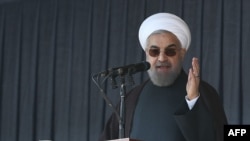
After being subjected to relentless attacks by conservatives for months, Iran's president has finally dropped his soft line and lashed out at his critics.
In a remarkable speech on January 4, Hassan Rohani called for taxing huge economic enterprises and conglomerates that currently are exempted from taxation but constitute close to half of Iran's economic turnover. Rohani also criticized the monopolistic nature of these enterprises, calling for an open and competitive economic system.
Who controls these monopolistic enterprises? Mostly, it's the Islamic Revolutionary Guards Corps (IRGC) and clerical circles who have been opposing a nuclear deal, making clear that his message was for them.
And lest there be any doubts about his seriousness, he added a completely new and potentially destabilizing twist -- implying that if his opponents did not see things his way he would propose holding national referendums on important issues.
A substantial segment of Iranian society opposed to the Islamic system, to various degrees, has long been talking about such referendums. So it is no small thing when the magic word is uttered by the president himself. The suggestion that Iranians themselves should have a direct say in important matters can be taken not only as a challenge and a threat to the conservatives, especially the IRGC, but also as an indirect jab at the authority of Supreme Leader Ayatollah Ali Khamenei.
So why would Rohani choose now to strike? It is impossible to know for sure -- or even to accurately measure the degree of his reformist convictions. But one thing is certain: Iran's economy is in a big black hole and Rohani has not only taken responsibility for saving it, but also by extension the country. This is to say nothing of the regime, whose protection is certainly an issue, considering the enormity of the problems faced by Iran; but at the moment, maintaining the internal peace and integrity of the country is of the highest priority.
The tough, U.S.-led sanctions, put in place more than three years ago, had a devastating impact on Iran's economy and triggered the election of Rohani, who was seen as a pragmatist willing and able to cut a nuclear deal. There is no doubt that the supreme leader gave his nod of approval for negotiations, hoping to get rid of the sanctions by making minimum concessions to the West. These were the terms and conditions under which Rohani embarked on his journey as president. But the negotiations have lasted for close to 18 months now under Rohani's presidency without any concrete signs of an agreement. The conservatives have harshly criticized and reacted to any hint of compromise and tried to erect roadblocks at every turn. In the nuclear negotiations, this may have been a useful card for Khamenei to play in trying to avoid making too many concessions.
In the meantime, oil prices have collapsed, making it very hard for the regime simply to muddle through in the hope that it can somehow break the sanctions. Rohani in particular, being responsible for disbursing cash subsidies and salaries to the huge state sector, has found himself facing a brick wall. As any educated and well-informed Iranian knows, an economy mired in inefficiency and corruption can hardly weather the two-front storm of sanctions and low oil prices. Rohani's coffers are getting low and he cannot simply print money.
These factors can only suggest why Rohani chose now to lash out at his detractors, but there is no question he has significantly raised the stakes.
He is not just defending the need for a nuclear compromise but questioning the very economic system that, to this point, was able to ensure the armed support of hundreds of thousands of IRGC and Basiji forces.
One need only look to the scenes that unfolded in Tehran in the summer of 2009, during which those forces brutally crushed anti-regime protests, to serve as a reminder of the dangers of alienating the IRGC.
Rohani, a man of the system, has presumably opted to use inflammatory speech, which has the potential benefit of coaxing conservatives into accepting nuclear concessions.
The question now is whether he is a committed reformer who wants to fundamentally change the economic -- and perhaps to an extent the political and social -- foundations of the Islamic Republic, or simply a pragmatist who wants to silence critics and get his nuclear deal.
Those of us old enough to remember the 1980s can reminisce about a figure in history who started reforms he could not control: Mikhail Gorbachev.
Recalling the way Gorbachev's reformist quest ended, it is not so important what Rohani really believes. What is most significant is that he is being propelled to confront detractors within the regime. This, by itself, carries the risk of unforeseen consequences for the Islamic system.