




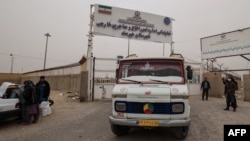
Iran's vast and restive southeastern province of Sistan-Baluchistan, located along the border with Afghanistan and Pakistan, has witnessed a deadly flare-up of violence in recent weeks.
Armed groups and Iranian security forces have clashed almost daily across the impoverished province, the site of a decades-long, low-level insurgency.
Separatist groups and Islamist militants in Sistan-Baluchistan, home to Iran's marginalized ethnic Baluch minority, are increasingly coordinating their efforts to challenge the Iranian state, experts say.
The intensifying insurgency has compounded the security threats facing Iran, which remains at war with the United States and Israel and braces for a possible resumption of major US combat operations.
"The renewed attacks in Sistan-Baluchistan come at a time when the Islamic republic is facing unprecedented military and economic pressure," said Hamidreza Azizi, senior Iran analyst at the Brussels-based International Crisis Group.
"What makes the situation more concerning for Tehran is the possibility that localized insurgent activity could become part of a broader security challenge," he added.
Spate Of Attacks
Baluch armed groups have claimed responsibility for a series of hit-and-run attacks, deadly roadside bombs, and shootings targeting the Islamic Revolutionary Guards Corps (IRGC), the elite branch of Iran's armed forces, the Basij paramilitary force, and local police across the province in recent weeks.
On October 14, a police officer and local Basij commander were killed in separate attacks in the town of Mehrestan, Iranian media reported.
A day earlier, the IRGC said one of its members was killed after a hostage-taking attempt triggered clashes in Zahedan, the provincial capital of Sistan-Baluchistan. Also on October 13, gun battles between gunmen and the IRGC broke out in the town of Taftan.
In response, the authorities have stepped up security operations in the province, including preemptive raids on suspected insurgent cells, underscoring the growing threat.
Iran also executed a prominent Baluch militant on October 11. Omar Dorostaran had been convicted of armed rebellion, membership in a terrorist group, and complicity in an armed uprising.
Iranian Foreign Ministry spokesman Esmaeil Baqaei on October 12 claimed that "terrorist groups" operating in the area were acting on "plans devised by Israel and the United States to destabilize the country's borders."
Azizi of the International Crisis Group said Iranian officials increasingly fear that their adversaries may try to exploit existing ethnic and political grievances to open new fronts inside the country.
"Tehran appears determined to prevent a longstanding security problem from developing into a more serious vulnerability during a potential new war," he said.
Sistan-Baluchistan, Iran's second largest province and roughly the same size as Syria, is particularly strategic and sensitive.
It borders Taliban-ruled Afghanistan and Pakistan's Balochistan Province, which has also been the scene of a decades-long insurgency.
Sistan-Baluchistan is also home to Chabahar, Iran's only port with direct access to the open ocean. It allows Iran to bypass the Strait of Hormuz, a major flashpoint in the war with the United States and Israel.
Militants Merge
In December 2025, four separate armed Baluch groups joined forces under the Mobarizoun Popular Front, signaling closer coordination among militant factions.
The umbrella group includes Jaish al-Adl, a Baluch separatist militant group that is designated as a terrorist organization by Iran and the United States.
Believed to be operating out of Pakistan, Jaish al-Adl is the most potent Baluch armed group fighting Tehran. Iran has accused the United States and Israel of arming the group.
"The Iranian government is currently facing multiple pressures at home and abroad, and naturally, armed groups may have come to the conclusion that they have found a good opportunity to expand their operations," said Fatemeh Aman, a US-based Iran analyst.
"If these attacks become coordinated, sustained, and continuous, they could pose a more serious security challenge for the government," Aman told RFE/RL's Radio Farda.
Experts say armed groups are exploiting the longstanding grievances of the Baluch minority, many of whom are Sunni Muslims in Shi'a-majority Iran. The group has long faced disproportionate discrimination and violence at the hands of the authorities.
Baluch make up around 5 percent of Iran's population of some 90 million. But they account for around 20 percent of all executions in the country.
During the nationwide antiestablishment protests that rocked Iran in 2022, Sistan-Baluchistan was the scene of the deadliest government crackdown. On September 30 that year, referred to as "Bloody Friday," nearly 100 protesters were gunned down.
Poverty, religious and ethnic discrimination, and lack of political representation have "created a basis for deep dissatisfaction in the province," said Aman.
"The government's largely security-based approach to the demands of the Baloch people has also contributed to the spread of this distrust," she added.