




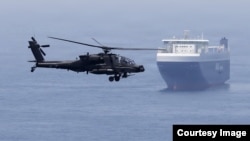
The flow of crude from the Persian Gulf has recovered to near-prewar levels, but the latest data shows that much of the oil is reaching markets through routes and shipping arrangements that did not exist before the war, raising the question as to whether Iran is losing its leverage in the Strait of Hormuz.
At least 16.5 million barrels per day of crude left the region between September 1 and 28, matching the prewar average when Iran is excluded, according to commodity analytics firm Kpler.
But while crude levels have risen, the refinery bottleneck that has caused a global spike in diesel prices persists. European Union figures published on October 1 showed diesel pump prices at record levels. Prices have also surged in the United States despite the recovery in oil exports.
The route, meanwhile, has changed dramatically.
Before the war, 83 percent of the region's crude crossed the Strait of Hormuz. In September, 40 percent bypassed the strait, with oil instead moving through pipelines and other routes via Saudi Arabia and the United Arab Emirates. About 60 percent, or 9.9 million barrels per day, physically crossed Hormuz.
Kpler said more than 70 percent of the crude that crossed the strait in August -- the most recent month available -- changed tankers offshore in the Gulf of Oman, highlighting how far the current system is from normal commercial shipping.
For Iran, the recovery is a sign that its ability to disrupt the waterway has been significantly degraded.
Mohammad Ghaedi, a lecturer at George Washington University, told RFE/RL's Radio Farda that the current level of traffic was already too much for Tehran and "unacceptable" to authorities there.
But the figures do not mean Iran has simply lost control of Hormuz. Tehran never formally controlled the strait in the first place. Its leverage has instead rested on its ability to make the passage dangerous, forcing shipping companies to weigh the risks and costs of entering the Gulf.
That ability appears to have weakened as US forces provide protection for commercial shipping and companies develop ways to move oil while limiting their exposure to the strait.
Ellen R. Wald, author and energy markets analyst, told RFE/RL that Iran's "ability and/or will to attack ships in the Gulf is declining," allowing vessels to transit under US military cover.
But she cautioned that the recovery in flows should not be mistaken for a return to normalcy.
Some shipping companies are accepting significant risks to effectively ferry oil through the strait to larger tankers waiting outside the Gulf. Others are operating without insurance or under unusually difficult conditions.
"This is not a return to normal," Wald said. "These are significant risks and come with high costs."

And that is why oil prices aren't dropping much despite oil flows increasing.
War Premium
The rebound in crude flows has reduced some of the immediate pressure on global supplies, but Wald does not expect oil prices to return to prewar levels yet. The continued threat to vessels, elevated insurance costs, and dependence on US military protection mean that a "war premium" remains embedded in the price of oil.
The latest Kpler figures also show why the recovery in exports should not be confused with the restoration of the old Gulf oil-trading system.
Before the war, almost all of the region's crude exports depended on Hormuz. Now, pipelines, Red Sea routes, and offshore ship-to-ship transfers are helping producers circumvent the chokepoint. Kpler said the region's export system has effectively been rebuilt around the disruption.

The more oil that moves without being stopped, the weaker Tehran's ability to use Hormuz as a coercive tool becomes. But the extraordinary measures required to keep that oil moving also demonstrate that the strait remains a source of leverage.
Ghaedi said he does not believe Iran is likely to attack regional energy infrastructure, despite commentary from Tehran it could escalate by targeting oil facilities. He argued that reports portraying Iran as having lost control of Hormuz could themselves risk provoking such a response.
For now, however, the evidence points to a gradual erosion rather than a complete disappearance of Iranian leverage. And as long as ships still require military protection, unusual routing and costly workarounds to move that oil, Hormuz remains a vulnerability for Washington, even if Iran is no longer able to exercise the same degree of pressure over it that it did at the height of the war.