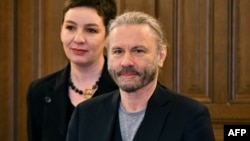
Iron Maiden frontman Bruce Dickinson attends a ceremony to make him an honorary citizen of Sarajevo on April 6.
Bruce Dickinson, frontman of the legendary heavy metal band Iron Maiden, has been made an honorary citizen of Sarajevo a quarter of a century after he played a concert when the city was under siege during the bloody breakup of Yugoslavia.
The Bosnian capital bestowed the honor on the rock icon on April 6 at a ceremony during a commemoration of the city's liberation in World War II and the 1992 start of the Bosnian Serb siege that killed about 11,000 people, including some 1,500 children.
Dickinson's concert in the Bosnian capital in 1994 "was one of those moments when we in Sarajevo realized we will survive," said City Mayor Abdulah Skaka.
During the siege of Sarajevo, hundreds of thousands of people were bombed and shot at by Bosnian Serb forces from surrounding hills and kept without food, water, and electricity for nearly four years.
The Siege Of Sarajevo
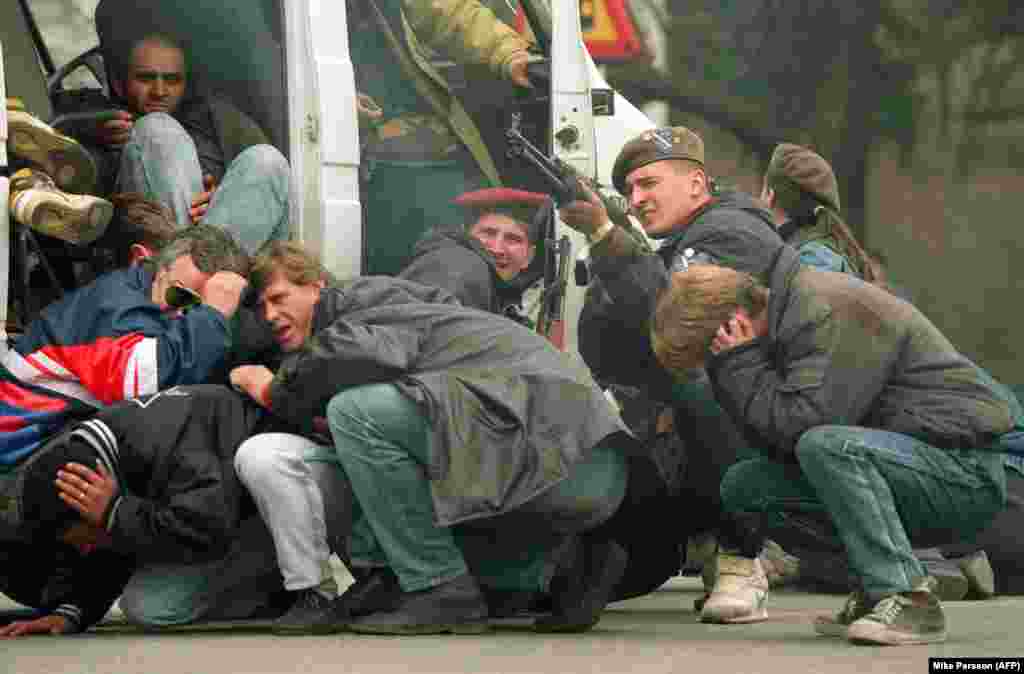
1/15In an iconic picture that captures the opening moments of the siege, a Bosnian soldier takes aim to return fire after Serb gunmen shot into a crowd of peace demonstrators on April 6, 1992.
April 5 marks 25 years since the first casualties in what would turn out to be a 1,425-day siege of the Bosnian capital, Sarajevo, by Bosnian Serb forces. More than 10,000 residents died as a result of shelling or other aspects of the blockade, the longest siege of any capital city in the history of modern warfare.
Show moreShow less
2/15A tower burns in downtown Sarajevo on June 8, 1992, as paramilitary groups in the surrounding hills fire mortars and artillery down on the blockaded city.
April 5 marks 25 years since the first casualties in what would turn out to be a 1,425-day siege of the Bosnian capital, Sarajevo, by Bosnian Serb forces. More than 10,000 residents died as a result of shelling or other aspects of the blockade, the longest siege of any capital city in the history of modern warfare.
Show moreShow less
3/15A man cradles the head of a woman badly injured by shelling in Sarajevo on June 27, 1992.
April 5 marks 25 years since the first casualties in what would turn out to be a 1,425-day siege of the Bosnian capital, Sarajevo, by Bosnian Serb forces. More than 10,000 residents died as a result of shelling or other aspects of the blockade, the longest siege of any capital city in the history of modern warfare.
Show moreShow less
4/15An injured girl in a Sarajevo hospital on August 3, 1992. A United Nations report concluded that at the height of the siege, more than 3,000 shells were falling on the city each day.
April 5 marks 25 years since the first casualties in what would turn out to be a 1,425-day siege of the Bosnian capital, Sarajevo, by Bosnian Serb forces. More than 10,000 residents died as a result of shelling or other aspects of the blockade, the longest siege of any capital city in the history of modern warfare.
Show moreShow less
5/15A family cutting firewood nearly one year into the siege in the hills that surround the city, which together with surrounding areas had a population of around 525,000 before the blockade.
April 5 marks 25 years since the first casualties in what would turn out to be a 1,425-day siege of the Bosnian capital, Sarajevo, by Bosnian Serb forces. More than 10,000 residents died as a result of shelling or other aspects of the blockade, the longest siege of any capital city in the history of modern warfare.
Show moreShow less
6/15Bosnian Serb soldiers patrol a mountain road to prevent Bosnian troops from breaking through to Sarajevo on April 17, 1994.
April 5 marks 25 years since the first casualties in what would turn out to be a 1,425-day siege of the Bosnian capital, Sarajevo, by Bosnian Serb forces. More than 10,000 residents died as a result of shelling or other aspects of the blockade, the longest siege of any capital city in the history of modern warfare.
Show moreShow less
7/15A man calls for help for one of the casualties of a mortar explosion.
April 5 marks 25 years since the first casualties in what would turn out to be a 1,425-day siege of the Bosnian capital, Sarajevo, by Bosnian Serb forces. More than 10,000 residents died as a result of shelling or other aspects of the blockade, the longest siege of any capital city in the history of modern warfare.
Show moreShow less
8/15A man mourns his wife in one of Sarajevo's ever-expanding cemeteries in 1993.
April 5 marks 25 years since the first casualties in what would turn out to be a 1,425-day siege of the Bosnian capital, Sarajevo, by Bosnian Serb forces. More than 10,000 residents died as a result of shelling or other aspects of the blockade, the longest siege of any capital city in the history of modern warfare.
Show moreShow less
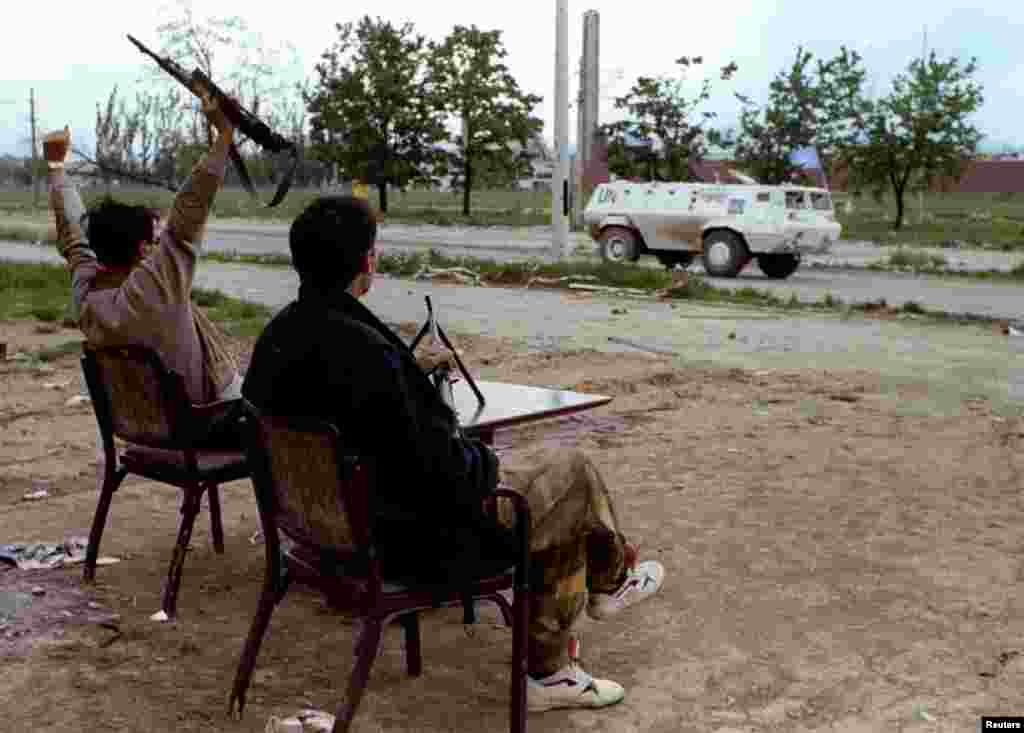
9/15Bosnian soldiers wave to a passing UN vehicle near Sarajevo airport on May 14, 1993. The UN airlift to the Bosnian capital, called Operation Provide Promise, lasted from July 1992 to January 1996, making it the longest-running humanitarian airlift in history.
April 5 marks 25 years since the first casualties in what would turn out to be a 1,425-day siege of the Bosnian capital, Sarajevo, by Bosnian Serb forces. More than 10,000 residents died as a result of shelling or other aspects of the blockade, the longest siege of any capital city in the history of modern warfare.
Show moreShow less
10/15A house burning in Sarajevo after a direct hit from a mortar in 1994. A UN commission concluded in 1994, with the siege still continuing, that property damage "includes specifically protected targets such as hospitals and medical complexes, medical facilities...medical personnel, as well as cultural property" and tens of thousands of apartments.
April 5 marks 25 years since the first casualties in what would turn out to be a 1,425-day siege of the Bosnian capital, Sarajevo, by Bosnian Serb forces. More than 10,000 residents died as a result of shelling or other aspects of the blockade, the longest siege of any capital city in the history of modern warfare.
Show moreShow less
11/15A young couple runs across the infamous Sniper Alley in Sarajevo in 1995. Snipers in the surrounding hills, combined with the relentless mortar rounds bursting on the streets, made even a trip to collect water a perilous task during the 44 months of the siege.
April 5 marks 25 years since the first casualties in what would turn out to be a 1,425-day siege of the Bosnian capital, Sarajevo, by Bosnian Serb forces. More than 10,000 residents died as a result of shelling or other aspects of the blockade, the longest siege of any capital city in the history of modern warfare.
Show moreShow less
12/15French cardinal Roger Etchegaray (left) and Bosnian cardinal Vinko Puljc in Sarajevo on August 15, 1995. Cardinal Etchegaray brought a message from Pope John Paul II of solidarity with Sarajevans.
April 5 marks 25 years since the first casualties in what would turn out to be a 1,425-day siege of the Bosnian capital, Sarajevo, by Bosnian Serb forces. More than 10,000 residents died as a result of shelling or other aspects of the blockade, the longest siege of any capital city in the history of modern warfare.
Show moreShow less
13/15Civilians injured by a mortar in Sarajevo's central market await treatment in a hospital corridor on February 5, 1994. The woman at left died before doctors could attend to her.
April 5 marks 25 years since the first casualties in what would turn out to be a 1,425-day siege of the Bosnian capital, Sarajevo, by Bosnian Serb forces. More than 10,000 residents died as a result of shelling or other aspects of the blockade, the longest siege of any capital city in the history of modern warfare.
Show moreShow less
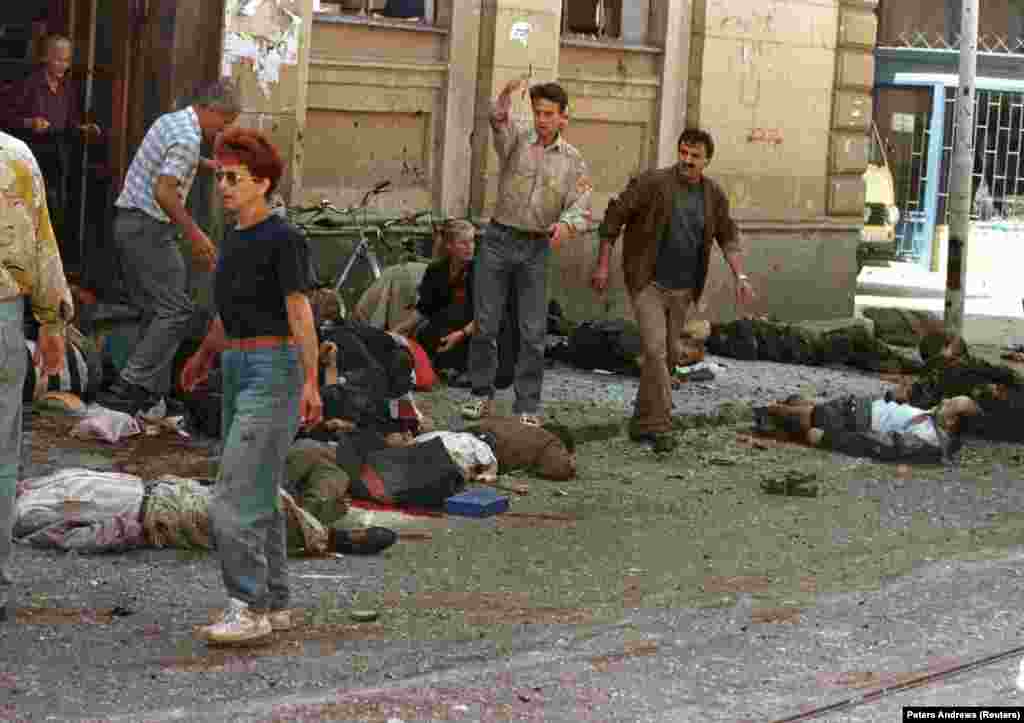
14/15The scene after mortars slammed into the crowded Markale marketplace in central Sarajevo on August 28, 1995. Forty-three people died in this, the second of two deliberate attacks on the market that came to be known as the Markale Massacres. The August shelling was among the reasons cited for NATO's bombing of Bosnian Serb forces, which started later the same month.
April 5 marks 25 years since the first casualties in what would turn out to be a 1,425-day siege of the Bosnian capital, Sarajevo, by Bosnian Serb forces. More than 10,000 residents died as a result of shelling or other aspects of the blockade, the longest siege of any capital city in the history of modern warfare.
Show moreShow less
15/15A Serb woman sells goods in a market as a shop burns behind her in Ilidzia, a Serb-held suburb of Sarajevo on March 9, 1996, three days before it was due to come under Croat and Muslim rule.
April 5 marks 25 years since the first casualties in what would turn out to be a 1,425-day siege of the Bosnian capital, Sarajevo, by Bosnian Serb forces. More than 10,000 residents died as a result of shelling or other aspects of the blockade, the longest siege of any capital city in the history of modern warfare.
Show moreShow less
Previous slide
Next slide
One night in December 1994, Dickinson, with the aid of United Nations soldiers, slipped into Sarajevo and played a concert with his solo band, Skunkworks.
The story of the band’s journey to a city cut off from the world, and the concert itself, was immortalized in the 2017 film "Scream For Me Sarajevo."
"While this is a great honor, I think that this award belongs equally to the people of Sarajevo who are still here," Dickinson said in accepting the award.
In his 2017 autobiography "What Does This Button Do?" Dickinson described the scene in Sarajevo as "intense" and life altering.
"We weren't protected, there was no plan and the bullets were real, but…we went anyway," he wrote.
"It changed the way I viewed life, death and other human beings."
RFE/RL journalists report the news in 24 languages in 18 countries where a free press is banned by the government or not fully established. We provide what many people cannot get locally: uncensored news, responsible discussion, and open debate.