


Accessibility links

Breaking News

Land Mine Kills Officer As Search Continues For Armenian, Azerbaijani Missing

Members of a mine-clearing survey team examine unexploded items of ordnance in the war-torn Nagorno-Karabakh region earlier this month.

A land mine reportedly killed an Azerbaijani officer and wounded several ethnic Armenian officials and a Russian peacekeeper in Nagorno-Karabakh on November 23, in the latest reminder of lingering obstacles to identifying the dead two weeks after a cease-fire between archfoes Armenia and Azerbaijan.

Around 2,000 Russian troops moved into areas in and around Nagorno-Karabakh earlier this month as part of the Moscow-brokered truce that ended six weeks of heavy fighting in the 30-year-old conflict that is thought to have killed thousands.
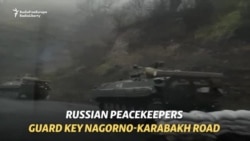
Russian Peacekeepers Guard Key Nagorno-Karabakh Road
please wait

No media source currently available

0:00 0:03:13 0:00

The Russian Defense Ministry announced the land-mine incident.

It said a group of its peacekeepers, Azerbaijani troops, ethnic Armenians from the area's de facto leadership, and International Committee of the Red Cross representatives were searching for the bodies of missing soldiers in the Tartar district northeast of Nagorno-Karabakh when the mine exploded.

An Azerbaijani officer died in the blast, near the community of Madagiz, four emergency-situations officials from the breakaway ethnic Armenian side were lightly injured, and the Russian peacekeeper taken to a Baku hospital for treatment.

There was no initial confirmation from the Azerbaijani or Armenian side.

Azerbaijan has consistently refused to report military casualties since the fighting flared up on September 27 and quickly escalated into an Azerbaijani offensive.

Baku's forces retook swaths of territory controlled by ethnic Armenians for decades but internationally recognized as part of Azerbaijan.

The cease-fire that went into effect on November 10 left most of those gains under Baku's control and mandated that ethnic Armenian forces withdraw from all seven districts around Nagorno-Karabakh in what was seen by many Armenians as a national defeat.
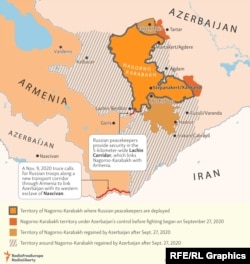
Yerevan announced on November 23 that it continued the handover of around 120 towns, villages, and settlements in the area.

Families on both sides of the conflict have complained of a lack of information about soldiers missing and in many cases believed to have been killed in combat.

Yerevan has announced the discovery or handover of the bodies of around 350 soldiers in the last several days.

But in the Armenian capital, Yerevan, family members gathered outside the Defense Ministry on November 23 to demand information about the whereabouts of dozens of troops still missing.

"We come here so a representative of a state body -- whether a minister or a military man -- comes and gives us an answer so we learn at least some information -- what's happening," said one of the women seeking information about her son. "We understand that there was a war, but they ignore us -- all of us parents."

Azerbaijani families have also complained of similar official failures, exacerbated by a culture of state secrecy in the tightly controlled country of around 10 million people, with some families appealing on social media for answers.

The district of Agdam was handed over on November 20.
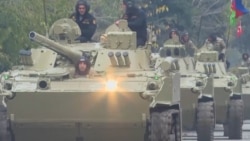
Azerbaijani Army Rolls Into Agdam, A Day After Armenians Move Out
please wait

No media source currently available

0:00 0:02:41 0:00

Ethnic Armenian forces are slated to hand over two more districts in the next week, with thousands more residents likely to flee, in many cases taking all their belongings and torching buildings in the process.

Karvachar (which Azeris call Kelbacar), wedged between Nagorno-Karabakh and Armenia, was slated for handover after a weeklong delay on November 25. The district of Kashatagh (which Azeris call Lachin), west of Nagorno-Karabakh, is scheduled for handover by December 1.

As the withdrawal continues by ethnic Armenians who have in many cases lived for decades or generations in the lands, a path to a permanent peace still appears fraught.

Scorched Earth: Ethnic Armenians Destroy Homes, Infrastructure Before Fleeing Azerbaijani Regions

Residents watch houses smolder in Charektar village, known in Azeri as Caraktar, in the district of Karvachar (Kalbacar in Azeri). The mountainous district in Azerbaijan to the west of Nagorno-Karabakh is being vacated by Armenians and returned to Baku’s control under a Russian-brokered truce.
1/18 Residents watch houses smolder in Charektar village, known in Azeri as Caraktar, in the district of Karvachar (Kalbacar in Azeri). The mountainous district in Azerbaijan to the west of Nagorno-Karabakh is being vacated by Armenians and returned to Baku’s control under a Russian-brokered truce.
Many ethnic Armenians who are fleeing the regions around Azerbaijan’s breakaway region of Nagorno-Karabakh have opted to destroy their homes after removing as much as they can carry. The destruction comes ahead of a scheduled handover to Azerbaijan of territory seized by Armenians during a war in the early 1990s.
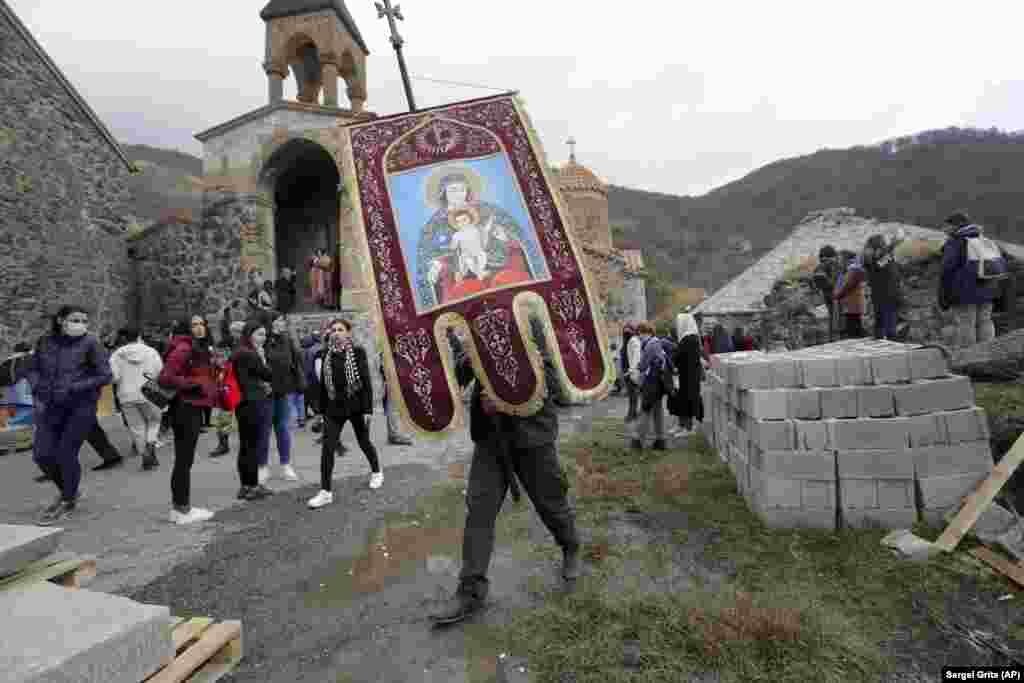
An Armenian church worker carries a religious pennant out of the Dadivank monastery in the district of Karvachar/Kalbacar.
2/18 An Armenian church worker carries a religious pennant out of the Dadivank monastery in the district of Karvachar/Kalbacar.
Many ethnic Armenians who are fleeing the regions around Azerbaijan’s breakaway region of Nagorno-Karabakh have opted to destroy their homes after removing as much as they can carry. The destruction comes ahead of a scheduled handover to Azerbaijan of territory seized by Armenians during a war in the early 1990s.
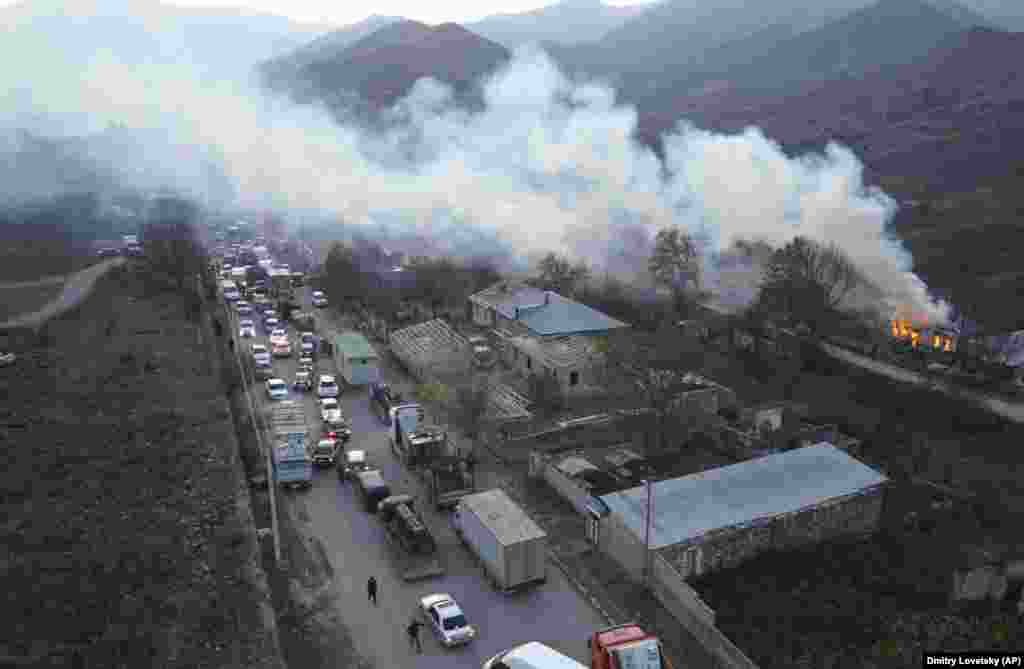
Smoke from a burning house drifts over a traffic jam as ethnic Armenians flee Karvachar/Kalbacar – which is internationally recognized as part of Azerbaijan. Ethnic Armenians point to ancient Christian monuments in the area that mark their historic ties to the land.
3/18 Smoke from a burning house drifts over a traffic jam as ethnic Armenians flee Karvachar/Kalbacar – which is internationally recognized as part of Azerbaijan. Ethnic Armenians point to ancient Christian monuments in the area that mark their historic ties to the land.
Many ethnic Armenians who are fleeing the regions around Azerbaijan’s breakaway region of Nagorno-Karabakh have opted to destroy their homes after removing as much as they can carry. The destruction comes ahead of a scheduled handover to Azerbaijan of territory seized by Armenians during a war in the early 1990s.
A burnt-out gas station near the Dadivank monastery in the district of Karvachar/Kalbacar. Hundreds of thousands of Azerbaijanis were forced to flee their homes in districts around Nagorno-Karabakh when Yerevan-backed Armenian separatists seized control of the territory during the early 1990s.
4/18 A burnt-out gas station near the Dadivank monastery in the district of Karvachar/Kalbacar. Hundreds of thousands of Azerbaijanis were forced to flee their homes in districts around Nagorno-Karabakh when Yerevan-backed Armenian separatists seized control of the territory during the early 1990s.
Many ethnic Armenians who are fleeing the regions around Azerbaijan’s breakaway region of Nagorno-Karabakh have opted to destroy their homes after removing as much as they can carry. The destruction comes ahead of a scheduled handover to Azerbaijan of territory seized by Armenians during a war in the early 1990s.
Ethnic Armenian soldiers topple a telephone pole in the village of Knaravan – a settlement recently built by ethnic Armenians in the Karvachar/Kalbacar district near Azerbaijan’s border with Armenia.
5/18 Ethnic Armenian soldiers topple a telephone pole in the village of Knaravan – a settlement recently built by ethnic Armenians in the Karvachar/Kalbacar district near Azerbaijan’s border with Armenia.
Many ethnic Armenians who are fleeing the regions around Azerbaijan’s breakaway region of Nagorno-Karabakh have opted to destroy their homes after removing as much as they can carry. The destruction comes ahead of a scheduled handover to Azerbaijan of territory seized by Armenians during a war in the early 1990s.
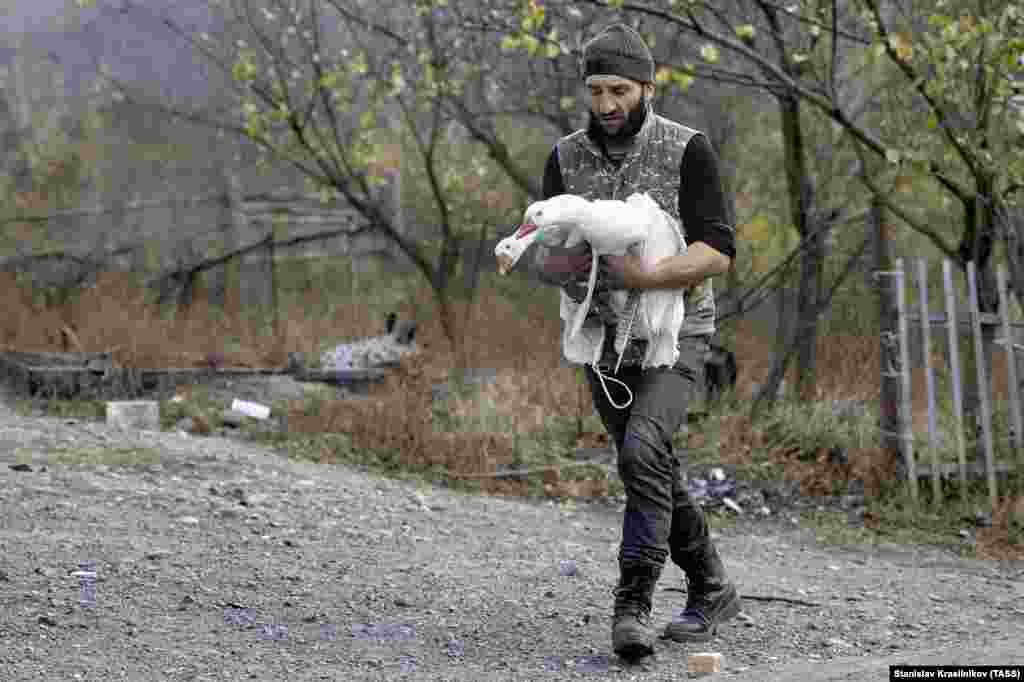
An ethnic Armenian man carries two geese as he packs up the contents of his home in the village of Charektar/Caraktar.
6/18 An ethnic Armenian man carries two geese as he packs up the contents of his home in the village of Charektar/Caraktar.
Many ethnic Armenians who are fleeing the regions around Azerbaijan’s breakaway region of Nagorno-Karabakh have opted to destroy their homes after removing as much as they can carry. The destruction comes ahead of a scheduled handover to Azerbaijan of territory seized by Armenians during a war in the early 1990s.
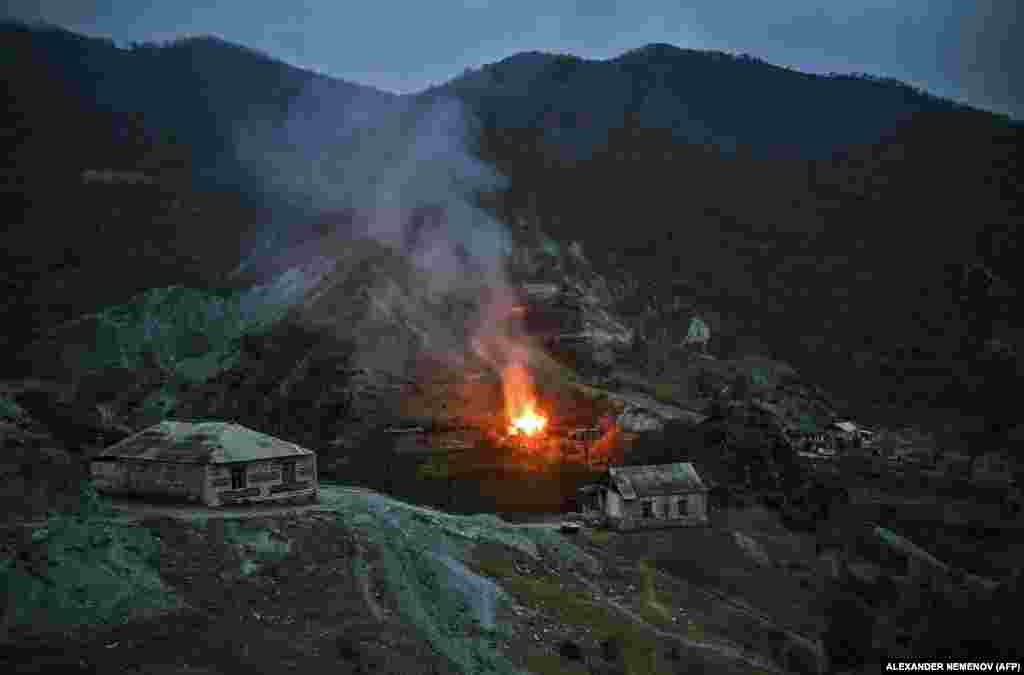
A house burns into the night in the district of Karvachar/Kalbacar.
7/18 A house burns into the night in the district of Karvachar/Kalbacar.
Many ethnic Armenians who are fleeing the regions around Azerbaijan’s breakaway region of Nagorno-Karabakh have opted to destroy their homes after removing as much as they can carry. The destruction comes ahead of a scheduled handover to Azerbaijan of territory seized by Armenians during a war in the early 1990s.
A home smolders in Charektar/Caraktar village.
8/18 A home smolders in Charektar/Caraktar village.
Many ethnic Armenians who are fleeing the regions around Azerbaijan’s breakaway region of Nagorno-Karabakh have opted to destroy their homes after removing as much as they can carry. The destruction comes ahead of a scheduled handover to Azerbaijan of territory seized by Armenians during a war in the early 1990s.
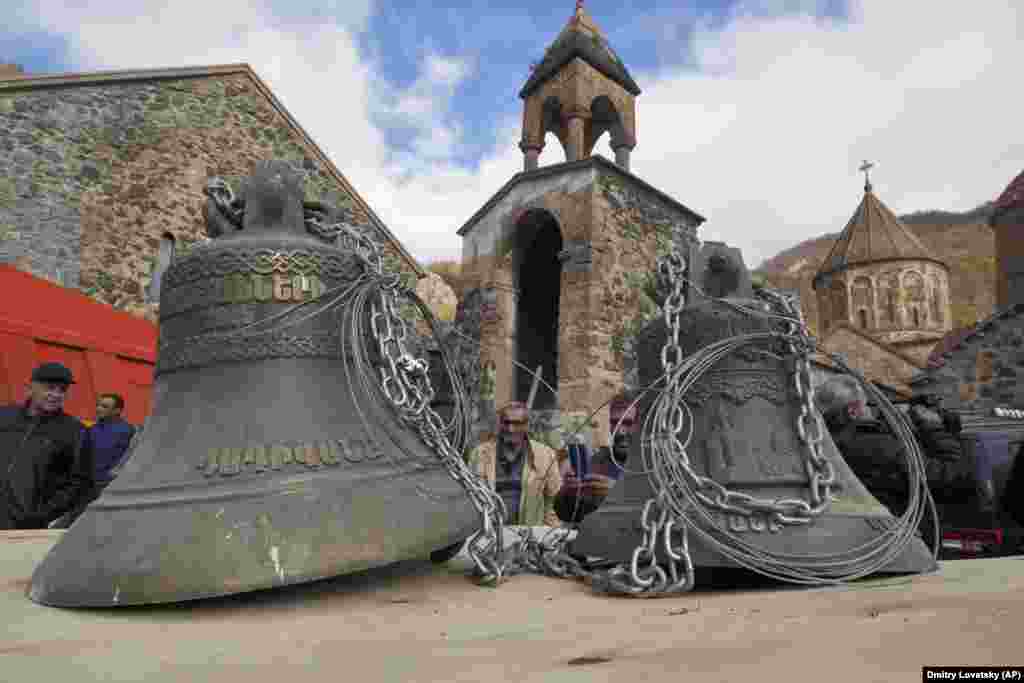
Bells removed from Dadivank monastery await transport to Armenia as preparations are made for ethnic Armenians to transfer control of the Karvachar/Kalbacar district back to Azerbaijan.
9/18 Bells removed from Dadivank monastery await transport to Armenia as preparations are made for ethnic Armenians to transfer control of the Karvachar/Kalbacar district back to Azerbaijan.
Many ethnic Armenians who are fleeing the regions around Azerbaijan’s breakaway region of Nagorno-Karabakh have opted to destroy their homes after removing as much as they can carry. The destruction comes ahead of a scheduled handover to Azerbaijan of territory seized by Armenians during a war in the early 1990s.
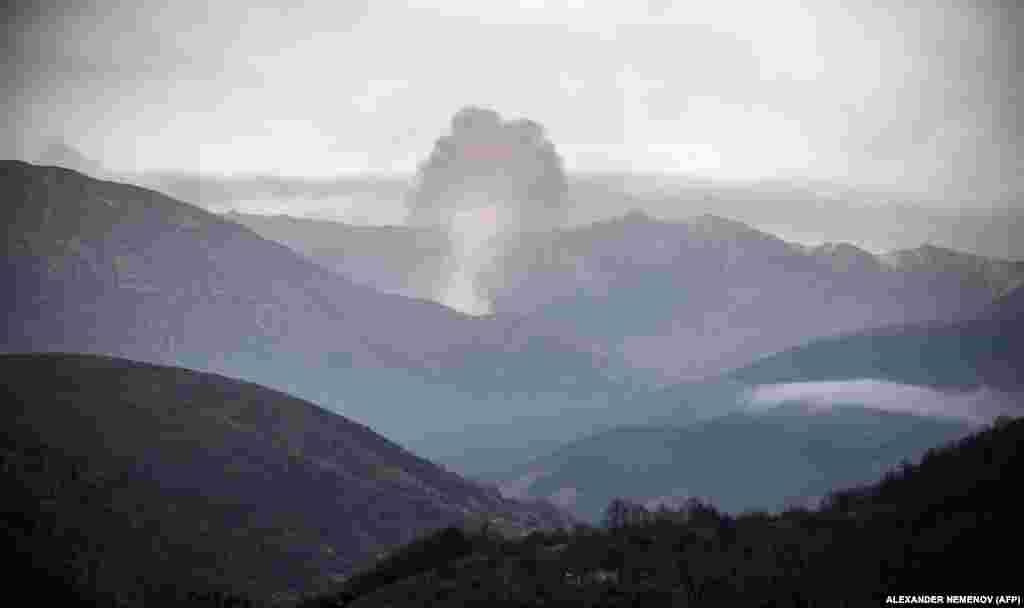
Smoke rises from buildings set ablaze in the Karvachar/Kalbacar district of Azerbaijan as ethnic Armenians leave the area.
10/18 Smoke rises from buildings set ablaze in the Karvachar/Kalbacar district of Azerbaijan as ethnic Armenians leave the area.
Many ethnic Armenians who are fleeing the regions around Azerbaijan’s breakaway region of Nagorno-Karabakh have opted to destroy their homes after removing as much as they can carry. The destruction comes ahead of a scheduled handover to Azerbaijan of territory seized by Armenians during a war in the early 1990s.
A man removes wiring from a telephone pole in the village of Yekhetnut in the district of Karvachar/Kalbacar.
11/18 A man removes wiring from a telephone pole in the village of Yekhetnut in the district of Karvachar/Kalbacar.
Many ethnic Armenians who are fleeing the regions around Azerbaijan’s breakaway region of Nagorno-Karabakh have opted to destroy their homes after removing as much as they can carry. The destruction comes ahead of a scheduled handover to Azerbaijan of territory seized by Armenians during a war in the early 1990s.
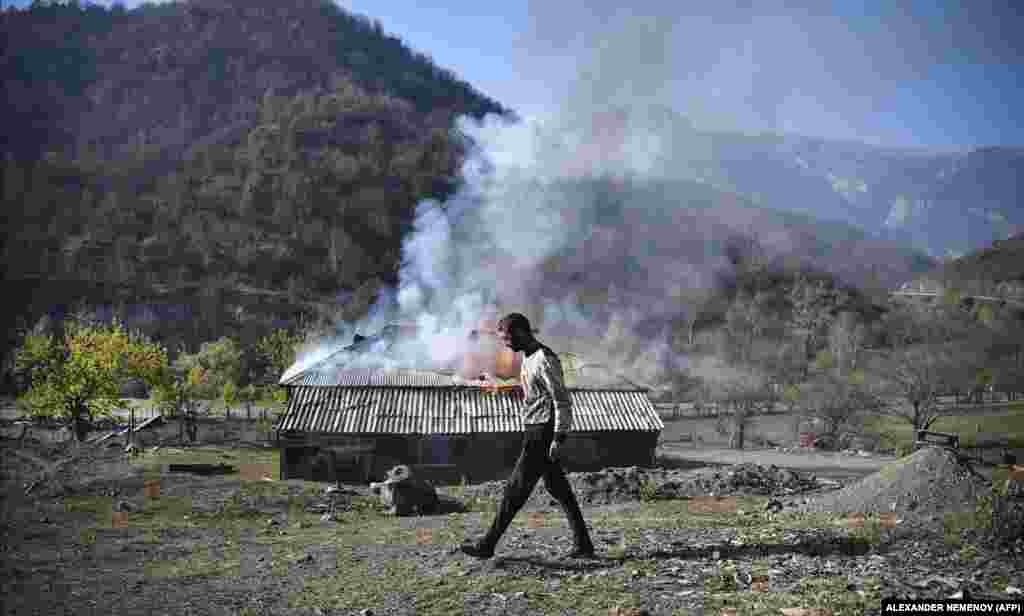
A man walks past a burning house in Charektar/Caraktar village.
12/18 A man walks past a burning house in Charektar/Caraktar village.
Many ethnic Armenians who are fleeing the regions around Azerbaijan’s breakaway region of Nagorno-Karabakh have opted to destroy their homes after removing as much as they can carry. The destruction comes ahead of a scheduled handover to Azerbaijan of territory seized by Armenians during a war in the early 1990s.
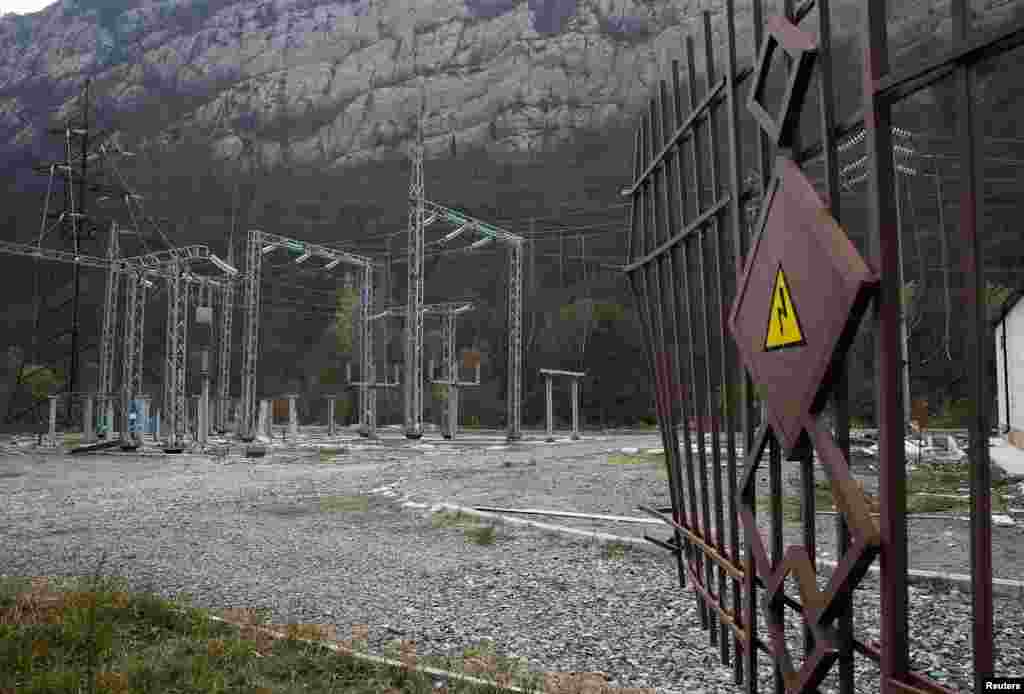
An electrical substation in Karvachar/Kalbacar after key components were removed.
13/18 An electrical substation in Karvachar/Kalbacar after key components were removed.
Many ethnic Armenians who are fleeing the regions around Azerbaijan’s breakaway region of Nagorno-Karabakh have opted to destroy their homes after removing as much as they can carry. The destruction comes ahead of a scheduled handover to Azerbaijan of territory seized by Armenians during a war in the early 1990s.
Garo Dadevusian (right) salvages the tin roof from his house in Karvachar/Kalbacar before setting the building ablaze.
14/18 Garo Dadevusian (right) salvages the tin roof from his house in Karvachar/Kalbacar before setting the building ablaze.
Many ethnic Armenians who are fleeing the regions around Azerbaijan’s breakaway region of Nagorno-Karabakh have opted to destroy their homes after removing as much as they can carry. The destruction comes ahead of a scheduled handover to Azerbaijan of territory seized by Armenians during a war in the early 1990s.
A woman carries a Christian painting out of her home before fleeing Karvachar/Kalbacar.
15/18 A woman carries a Christian painting out of her home before fleeing Karvachar/Kalbacar.
Many ethnic Armenians who are fleeing the regions around Azerbaijan’s breakaway region of Nagorno-Karabakh have opted to destroy their homes after removing as much as they can carry. The destruction comes ahead of a scheduled handover to Azerbaijan of territory seized by Armenians during a war in the early 1990s.
Ethnic Armenians in a truck pass houses destroyed in the recently built ethnic-Armenian settlement of Knaravan before control of the Karvachar/Kalbacar district is returned to Azerbaijan.
16/18 Ethnic Armenians in a truck pass houses destroyed in the recently built ethnic-Armenian settlement of Knaravan before control of the Karvachar/Kalbacar district is returned to Azerbaijan.
Many ethnic Armenians who are fleeing the regions around Azerbaijan’s breakaway region of Nagorno-Karabakh have opted to destroy their homes after removing as much as they can carry. The destruction comes ahead of a scheduled handover to Azerbaijan of territory seized by Armenians during a war in the early 1990s.
A dog in front of a burnt-out school building in Charektar/Caraktar.
17/18 A dog in front of a burnt-out school building in Charektar/Caraktar.
Many ethnic Armenians who are fleeing the regions around Azerbaijan’s breakaway region of Nagorno-Karabakh have opted to destroy their homes after removing as much as they can carry. The destruction comes ahead of a scheduled handover to Azerbaijan of territory seized by Armenians during a war in the early 1990s.
An ethnic Armenian couple embraces while watching their home burn in Charektar/Caraktar.
18/18 An ethnic Armenian couple embraces while watching their home burn in Charektar/Caraktar.
Many ethnic Armenians who are fleeing the regions around Azerbaijan’s breakaway region of Nagorno-Karabakh have opted to destroy their homes after removing as much as they can carry. The destruction comes ahead of a scheduled handover to Azerbaijan of territory seized by Armenians during a war in the early 1990s.
Previous slide
Next slide

Two of the most influential regional powers in the Caucasus, Russia and Turkey, are said to be quietly disagreeing over the possible role of Turkish peacekeepers as part of the cease-fire.

Russia has extensive relations with both countries but provides security guarantees to Armenia, while Turkey is a staunch Azerbaijani ally with longtime animosities with Yerevan.

Many analysts suggested Moscow won a major concession in the cease-fire through the insertion of peacekeeping troops that give it boots on the ground in the strategic and volatile South Caucasus.

Previous Russian "peacekeeping" missions in breakaway regions of Georgia and Moldova have remained despite local opposition.

Reuters quoted an unnamed Turkish source as saying on November 23 that Ankara and Moscow are now in disagreement over monitoring the Armenian-Azerbaijani cease-fire.

In addition to Russia's peacekeepers on the ground, the truce called for a remote monitoring center staffed by Turkey and Russia in the region.

But Turkish authorities are reportedly pushing for their own, independent peacekeeping presence to project influence.

Their Russian counterparts, including senior officials who visited Yerevan and Baku over the weekend, are said to oppose such a Turkish presence.

With reporting by RFE/RL's Armenian Service, TASS, and Reuters
  • 16x9 Image

    RFE/RL

    RFE/RL journalists report the news in 24 languages in 18 countries where a free press is banned by the government or not fully established. We provide what many people cannot get locally: uncensored news, responsible discussion, and open debate.

This item is part of
XS
SM
MD
LG