




BELGRADE -- Former Bosnian Serb Army commander Ratko Mladic, who was convicted by The Hague tribunal for war crimes in Bosnia-Herzegovina, has been buried with state honors in Belgrade on September 7 despite international condemnation.
In the presence of members of the Serbian Army, Serbian officials, and the political leadership of the Republika Srpska entity, many of those gathered at the Belgrade cemetery chanted Mladic's name and greeted the arrival of his coffin with applause.
Mladic, who died at the age of 84 on August 27 in The Hague while serving a life sentence for genocide and crimes against humanity, had lain in state at the Church of St. Luke in the Serbian capital.
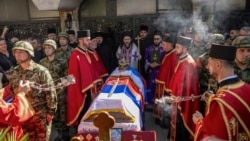
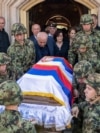

During the ceremony, the head of the Serbian Orthodox Church, Porfirije, said the Hague convict's name "will remain deeply embedded in the memory and prayers of the majority of the Serbian and Orthodox people."
Mladic was honored on September 7 by numerous officials from Serbia, Republika Srpska, and Montenegro, despite warnings from the United States and the European Union that glorifying convicted war criminals was unacceptable.
During the funeral service, a prayer was offered that "General Ratko be forgiven for his voluntary and involuntary sins" as an honor guard from the Serbian armed forces stood watch. Veterans from the former Bosnian Serb Army are taking turns to stand beside the coffin.
Thousands of people waited in lines outside the church to pay their respects, with some wearing T-shirts with Mladic's image or symbols related to the 1992-95 Bosnian War.
Four buses carrying demobilized members of the former Bosnian Serb Army traveled to Belgrade from Banja Luka, the administrative center of Bosnia's Serb-majority Republika Srpska, for the funeral. The transportation was organized by the Republika Srpska Veterans Organization.
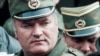
Politicians from Serbia attending the funeral, included Culture Minister Nikola Selakovic and Public Investment Minister Darko Glisic. Defense Minister Bratislav Gasic and Justice Minister Nenad Vujic also paid tribute to Mladic.
Serbian President Aleksandar Vucic said he could not attend because the president of Uzbekistan, Shavkat Mirziyoev, was visiting Belgrade. The ceremony was also attended by Zeljka Cvijanovic, the Serb member of Bosnia's Presidency, and former Republika Srspka leader Milorad Dodik.
Russian Ambassador to Serbia Aleksandr Botsan-Kharchenko also led a delegation to the funeral.
Reporters from RFE/RL's Balkan Service say numerous media crews were outside the church during the ceremony but were not allowed to enter the cordoned-off area or the site itself.
Nearby streets were closed to traffic ahead of the funeral, and police patrolled the area.
'A Mirror Of Serbia'
Mladic took command of the Bosnian Serb Army in 1992 and led a campaign that seized large parts of Bosnia. His forces laid siege to Sarajevo and carried out the 1995 Srebrenica massacre killing more than 8,000 Bosniak men and boys.
In 2017, the UN-backed International Criminal Tribunal for the former Yugoslavia convicted Mladic of genocide, crimes against humanity, and violations of the laws or customs of war.
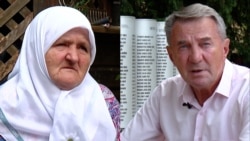
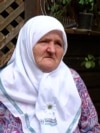
Speaking to RFE/RL's Balkan Service, Fazila Efendic, president of the Mothers of Srebrenica association that represents families of victims, lamented that Mladic had been buried "as if he were a statesman."
"This is terrible for me. But there it is. This is a mirror of Serbia, let the whole world see," said Efendic, who lost her son, husband, and 22 other family members in the massacre.
Earlier, the association had said the funeral "threatens to become the largest fascist gathering in Europe in the past 70 years."
US lawmaker Joe Wilson (Republican-South Carolina) wrote on social media that the funeral was "a rogue's gallery of anti-American Vucic and Russian regime figures."
Bosnia's foreign minister, Elmedin Konakovic, announced on September 7 that the country was downgrading its diplomatic relations with Serbia and recalling a majority of the diplomatic staff from the embassy in Belgrade.
He justified the decision by citing developments in Serbia following Mladic's death, including the funeral, the commemoration, and the public messages that emerged.
"If I could, I would sever diplomatic relations with Serbia today. What I can do, I will work on reducing relations to the absolute minimum," Konakovic said.
In the days since Mladic's death, tributes have been held across Serbia and Republika Srpska. A banner describing Mladic as a "hero" has been put up on a wall near the Church of St. Luke. A post on X shared by the Red Star Belgrade soccer team showed fans unfurling a tifo with a portrait of Mladic next to a banner with the words "Direction Potocari."
Potocari, a village just outside Srebrenica, was the site of the Dutch UN base where thousands of civilians fled in July 1995 and where Bosnian Serb forces separated men and boys from women and children. It is now home to the Srebrenica Genocide Memorial.
On August 27, Denis Becirovic, chairman of Bosnia's presidency, issued an official statement saying the Hague judgment placed Mladic among the most brutal killers of the 20th century.
In a statement on September 4, Becirovic condemned the granting of Serbian state and military honors to Mladic, saying they represented an "unacceptable act of institutional glorification" of a convicted war criminal and constituted an insult to the victims of the Srebrenica genocide.
Politicians in the United States and Europe joined in the condemnation of the public glorification of Mladic in Serbia.
Ahead of the funeral, US Senators Jeanne Shaheen, Chuck Grassley, and Keith Self released a joint statement, calling on the authorities in Republika Srpska and Serbia to distance themselves from Mladic's funeral.
"It is deeply concerning that Serbia has announced Mladic will be buried with state and military honors. The coming days will be a test of whether Serbia and RS are ready to break with the past and move toward European Union membership and Euro-Atlantic integration," the statement reads.
On September 4, EU Enlargement Commissioner Marta Kos canceled a planned visit to Serbia after a government plane flew Mladic's body to Belgrade, where soldiers carried his Serbian flag-draped coffin from the aircraft.
The US Embassy in Bosnia said two US representatives, Greg Murphy (Republican-North Carolina) and Marc Veasey (Democrat-Texas), "traveled to Srebrenica to honor the victims of the 1995 genocide."
In a statement, the diplomatic service of the European Union said, "Any glorification of war criminals, genocide denial, and revisionism contradict the most fundamental European values and have no place in the EU or in EU candidate countries."
Serbia is an official candidate for membership of the EU.

