




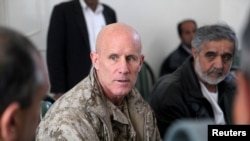
WASHINGTON -- As Washington weighs military pressure against diplomacy, President Donald Trump has paused plans for a major strike on Iran while negotiations continue over the Strait of Hormuz and Tehran's nuclear program. Both Tehran and Washington say talks are progressing, but no agreement has yet been reached.
To better understand how Iran may be interpreting this moment -- and whether the current diplomatic push can produce lasting results -- RFE/RL spoke with retired Vice Admiral Robert Harward, a former Navy SEAL who served as deputy commander of US Central Command (CENTCOM).
The interview has been edited for length and clarity.
RFE/RL: From a military perspective, how does Tehran interpret [POTUS'] decision? Do they see it as strategic patience and an opportunity for negotiations? Or do they see it as a sign that pressure can be delayed?
Robert Harward: Well, this is my opinion based on my history with Iran, having lived there and knowing the Persian people: they are very strategic by nature. They're chess players. They think long term. In my dealings with them personally, living there, and then professionally, they've always been willing to take time because they see it as being to their advantage. I think that's what we're seeing play out right now. The longer this goes on, the more they think they can survive. They know how our political system works. They know how elections work, how fickle we can be, and how our political will can be driven by very tactical and local politics in the United States.
So I think the government -- and when I say the government, I'm primarily referring to the Islamic Revolutionary Guards Corps (IRGC), because that's where I believe the crux of decision-making and authority lies, and no one is willing to challenge it because of the risk of death or other consequences -- they believe time is on their side.
Can they outlast Trump through the midterm elections or through his entire term? I believe they see these negotiations as advantageous because they think they can survive long enough to outlast President Trump or the political will of the United States.
RFE/RL: Where is the line between creating diplomatic space and giving an adversary time to regroup?
Harward: At first, I did not think this administration believed it would need to bring together all the elements of national power. Now I think they've come to that realization because the negotiations and concessions from Iran have not developed into anything.
I believe they are now very focused on bringing the whole of government and all the elements of national power together -- politically, economically, and militarily. Up to this point, they've relied almost entirely on military power, and that has not produced the results they needed, including reopening the Strait of Hormuz, much less addressing the nuclear weapons program, which are clearly their highest priorities.
So now they're placing much greater emphasis on political leverage. Internally, you saw the president bring together his cabinet at Camp David, clearly indicating he is looking at every component of the US government that can help solve this problem.
Internationally, as you saw in Ankara, the US spoke with Arab countries and others about how they could support these efforts. Now you're seeing elements of that political pressure: Saudi participation in strikes, Lebanon reaching an agreement with Israel to disarm Hezbollah and reduce its influence, Hamas moving toward an agreement to disarm and pursue peace, and coalitions -- including the British -- helping secure the Strait of Hormuz, while others address Houthi threats to Saudi Arabia and the Bab al-Mandab.
In that regard, I think you're seeing much greater political pressure. The [US] president believes -- and this is the counterargument to Iran's assumption that time favors Tehran -- that if he economically strangles Iran, it will eventually be forced to comply with demands regarding the Strait of Hormuz and its nuclear weapons program.
RFE/RL: Some military analysts argue Iran has already demonstrated its ability to disrupt the region and therefore has every incentive to de-escalate. Why isn't Tehran moving more aggressively toward a deal?
Harward: Let's be specific about what we mean by "Tehran." I believe the government is the IRGC. There may be political figures who have too much blood on their hands or too many business interests to separate themselves from it. If that government relinquishes either of those, it demonstrates weakness and creates greater opportunities for internal accountability.
They could then be held responsible by the Iranian people for all those they have murdered, executed, hanged, and shot in the streets. For them, this is an existential threat.
If they give up any of their primary sources of power, they create long-term threats to their own survival. It's essentially do or die. They have to go all the way. If they start giving up anything, they know they're ultimately doomed.
RFE/RL: Based on your experience, what do outside observers most often misunderstand about how Iran's leadership calculates risk?
Harward: I think they overlook one thing. There are opportunities, and there are miscalculations. The opportunity we're missing is Iran itself.
How many of the country's 95 million people want a change in government? I think that's a gross miscalculation, and we have not leveraged that opportunity or focused on it enough.
President [Trump] has talked about it, but I have not seen policies or programs that capitalize on it. I also think people understand that this is an existential threat to members of the government -- the IRGC and political leaders aligned with it. That's why they're being offered opportunities to reach some sort of agreement.
But at the end of the day, an agreement only allows this threat to continue for decades. As they've always done, they are quick to rebuild their capabilities and work around any agreement.
The Joint Comprehensive Plan of Action (JCPOA) is the perfect example. Under the JCPOA, they agreed to the guidelines, complied with them, and received tens of billions of dollars. But outside those guidelines, they continued building the systems needed to become a nuclear-armed state. Even while International Atomic Energy Agency inspectors were present and they appeared transparent, they still concealed activities.
They expanded enrichment capacity, developed better centrifuges, and positioned themselves so they could take uranium enriched to 60 percent and bring it to weapons-grade material -- 95 percent -- in a matter of weeks.
At the same time, none of that addressed their missile and drone programs. Those capabilities grew exponentially, to the point where they had ballistic missiles capable of reaching Europe, as demonstrated by the missile launched toward Diego Garcia. The lesson -- and where I think people underestimate Iran -- is believing that any agreement on the Strait of Hormuz or the nuclear program will eliminate the long-term threat Iran poses to its regional partners and beyond.
RFE/RL: You grew up in Iran, you speak Persian, and you remain in contact with people connected to the country. What are ordinary Iranians telling you today? What do they want the world to understand?
Harward: They are optimistic, but they are also very insistent that this administration stay the course toward government change in Iran. The people I'm talking to -- and I believe they are ordinary Iranians, although some were educated in the United States and still live there -- I don't want to put any of them at risk by revealing who they are. All of them believe the country has been stunted by this government.
The tremendous resources of this rich country have been misused rather than applied to the well-being of the Iranian people. They look at countries like Qatar, the UAE, and Saudi Arabia, and they see freedoms, prosperity, and opportunities that they do not have because the government in Iran has denied them.
They are praying and hoping that the United States stays the course and sees this through to a government that is more focused on the development of Iran and the well-being of its people than on exporting the Islamic Revolution, both inside Iran and beyond.
That's what I'm hearing from all my Iranian friends. They're praying that we stay the course toward that end state.

