




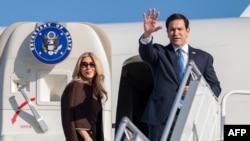
SAMARKAND, Uzbekistan -- US Secretary of State Marco Rubio departed Uzbekistan on October 20 for India after meetings with all five Central Asian countries, wrapping up a visit aimed at expanding Washington’s economic and diplomatic engagement with a region increasingly intent on shaping its own international partnerships.
Rubio’s visit to the historic Silk Road city of Samarkand brought together the foreign ministers of Kazakhstan, Kyrgyzstan, Tajikistan, Turkmenistan, and Uzbekistan. He also met Uzbek President Shavkat Mirziyoev and attended a US-Uzbekistan business council event alongside a delegation of nearly 300 American business leaders.
The visit produced several concrete initiatives, including Uzbekistan’s signing of the US-led Artemis Accords on peaceful space exploration and a bilateral investment agreement that the parties said would total $12 billion when implemented.


But the broader significance of Rubio’s trip may lie less in the immediate announcements than in Washington’s renewed attention to Central Asia -- and its stated willingness to pursue closer ties without demanding that regional governments choose between the US, Russia, and China.
“This is not simply a contest between outside powers,” US Ambassador to Uzbekistan Jonathan Henick told RFE/RL in an interview as Rubio departed Samarkand.
Henick said Central Asian countries had demonstrated their independence and their ability to determine the terms of their own international relationships over the 35 years since the collapse of the Soviet Union.
The United States, he said, wants to offer them additional options, both politically and economically, that would help them preserve their independence and expand their room for maneuver.
A Renewed Place On Washington’s Strategic Map
Henick said Rubio’s visit represented a historic expansion of American engagement, with growing economic and commercial ties accompanying closer political contacts.
But he also stressed that American interests were coinciding with changes already underway in Central Asia, rather than creating them from scratch.

Uzbekistan, he said, was in the midst of a historic period of economic reform under Mirziyoev, whose government has sought to create a more business-friendly environment and attract foreign investment.
“The coincidence of the attention from Washington with the opportunities that we’re seeing here,” Henick said, was helping drive the transformation.
Luke Coffey, a senior fellow at the Hudson Institute, offered a more measured assessment of the immediate diplomatic results.
Speaking to RFE/RL, Coffey described Rubio’s visit as largely a maintenance exercise intended to keep agreements reached during last year’s White House summit on track.
He considered that earlier gathering more consequential than the Samarkand meetings themselves.

Nevertheless, he said, the Trump administration’s broader actions during its second term had collectively returned Central Asia to Washington’s strategic map -- a development he welcomed.
All five Central Asian states retain significant commercial and diplomatic links with Russia, while China remains a major regional economic power. Their relationships with Iran also vary.
Rubio acknowledged that reality during his visit, saying countries wanted as many international relationships as possible. Uzbekistan, he noted, had made clear that it wanted to be friends with everybody.
No Demand To Choose Between Washington, Moscow, Beijing
The question of whether Washington can expand its influence without pressuring Central Asian governments to distance themselves from Russia and China emerged as a central theme of the visit.
Henick rejected the notion that the region should be viewed primarily through the lens of competition among outside powers.
“For too long we’ve been characterizing this region as, you know, as sometimes they call it the Great Game,” he said. “It’s outside powers competing in the region. Honestly, I think that completely mischaracterizes what’s happening here.”
Coffey agreed that the US should not seek to force regional governments to choose Washington over Moscow or Beijing.
Geography, economic ties, history, and cultural connections make such a choice unrealistic, he said. Instead, Washington should remain actively engaged and help its partners balance their relationships with major powers.
Angela Howard, a research analyst at the Foundation for Defense of Democracies’ Center on Economic and Financial Power, said Rubio’s approach could make it easier for Washington to establish partnerships that might otherwise be blocked by an insistence on choosing sides.
The administration is signaling that it is interested in the region, prepared to compete with Russia and China, and prioritizing economic statecraft, Howard said.
An approach that avoids an “us-versus-them” framework could allow the United States to provide alternatives to Russia, China, and Iran incrementally, she added.
Howard argued that Washington would make more progress in limiting its competitors’ influence by pursuing specific policy changes -- including action against sanctions-evasion networks -- than by issuing ultimatums that Central Asian governments would be unlikely to accept.
Investment Remains The Real Test
The visit’s economic agenda was underscored by the large business delegation accompanying Rubio, as the administration seeks greater access to Central Asia’s markets and natural resources, including critical minerals.
During his visit, Rubio defended the commercial dimension of American diplomacy, saying the United States wanted fair competition and an opportunity for its companies.
At a business council event, he also argued that US foreign policy should not focus so heavily on immediate crises that it neglects long-term opportunities.
“Our focus on a problem region or a problem country or a problem issue in the world still has to be there, but it cannot come at the expense of embracing opportunities,” Rubio said. “You have to be able to do both.”
Henick said the visit had helped businesses already working on deals make progress in their relationships and introduced other American companies to opportunities in Uzbekistan for the first time. He expected many of those first-time visitors to return.
Uzbekistan’s signature on the Artemis Accords could also open new avenues for cooperation in space exploration, the ambassador said.

Washington and Tashkent are continuing to work on other projects that Henick hopes will be ready in time for Mirziyoev’s planned trip to the United States to attend the G20 summit in Florida as an official observer.
Another issue on the bilateral agenda is the Jackson-Vanik amendment, a Cold War-era US trade provision that continues to apply to Uzbekistan and several other countries.
Henick said the provisions were routinely waived and did not significantly affect the embassy’s day-to-day work, but acknowledged their symbolic importance to the countries still covered by the measure.
President Trump and Rubio have made clear that they support lifting Jackson-Vanik, Henick said. He also pointed to a recent visit by US Representative Jason Smith, chairman of the House Ways and Means Committee, who met with Mirziyoev and committed to working in Congress toward lifting the restrictions.
For Coffey, however, the ultimate measure of success will be a measurable increase in private-sector investment flowing into Central Asia.
Such growth will take time, he said, but the Samarkand meetings may have planted the seeds for it.

Coffey also called for tangible progress on the Trans-Caspian trade route, including infrastructure projects and investment in oil and gas pipelines connecting the two shores of the Caspian Sea.
He suggested Washington could broaden its regional engagement beyond the five Central Asian states by considering a C6 format that includes Azerbaijan and deepening ties with the Organization of Turkic States.
The push for more American investment also raises questions about how Washington will ensure that new commercial relationships do not expose US companies to sanctioned actors, corruption, and other violations.
Some Central Asian countries have been identified as channels through which Russia has obtained goods subject to Western sanctions, making enforcement a particularly sensitive issue as the United States pursues closer economic ties.
Coffey said addressing sanctions evasion would require coordinated action by the Departments of Commerce, Treasury, and State, as well as the White House.
All available tools, he said, should be used to close loopholes and ensure investments comply with US interests, objectives, and laws.
Howard likewise warned that the success of new deals would depend on their terms and implementation, rather than simply the announcement of headline figures.
Investments must be structured to guard against exposure to sanctioned entities, corruption, and human rights violations, she said. That requires effective oversight, rigorous due diligence, and screening for connections to US adversaries.

