




A visit by officials from Afghanistan's unrecognized Taliban government to Moldova has triggered a political storm in the small Eastern European country.
Three officials from the Taliban's Agriculture Ministry arrived in Chisinau on August 3 for a dayslong visit after they were granted visas.
The militant Islamist group, which seized power in 2021 after the withdrawal of international troops, has tried to use the trip to boost its international image and legitimacy.
The Taliban government is considered one of the most repressive regimes in the world. The international community has blacklisted Taliban leaders and cut off the group from the global financial system.
The Taliban's 'Official Visit To Europe'
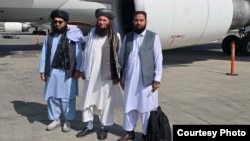
On August 3, the Taliban's Agriculture Ministry posted a photo on X showing the three Taliban officials in traditional clothing on the airport tarmac next to a Turkish Airlines plane. The photo caption stressed the "official" nature of the trip not once, but twice -- framing the visit as a high-level state affair.
Since the post, Taliban-affiliated media outlets have provided almost hour-by-hour updates on the trip.
The Kabul Tribune reported that Deputy Agriculture Minister Sadr Azam Osmani had arrived in Moldova "to discuss expanding practical and technical cooperation between the two countries."
Ariana News went even further, quoting the ministry's spokesman as saying the delegation would meet with Moldovan counterparts to discuss "agricultural development, scientific research, plant protection, pest management, modern agricultural technologies, and the implementation of joint research projects."
Afghanistan's state TV led its August 3 main evening broadcast with the trip.
'Embarrassing And Unacceptable'
At the center of the controversy is Vasile Sarban, the Moldovan official who invited the Taliban officials. He said he made the decision at the request of private Moldovan companies keen to export to Afghanistan.
"I believe it is right for the authorities of Moldova to look after Moldova's economic operators," Sarban, an official in Moldova's Agriculture and Food Industry Ministry, later said. "If our producers say they have nowhere to sell, the state should help them find markets."
But the comments from Sarban have failed to quell the growing uproar over the visit.
When the Taliban delegation arrived in Chisinau, the Moldovan Foreign Ministry rushed out a statement confirming that visas had indeed been issued but immediately distanced itself from the Taliban's narrative.
The ministry stressed that the visitors "are not targeted by international sanctions" and reiterated that "the Republic of Moldova strictly complies with international sanctions regimes and does not recognize the Taliban government in Afghanistan."
"There will be no bilateral meetings or official contacts with the delegation's representatives," the ministry's statement added.
The Moldovan government also announced that it was launching an investigation into how the visas were issued.
Prime Minister Vasile Tofan, in a Facebook post, called the affair "embarrassing and unacceptable," characterizing it as an administrative failure.
"The procedure was formally followed, but without the necessary political and diplomatic assessment," Tofan said in the post. "A clearly sensitive case was treated as a routine administrative file. The result was a wrong decision."
Search For Partners
Russia is the only country that has formally recognized the Taliban as Afghanistan's legitimate government. It did so in 2025, four years after the group seized power following the withdrawal of US and NATO forces from Afghanistan in 2021.
Several countries -- including China, Kazakhstan, and Uzbekistan -- maintain diplomatic, trade, and economic ties with the Taliban without officially recognizing its government.
The Taliban has sought to establish ties with countries across the world, in an effort that experts say is designed to claim external legitimacy and to influence public opinion domestically.
In June, Taliban officials for the first time held talks in Brussels on the repatriation of Afghans despite sharp criticism from rights groups that said the European Union was legitimizing the hard-line group, which has been accused of severely curtailing the basic rights of Afghans, especially of women.