




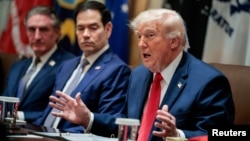
US President Donald Trump has indicated that Iran's decision to end its unprecedented Internet blackout is a sign that the country wants to reach an agreement with the United States.
Speaking at the opening of a cabinet meeting in Washington on April 27, Trump said Iran was "intent" on a deal.
"I think it looks like they want to just make a deal. I don't think they have a choice. They're just going back to the Internet because they're getting clobbered. Their economy is in freefall," he said.

Iran switched off access to the Internet after the beginning of US and Israeli military strikes on February 28.
It has previously taken similar steps during times of internal unrest, such as during mass nationwide protests in January. But this latest Internet shutdown was the longest it has ever imposed.
The economic toll of Iran’s blackout has been significant. Afshin Kolahi, an official from Iran’s Chamber of Commerce, said during an April 12 session that the shutdown was costing the country up to $40 million per day. Indirect losses, he said, were up to $80 million each day.
Talks Ongoing
Trump also hinted at the progress of diplomatic efforts to reach a deal. The United States and Iran have been sending proposals backwards and forwards via Pakistani mediators.
"They want very much to make a deal. So far, they haven't gotten there. We're not satisfied with it," Trump said.
"But we will be. We will be. Either that or we'll have to just finish the job," he added, apparently referring to a resumption of military action.
Earlier on May 27, Iranian State TV reported on what it said was a draft of a framework agreement.
It included commitments to lift the US naval blockade on Iran, restore commercial traffic through the Strait of Hormuz, and reduce the American military presence in the Persian Gulf region.
According to the report, which cited a draft memorandum of understanding (MOU) that was “still not finalized,” Washington had allegedly committed to “cease harassing ships passing to or from the Islamic republic of Iran.”
In return, Iran would allow the resumption of commercial shipping through the Strait of Hormuz within one month, while continuing to manage shipping lanes, inspect vessels, and impose service fees. Iran would manage the strait in cooperation with Oman.
The details as reported by Iranian TV underlined many of the key issues in the talks. They also indicated many of Tehran's desired outcomes.
However, a White House statement later said that the report was "not true."
"The MOU they 'released' is a complete fabrication," said a post on X by the White House's Rapid Response 47 account. "Nobody should believe what Iranian state media is putting out. FACTS MATTER."
Asked about the Iranian report's claim that Tehran would control the Strait of Hormuz in cooperation with Oman, Trump said it was international waters.
"Oman will behave just like everybody else, or we'll have to blow them up," he said. "They understand that."
A Shaky Cease-Fire
Also on May 27, a senior commander of Iran's Islamic Revolutionary Guards Corps (IRGC) said there was a "low possibility" of war resuming.
Mohammad Akbarzadeh said this was "because of the enemy's weakness. The armed forces are lying in wait with full magazines."
Nevertheless, the threat of military action continues to cast a shadow over the ongoing diplomatic efforts.
On May 25, US Central Command said "self-defense strikes" had been carried out on Iranian missile sites and mine-laying boats. Iran said four soldiers had been killed in the strikes, the first since the cease-fire began on April 8.
Iran accused Washington of violating the cease-fire and said, as it has before, that it reserves the right to respond -- but it has continued to engage diplomatically.

