


"According to the letter posted by Kuchma's press secretary Darka Olifer, Ukraine agrees to hold snap elections in certain districts of Donetsk and Luhansk regions."
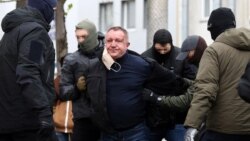
A new secretary for the National Security and Defense Council of Ukraine:
Volker expected to testify in House impeachment probe:
By RFE/RL
Kurt Volker, the former special U.S. envoy to Ukraine, will be the first State Department official directly connected to the Eastern European country to testify before three congressional panels that are conducting an impeachment probe of President Donald Trump.
He is expected to voluntarily give a closed-door deposition on October 3 before three House of Representatives committees as they seek to shed light on whether Trump abused his office by asking Ukraine's president to investigate former Vice President Joe Biden and son Hunter, who had business dealings in Ukraine. Joe Biden is a leading electoral opponent in the 2020 election.
The allegation stems from a government whistle-blower's complaint that details how Trump, in a phone call with Ukrainian President Volodymyr Zelenskiy on July 25, pressured him to investigate an energy company where Hunter Biden had sat on the board of directors from 2014 until his father announced his candidacy in April.
Leading up to the call, Trump had abruptly withheld some $400 million in military funding for Ukraine, which has been battling Russia-backed separatists since 2014.
A day after the Trump-Zelenskiy call, Volker, who was mentioned in the whistle-blower complaint, and U.S. Ambassador to the EU Gordon Sondland gave the Ukrainian president advice on how to "navigate" Trump's demands.
Volker resigned after his name surfaced in the complaint last week.
Volker also had put Trump's personal lawyer, Rudy Giuliani, in touch with Andriy Yermak, an aide to the Ukrainian president, but at Yermak's request, a State Department official told The Wall Street Journal.
During the call with Zelenskiy, Trump told him that Giuliani and Attorney General William Barr would be the ones with whom to work on investigating the Bidens.
AP has reported that in September 2018 Volker met with a board adviser to the energy company that Trump had asked Zelenskiy to investigate.
Burisma Group adviser Vadym Pozharskiy met Volker at an event devoted to energy in New York organized by the Atlantic Council, a think tank based in Washington.
"It would have made perfect sense for Kurt to meet with the Burisma people," Daniel Fried, a former top State Department official, told AP.
Fried, who is a senior fellow at the council's Future Europe Initiative and Eurasia Center, had also met with Pozharskiy.
Volker and Pozharskiy didn't respond to AP's e-mails and calls.
Giuliani and other researchers supportive of Trump have accused Joe Biden of pressuring Ukraine to fire a prosecutor who had previously investigated Burisma.
However, Biden and other officials from former President Barack Obama's administration have said the former vice president's effort had nothing do with Hunter Biden.
The effort, on the contrary, was a shared goal of U.S. allies, and a demand of Ukraine's Western lenders, as well as local corruption watchdogs in Kyiv, to fire the prosecutor because he wouldn't prosecute corruption, or thoroughly investigate Burisma.
The fired prosecutor, Viktor Shokin, refused to assist an earlier British probe of Burisma. When Hunter Biden joined Burisma's board, the British government had $23 million of the company's money frozen, but later unlocked the funds due to a lack of evidence.
The energy company is a major donor of the Atlantic Council, having donated between $100,000 and $249,000 between 2018 and 2019.
Burisma's founder, Mykola Zlochevskiy, also spent $90,000 on lobbying Congress, as well as the State, Treasury, and Energy departments in 2014-16, according to AP.
Burisma Group received some of its 39 gas licenses while Zlochevskiy was natural resources minister from 2010 to 2012, when Viktor Yanukovych was president.
Volker is the executive director of the McCain Institute in Arizona. He was a volunteer member of the State Department in his role as special envoy to Ukraine.
He also has lobbying experience, having owned BGR Group, where he is currently listed as a "senior international adviser." (w/The New York Times, The Wall Street Journal, Politico, Reuters, and AP)
Putin: Russia ready to prolong gas deal if needed:
By RFE/RL
Russian President Vladimir Putin has indicated he is ready to offer Ukraine a temporary contract for the transit of natural gas if talks fail before the current one with Moscow expires on January 1.
Speaking at the sidelines of an energy forum in Moscow on October 2, Putin said he was prepared to sign a transit agreement under European law if Kyiv succeeds in implementing the European energy package by the end of the year.
The Russian president was referring to Ukraine's commitments to abide by EU energy regulations, which include having companies independent of one another produce and transmit gas, known as "unbundling."
Putin noted that it was "quite likely" that Ukraine won't fulfill its EU obligations by the end of the year, which will also require Kyiv to pass additional legislation, he suggested.
If Ukraine didn't succeed, Putin said Russia would consider extending the contract for up to a year.
Kyiv usually makes about $3 billion annually for transmitting gas to EU countries based on the current 10-year contract with Moscow.
Ukraine stopped importing gas directly from Russia in 2015 after Moscow sent troops into Crimea the previous year, eventually taking it over while backing separatists in two eastern Ukrainian regions.
Instead, Kyiv gets Russian gas indirectly through reverse flows from neighboring EU countries, namely Slovakia, Poland, and Hungary.
An additional reverse-flow point is expected to open with Romania on January 1.
As winter approaches, a third round of EU-mediated energy talks between Moscow and Kyiv in September were inconclusive.
After the talks in Brussels, the energy ministers of Russia and Ukraine, Aleksandr Novak and Oleksiy Orzhel, said the sides had agreed to meet again by the end of this month.
Currently, Ukraine is an important gas-transit country for the EU, but its role could be diminished as Moscow pursues the Nord Stream 2 project to build a pipeline under the Baltic Sea, bypassing Ukraine, that could go online as soon as spring 2020.
However, at the same Russia Energy Week conference, the board chairman of Russian state-run Gazprom, Viktor Zubkov, said that if the company wanted to, it could complete Nord Stream 2 by November.
So far, 2,042 kilometers of Nord Stream 2, or 83 percent of its total length, has been laid.
On October 1, German Chancellor Angela Merkel, whose country will benefit the most from Nord Stream 2, appointed Count Bernard Waldersee as commissioner for ensuring gas transit through Ukraine, Ukrainian Ambassador to Germany Andriy Melnyk said on social media.
Germany and other EU countries have pressed for gas to still flow through Ukraine after the Russian energy project is completed.
Russia meets about a third of Europe's gas needs, much of which currently flows through Ukraine's state-run 38,000-kilometer gas-pipeline network. (w/dpa, Reuters, and RIA Novosti)
We are now closing the live blog for today, but we'll be back again tomorrow morning to follow all the latest developments. Until then, you can keep up with all our other Ukraine coverage here.