




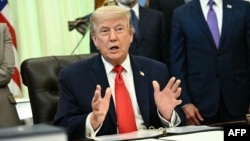
US President Donald Trump has claimed that a "great settlement" has been reached with Iran to end the Middle East war and that the agreement could be signed as early as this weekend, possibly in Europe.
"We just made a great settlement of the war with Iran," Trump told reporters in the Oval Office on June 11.
He added, though, that the agreement is still "subject to finalization of documents, which should get done, over the next few days, probably have a signing, maybe in Europe."
Asked by reporters if Iranian Supreme Leader Mojtaba Khamenei had approved the deal, Trump said: "I understand the answer is yes."
Trump described the deal as "a very strong memorandum of understanding [MOU]," adding it was "a little conceptual, but it's something that's going to get done."
“We have a deal that Iran will never have a nuclear weapon, which was the whole purpose of what we had to go through to get this. So, it's a very big thing,” Trump told reporters.
Trump said he would not be able to attend himself a signing ceremony, but he added that Vice President JD Vance could.
However, Iranian Foreign Ministry spokesman Esmaeil Baqaei appeared to downplay the prospects for a quick signing, saying Iran has not yet reached a final decision on an agreement.
He added that many details had been finalized but that the "Americans keep changing their positions," according to Iran's Tasnim news agency. There has been no official comment from the government.
Trump has often declared that a deal with Tehran was imminent to end the fighting only to have negotiations break off without a final agreement, leading to renewed threats and outbreaks of air strikes from the US, Iran, and Israel.

Israeli Prime Minister Benjamin Netanyahu’s office said it was grateful for any deal negotiated by Trump, but it pointed out it was not a party to the MOU.
Trump said the Strait of Hormuz, a vital waterway that Iran effectively closed after the war began on February 28, will also be opened “as soon as we have it signed.”
"The strait will officially open as soon as we sign, which could be soon, very soon, maybe over the weekend in Europe," he said
He also said that he had spoken to leaders in the region, including allies in the Persian Gulf and Netanyahu, adding: “The whole Middle East is very happy.”
The latest zig-zag announcement of a tentative settlement comes hours after Trump said he had canceled strikes that he had threatened to hit Iran with later on June 11.
"Based on the fact that discussions with the Islamic Republic of Iran have been brought to the highest level of Iranian leadership and approved, I have, as President of the United States of America, cancelled the scheduled strikes and bombings against Iran this evening,” Trump said in a post.
Trump added that "discussions and final points" have been approved by the United States, Israel, Saudi Arabia, UAE, Qatar, Turkey, Pakistan, Bahrain, Kuwait, Jordan, Egypt, and others.
"The Naval Blockade will remain in full force and effect until this Transaction is finalized -- Time and place of the signing to be announced shortly," he said.
Shortly before Trump's comments, Mohammad Baqer Qalibaf, a senior Iranian official, warned the United States against becoming entangled in an "endless quagmire."
"Wrong strategies and impulsive decisions will reset the entire board for the worse, explode energy infrastructure and markets and create an endless quagmire that you will be stuck in for years," Qalibaf, who is Iran's parliamentary speaker and chief negotiator, said in a June 11 post on X.
Earlier on the same day, Trump said the United States would conduct fresh military strikes on Iran.
"The United States will be hitting Iran...VERY HARD TONIGHT," he wrote in a Truth Social post, also threatening to seize Iran's oil infrastructure facilities, including Kharg Island, the country's main oil export hub.
His comments came after Washington and Tehran exchanged attacks for a second consecutive night on June 10, deepening one of the most serious escalations in hostilities since a fragile cease-fire took hold in April.
Iran claimed it had fully closed the Strait of Hormuz, a key artery for global oil and gas supplies, following overnight US strikes on targets in the country.
Iran responded by launching missile and drone attacks against US-linked targets in Bahrain and Kuwait.
As Tehran warned that any vessel attempting to transit the strategic waterway would be targeted, Iranian state media later reported that two ships had come under attack.
US Central Command (CENTCOM) disputed those claims, saying commercial shipping continued to move through the strait, which usually accounts for the passage of one-fifth of global oil and gas supplies.

