



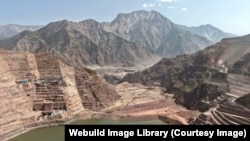

A Soviet-era plan to build the world's tallest dam edged closer to reality this month as international lenders step up support for Tajikistan's Roghun hydropower project.
In early October Dushanbe ratified a $300 million grant from the World Bank for the project and reports have since emerged of a possible further $500 million in funding from the Asian Development Bank.
Filippo Menga, an associate professor of geography at the University of Bergamo in Italy, told RFE/RL the recent funding news doesn't assure the project's completion, but with major multilateral banks tying their own credibility to Roghun, "financially and politically the project is now very hard to stop," he said.
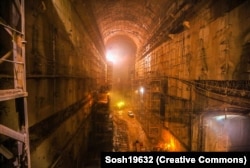
The Roghun Dam project is set to rise 335 meters -- higher than the Eiffel Tower -- to plug a narrow gorge of the Vakhsh River 100 kilometers east of Dushanbe. The hydropower plant will double Tajikistan's generating capacity, potentially ending the country's chronic winter electricity shortages, and providing surplus power for export.
The massive dam will also displace more than 50,000 people as water rises to fill its reservoir, inundating several villages upstream of the project.
In a village near Roghun, Mukim Khasanov was one of the tens of thousands of people awaiting resettlement when RFE/RL's Tajik Service spoke to him in June. The 75-year-old farmer said his family were allocated a plot of land away from the dam but that inflation will devour much of the compensation for his house that was promised years earlier.
"When they assessed our housing and property, prices were completely different, including for building materials," he said. "Now everything is very expensive. For example, a wood panel cost 50 somoni (about $5.40) back then, and now it's 150 somoni (about $16.30)."
In Roghunyon, a suburb on the outskirts of Dushanbe named to reference the origin of many villagers already relocated from the reservoir's flood zone, some complain the land promised to them for growing crops never eventuated.
Others express "100 percent satisfaction" with the settlement. "No problems whatsoever," Tavakkal Shamsulloev said. "They've repaired our roads and installed electricity."
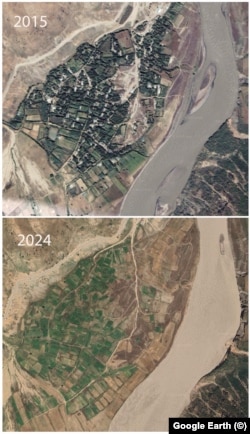
Opponents of the dam project have claimed some 32,000 people would be able to avoid resettlement if the dam were to be built just 35 meters lower.
Eugene Simonov, the coordinator of the conservation coalition Rivers Without Boundaries, told RFE/RL it appears likely Dushanbe has pursued the title of the tallest dam in the world as "an important quality of the national pride project akin to a sacred pyramid," for the country.
Dushanbe has said the record-breaking height will offer "superior economic and environmental performance" compared to lower versions of the dam. That assessment has been backed by World Bank reports.

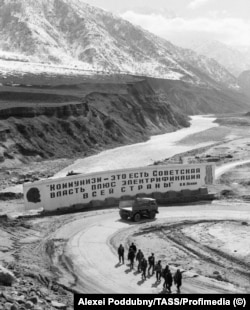
The Roghun Dam was initially envisioned by the Soviet Union and work began in 1976. Amid the breakup of the USSR, followed by civil war in Tajikistan, the project collapsed. Efforts by newly independent Tajikistan to restart the project were initially opposed by Uzbekistan, which lies downstream of the dam.
Uzbekistan's then President Islam Karimov slammed the Roghun Dam as "stupid," citing safety concerns and fears Tajikistan could use its control of water flowing toward Uzbekistan for political leverage.
Uzbekistan's opposition to the dam evaporated following the death of Karimov in 2016. The following year, Uzbekistan's Foreign Minister Abdulaziz Komilov publicly invited Tajikistan to "go ahead and build" the dam, while insisting on guarantees regarding water use.
Construction resumed later that year, but the site proved immensely complex. A meters-wide vein of rock salt just upstream of the dam risked dissolving under pressure of a rising water reservoir, and the dam's location in a seismically restless region introduced the potential for "reservoir-triggered" quakes, according to multiple technical reports. Additionally, the Soviet-era work on the project was found to require extensive rebuilding to meet modern safety standards.
Webuild, the Italian infrastructure giant working on the project, declined to comment on technical aspects of the build, but a 2014 report describes "substantial remedial works" needed on Soviet construction efforts.
Roghun is being built as an embankment dam, incorporating a core of watertight clay buttressed on both sides by rockfill. The relatively flexible dam type was chosen in part for its capacity to absorb quakes better than crackable concrete-faced dams.
Two of the hydropower plant's turbines are already in operation, with the third of a total of six generating units scheduled to come online in 2027.
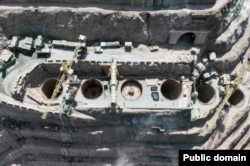
Menga, who has authored a book on water politics in Central Asia, says that with around 145 meters left to build up the dam and its completion requiring continued political goodwill from Tajikistan's Central Asian neighbors, "Roghun is more likely to be finished than ever before, but 'virtually assured' overstates it."
The Tajik government is estimated to still require around $5.8 billion to complete the Roghun hydropower project, which will be funded largely from the country's state budget. The target completion date is 2035.