



Twenty years after investigative journalist Anna Politikovskaya was shot dead in Moscow, the paper she worked for has been crushed under pressure from the Russian state. A small cease-fire in Ukraine was followed by a massive and “evil” attack, while a seismic shift in the US political landscape precedes new trilateral peace talks.
Here are some of the key developments in Russia and its war against Ukraine over the past week, and some of the takeaways going forward.
'They Killed Us'
On October 7, 2006, investigative journalist Anna Politkovskaya was shot dead in the lobby of her Moscow apartment building as she returned home from a grocery run.
The dogged documenter of rights abuses in Russia and its Chechnya region was not the first contributor to the newspaper Novaya Gazeta -- founded with support from Mikhail Gorbachev -- to be killed or to have died in mysterious circumstances during President Vladimir Putin’s long rule.
But she was the most prominent, and her murder was a chilling milestone of an era -- still in its early years at the time -- in which the Kremlin and its allies have used an array of tools to silence opposition, dissent, and basic freedoms, from electoral manipulation and trumped-up court cases to sometimes deadly violence.
Twenty years later, Novaya Gazeta is dead.
"They killed us,” the paper said in a Telegram post on October 30, a day after authorities began evicting the remaining staff from their Moscow editorial offices -- the final blow in a series of hits that made it impossible to keep operating.
Five years after Novaya Gazeta editor Dmitry Muratov shared the 2021 Nobel Peace Prize with Filipino-American journalist Maria Ressa "for their efforts to safeguard freedom of expression," the end comes in a few days.
“On November 9, we will shut out the lights in the home where we’ve lived for 30 years, turn off the servers, and leave,” the editors said. “The paper is no more.”
Abroad, the paper lives on by way of Novaya Gazeta Europe, a Paris-based edition. In Russia, after surviving for years under increasing pressure from the state, it has finally become a victim of the clampdown that began before Politkovskaya’s killing and has intensified since Putin launched the full-scale invasion of Ukraine in 2022.
Like the clampdown, there’s no clear end in sight for Russia’s all-out war, which many analysts predict will persist past the five-year mark in February.
More clarity on the prospects for peace may come next week, when US, Ukrainian, and Russian negotiators are scheduled to meet in Abu Dhabi on November 10-11 -- ending a long hiatus in direct, US-brokered talks, which went dormant as President Donald Trump focused on the war with Iran.
'Serious Reasons To Doubt'
In an X post about the talks, Tatyana Stanovaya, a senior fellow at the Carnegie Russia Eurasia Center, said she sees several developments that “suggest a gradual, albeit very slow, movement towards an agreement.”
But she remains skeptical about the chances for “meaningful progress.” Also, she cautioned that if an agreement is reached, implementation will be difficult “and there are still serious reasons to doubt whether it could lead to a sustainable settlement.”
Stanovaya was writing as Americans voted in elections that dealt a huge defeat to Trump and his Republican Party, handing control of both the Senate and House of Representatives to the Democrats for the last two years of his second and final term as president.
For Kyiv and Moscow, the crucial question is how the midterm election results may affect the war and the US effort to end it, which Trump made a priority when he took office. He has struggled to make progress ever since.
One major factor has been the amount of pressure applied on Russia and Ukraine. Multiple times over the past two years, Trump has seemed poised to turn up the pressure on Kyiv to accept a settlement on terms that would favor Moscow -- which, among other demands, says full Russian control over Ukraine’s Donbas region is a prerequisite for any peace deal.
But a hard push in that direction seems less likely -- or less likely to succeed, at least -- given the election results.
On the other side of the coin, backers of Ukraine have frequently said Trump has not put sufficient pressure on Putin to push him into considering substantial concessions.
Among other White House overtures to Moscow that have raised alarms in Kyiv and in Congress in recent weeks, Trump waived new sanctions against Russia after signing off on them -- and separately agreed with Putin on a deal to get Russian diesel to US and world markets.
Once the new Congress is seated on January 3, lawmakers could seek to push back.
Democrats “could rescind the diesel oil deal with Russia. They could provide military assistance to Ukraine,” Richard Fontaine, CEO of the Washington-based Center for a New American Security, wrote on X.
But “there will be more continuity than change” on key policy issues, he wrote. “The President remains in the driver’s seat on foreign policy, with an array of institutional and political advantages over Congress.”
One big question is how Trump will seek to use those advantages. Another is how Russia will react to the new reality.
Moscow may see a new urgency in achieving its goals -- or some of them, such as gaining control over the portion of the Donbas its forces have been unable to take in years of extremely deadly fighting.
A Devastating Attack
On the other hand, shifting US political fortunes may already be baked into Russia’s calculations.
Putin knows Trump will be out of the White House in 2028, and analysts say the Kremlin’s confidence that interaction with the Trump administration can produce the results it desires has faded over time.
In any case, there’s little or no evidence that a heightened sense of urgency in Moscow would translate into concessions.
Instead, Russia could seek to step up already relentless air attacks, in a bid to pummel Ukraine into submission, and try to push forward faster on the ground in eastern Ukraine – though its slow pace and massive losses there so far suggest that would be a tall order.
According to Ukrainian President Volodymyr Zelenskyy, Russia suffered more casualties in October than in any other month of the war: about 54,400 soldiers killed or wounded.
Ahead of the Abu Dhabi talks, Moscow used a humanitarian operation allowing hungry residents to leave the Russian-held city of Oleshky, in Ukraine’s southern Kherson region to show that it can stop fighting on a dime if it wants to -- and start up again just as quickly.
Both Ukraine and Russia adhered to a localized six-day cease-fire brokered mainly by US first lady Melania Trump, who was set to host representatives of both countries at the White House on November 5.
But while Russian officials suggested similar operations could take place in future, Putin’s spokesman said the Oleshky truce should not be extrapolated to the broader efforts to end the war. Putin has repeatedly rejected calls for a total cease-fire, including one made by Trump, saying fighting can stop once a comprehensive peace agreement is reached.
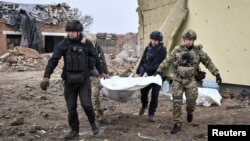
During the Oleshky cease-fire, Russian attacks continued outside the Kherson region. And on November 2, a day after it expired, Ukraine said Russia attacked a school in the adjacent Zaporizhzhya region where residents were receiving humanitarian aid, dropping at least 10 bombs in a “double tap” strike that left part of a town in ruins.
Zelenskyy called it a "vile" attack, saying that rescue workers and residents seeking shelter were targeted after the initial hit.
Days later, K-9 units and mine-clearing personnel were still working amid the debris, the State Emergency Service said. On November 5, the death toll reached 42, and as many as 33 people were still feared trapped under the rubble.