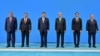

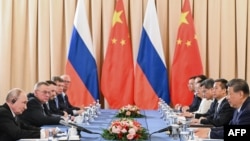

With a summit in Bishkek, the Shanghai Cooperation Organization (SCO) is turning 25 at a moment of extraordinary tension that touches directly on many of the increasingly sprawling regional group's members.
Iran is at war with the United States, Russia's war on Ukraine continues to rage with no sign of a let-up, China faces mounting US pressure over trade, and nuclear-armed foes India and Pakistan sit together despite deep rivalry, just to name a few.
The four Central Asian members -- host country Kyrgyzstan, Kazakhstan, Uzbekistan, and Tajikistan -- are regional players but also the objects of various nations seeking to increase their sway, including China, Russia, India, and the United States, which is not a member of the SCO.
In an interview with the People's Daily, the newspaper of the Central Committee of China's Communist Party, SCO Secretary-General Nurlan Yermekbaev of Kazakhstan touted the "Shanghai spirit," which he said involves mutual trust, respect, and benefit, among other qualities he asserted make the group appealing to the so-called Global South.
But behind these "shared values" are deep differences, with members using the SCO platform to pursue their own, often competing agendas.
Each member "has its own distinct position, and the major powers have views that differ from one another," Kyrgyz political analyst Emil Juraev said.
China and India "have differing positions on many issues, and there are also areas of dispute between them," Juraev said. "Russia is trying to exert influence on the world and…continues its war without stopping it. In addition, there is Iran. Everyone is waiting to see what Iran will do."
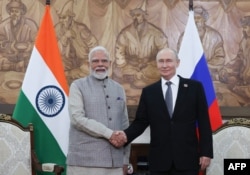
The 26th annual SCO summit marks 25 years since it was established by China, Russia, Kazakhstan, Kyrgyzstan, Tajikistan, and Uzbekistan. India, Pakistan, Iran, and Belarus are now members, and along with observer states and dialogue partners it represents nearly half of the world's population and roughly a quarter of the global economy.
"Bishkek has become a world capital today," a local paper proclaimed on August 31 as leaders gathered for bilateral meetings on the eve of the formal summit.
The September 1 meeting is expected to produce a Bishkek Declaration marking the anniversary along with thematic statements and decisions covering security, the economy, transport, environmental protection, artificial intelligence, and cultural and humanitarian cooperation.
Past gatherings have produced no momentous decisions, however, and for members large and small it may be more about show than substance.
Despite deep differences within the organization, the SCO gives its members and observers a platform to appear together on the international stage and project the weight of a larger collective, said Reid Standish, a nonresident research fellow at the Central European Institute of Asian Studies and a former RFE/RL correspondent.
"It may not have major policy achievements to its name and it can be hamstrung by its internal rivalries, but the SCO still clearly serves a purpose in bringing these leaders together in a forum that isn't dominated by Western powers," he said. "The SCO's leaders clearly attach meaning to this, otherwise they would not be attending."
China is the SCO's most influential member, and its economic weight has put Beijing at the center of mounting international pressure over trade.

Ahead of an August 31 meeting of G20 finance ministers and central bank governors halfway around the world in Asheville, North Carolina, US Treasury Secretary Scott Bessent said he would encourage members to rethink their trade with China, calling Beijing's roughly $1.2 trillion global trade surplus unsustainable.
Last week, Bessent urged countries to cut ties with Iran as part of an effort to "sever every economic lifeline that sustains this tyrannical regime until Tehran stands alone."
For Iran, the signal it hopes the SCO summit will send is that it is not alone.
"In the confrontation between Iran and America, we should expect stronger statements here, statements about Western influence and pressure or a declaration expressing disagreement with the processes in Iran or saying something along the lines of, 'You are doing the wrong thing,'" Kyrgyz political analyst Chynara Esengul said.
Likewise Russia, which is under increasingly tight Western sanctions over its war against Ukraine. In 2023, the International Criminal Court issued an arrest warrant for Putin on suspicion of war crimes over the illegal transfer of Ukrainian children to Russia.
For China, Standish said, SCO meetings "serve a useful purpose in providing important optics to the world that key global decisions can be reached without the presence of Western leaders."