

Accessibility links

Breaking News

Wider Europe

An estimated 1.5 million Russian citizens have taken part in combat operations in Ukraine since February 2022.

Welcome to Wider Europe, RFE/RL's newsletter focusing on the key issues concerning the European Union, NATO, and other institutions and their relationships with the Western Balkans and Europe's Eastern neighborhoods.

I'm RFE/RL Europe Editor Rikard Jozwiak, and this week I'm drilling down on two issues: How to prevent Russian combatants from entering the EU and how Brussels is planning to prolong the rights of Ukrainian refugees.

please wait

No media source currently available

0:00 0:09:47 0:00

Briefing #1: EU Looking At Ways To Keep Russian Soldiers Out

What You Need To Know: When the European Commission presented its proposals for the EU’s next sanctions package on Russia to member states earlier this month, one of the key suggestions was a Schengen-wide entry ban on anyone who has fought with the Russian army or pro-Kremlin militias in Ukraine over the past four years.

Initially, there were few details but now more information has emerged. Estonia was the first country signaling that Russians entering the EU could be a problem, pointing out to other EU capitals that some 1.5 million Russian citizens have taken part in combat operations in Ukraine since February 2022, with close to 650,000 still on active duty. Tallinn also warned that there was a link between ex-soldiers and increased violence inside Russia: An estimated 180,000 prisoners have been recruited to serve in special military units and many of these have already resumed criminal activities.

Deep Background: At the start of the year, with increased fears that many of these former combatants would also come to the EU, Estonia started to identify soldiers and ex-soldiers mainly using social media accounts and started slapping a so-called Schengen entry ban on hundreds of them. Such a ban, valid for five years, prevents any non-EU national from entering all EU countries apart from Cyprus and Ireland as well as non-EU Schengen members Iceland, Liechtenstein, Norway, and Switzerland. While the issuing or denial of visas is a national competence, an EU-wide approach would be necessary to make these bans really workable. And that is why EU member states -- both during leaders’ summits in March and now in June -- asked the European Commission to come up with various assessments on how to make it easier to ban these people. Last week, the commission delivered a three-page-assessment, seen by RFE/RL, on the subject of “possible ways to address the issue of Russian combatants” with the aim to agree on this -- as well as the other sanctions -- by the time EU foreign ministers meet in Brussels on July 13.

Drilling Down:

  • The first proposal is an update of the 2022 European Commission guidelines on visa issuance in relation to Russia visa applicants. The issuance of visas has already been very strict since Russia’s full-scale invasion of Ukraine in 2022, after Brussels suspended the visa facilitation agreement with Moscow. This has led to higher fees, longer waiting times, and more extensive documentation requirements.
  • Yet, this has still not prevented Russian citizens arriving in increased quantities on tourist visas often issued by southern EU member states dependent on tourism.
  • This change would provide additional guidance to EU member states on how to assess applications from former Russian combatants, notably that the burden of proof should be on the applicant and not the consulate of the EU member state assessing the application.
  • This would involve checks on all military-age males applying for visas, plus potentially conducting interviews as part of the application process -- something that is not standard procedure so far.
  • A second proposal empowers member states’ consulates and diplomatic missions in Russia and other non-Schengen countries to update the existing list of required supporting documents for Russian visa applicants. That would mean applicants, such as men of conscription age, have to submit their official military ID documents, which have a record of their military service.
  • A third, longer-term measure involves updating the EU visa code -- the legislation governing all types of Schengen visas. If adopted by a qualified majority of member states (55 percent of the 27 EU nations, constituting 65 percent of the entire EU population), this would allow the bloc to issue a blanket suspension, rejection, or restriction of visa applications submitted by “nationals of third countries that pose tangible risks to the Union’s security, public policy, or international relations,” according to a European Commission assessment.
  • This could mean no visas whatsoever for Russians, although this remains unlikely. What is more probable is that the European Commission could create targeted visa measures for specific categories, such as former and current Russian combatants.
  • Proposals regarding a change to the EU-wide legislative framework are already being worked on and could be presented for adoption in early 2027.


Briefing #2: Brussels To Prolong Protection Mechanism For Ukrainians -- But Will Make It Harder For Draft Dodgers

What You Need To Know: As expected, on June 26, the European Commission proposed to EU member states to prolong the EU-wide temporary protection mechanism for Ukrainian citizens who have fled the war to seek refuge in the bloc. The mechanism offers Ukrainian refugees immediate access to accommodation, health care, education, and employment. First proposed in the immediate days after the start of the 2022 full-scale invasion of Ukraine, the mechanism has been prolonged yearly without any issues. In the summer of 2025, it was extended by EU capitals until March 2027 for what was then believed to be the final time. Talks, led by the United States, on a settlement to end the conflict were then in full swing and EU officials were predicting that the “hot phase” of the war would be over by 2027.

Deep Background: Instead, the latest European Commission proposal notes that “In Ukraine, Russia’s war of aggression continues unabated. Russia persists in its deliberate and systematic targeting of civilian infrastructure and populated areas.” The document mentions that, according to the United Nations Human Rights Monitoring Mission in Ukraine, the number of civilian casualties in May rose by 93 percent compared to the same month in 2025 and adds that “this represents a significant escalation and underscores the sustained toll of the war on civilians.” It is therefore fair to say that confidence in a quick end to the war has evaporated in Brussels -- and the new proposal to extend the protection mechanism until March 2028 is the clearest evidence of that.

The very fact that EU member states pushed for extending the mechanism when their interior ministers met in June was another sign it's likely to be voted through as early as July. EU member states would prefer an over-arching EU system that is already in place rather than dealing with this on a national level. As one European diplomat, who wished to remain anonymous, told me: “No one has an interest in abruptly ending this arrangement as it would mean all those people would immediately request asylum thereby overwhelming the regular asylum systems in member states.”

Drilling Down:

  • And we are talking about a lot of people -- 4.4 million, out of which 58 percent are women and 30 percent are minors. The Czech Republic, Germany, and Poland are hosting the majority of them. While the numbers are stable, there has been a slight upward trend, with tens of thousands added every year over the last two years.
  • This upward trend is likely to continue for two reasons. Firstly, it appears it is not only EU bureaucrats that believe that the war won’t end soon. Ukrainian refugees living in the EU seem to believe so as well. While 61 percent still hope to return some time in the future, that number is steadily decreasing year by year. Secondly, as Russia continues to indiscriminately target civilian infrastructure in Ukraine, Brussels is also expecting that more and more people will seek refuge in the EU.
  • The European Commission proposal notes that there are over 3.7 million internally displaced people (IDPs) within Ukraine and that “the volatile situation, combined with the difficult humanitarian situation in Ukraine, could also lead to further arrivals at large scale into the Union resulting in the need to provide protection to an additional number of displaced persons.”
  • There is, however, one snag when it comes to this proposal: The EU will start becoming strict with Ukrainian draft dodgers. This has been a contentious issue for years: Kyiv has asked the EU to be stricter, and officials from EU countries have sometimes grumbled that there appears to be too many Ukrainian men of fighting age in the bloc.
  • The new proposal states that “temporary protection is not to be granted as a rule to persons who cannot provide evidence to national authorities that they are authorized by Ukrainian authorities, where applicable in Ukrainian law, to leave Ukraine in compliance with their military obligations.” This would apply to all Ukrainian men aged 23–60 attempting to enter the EU once the new rules would take effect (likely in August).
  • Ukrainian men already living in the EU will be exempt from the rules as the proposal states that many have already been in the EU for several years and “have integrated into their host societies by learning the language, finding employment, and enrolling in education. It is therefore appropriate that these persons retain the temporary protection status and its ensuing rights.”


Looking Ahead

Most of this week is dedicated to the run-up to the NATO summit in Ankara on July 7-8. Expect some European members to scramble to announce that they will increase defense spending in order not to fall foul of US President Donald Trump, who has constantly pushed Europe to step up. A full preview of the summit will appear in next week’s issue of Wider Europe, published just as the meeting gets under way in the Turkish capital.

That's all for this week! Feel free to reach out to me on any of these issues on Twitter @RikardJozwiak, or via e-mail at jozwiakr@rferl.org.

Until next time,

Rikard Jozwiak

If you enjoyed this briefing and don't want to miss the next edition subscribe here.
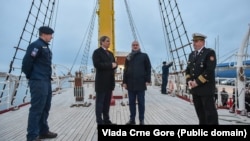
Ireland's prime minister Michael Martin (left) and other government ministers speak to during a press conference to launch the program of the Irish EU presidency in Dublin on June 10.

Welcome to Wider Europe, RFE/RL's new newsletter focusing on the key issues concerning the European Union, NATO, and other institutions and their relationships with the Western Balkans and Europe's Eastern neighborhoods.

I'm RFE/RL Europe Editor Rikard Jozwiak, and this week I am drilling down on one issue: EU enlargement as Ireland takes over the EU presidency.

please wait

No media source currently available

0:00 0:12:24 0:00

The Briefing: EU Enlargement High On Agenda As Ireland Takes Over Presidency

Ireland takes over the six-month rotating presidency of the Council of the EU on July 1, and that half year will be a significant one for the enlargement of the bloc for several reasons.

Montenegro might wrap up talks under Irish auspices, setting it on course to become EU member No. 28 by 2028. Ukraine, Moldova, and Albania are also set to continue their progress toward joining and there might even be some movement in the same direction for Iceland and Serbia.

There is also quite a buzz that it is the Irish taking over the baton. Dublin held the presidency when the EU carried out its big bang enlargement of 2004 -- welcoming eight Central and Eastern European countries into the club as well as Cyprus and Malta.
Speaking to Irish diplomats, they point out that this is still remembered fondly on the island and numerous public surveys show that the Irish are largely supportive of enlarging the club.

In Brussels, Ireland is also seen as a proper “honest broker” on the issue – one of the few member states whose government has never blocked any enlargement steps and doesn't have any bilateral issues with any of the candidate countries.

The issue is one of Dublin's top priorities for the coming months, and significant progress is therefore expected.

Montenegro -- No. 28 in 2028?

Montenegro is obviously the one to watch at the moment.

The small Western Balkan country has currently closed 16 out of 33 accession chapters, with each chapter corresponding to a policy area in which a candidate must adopt EU rules and regulations in that specific field.

Podgorica wants to close the remaining 17 during the Irish presidency. The Irish prime minister, Micheal Martin, was in Montenegro in early June in conjunction with the EU-Western Balkans summit and noted that it would be “challenging” to complete everything in the next six months but that this was Dublin’s goal.

Cyprus, the current holder of the rotating presidency, could still close up to three more chapters at the very end of June before it hands over the baton to the Irish who then hope to have regular intergovernmental conferences (known in Brussels as “IGCs”) in the autumn where more chapters will be closed.

An EU diplomat with knowledge of the matter noted that Montenegro needs to wrap up all the negotiations in 2026 or very early in the following year to be able to meet its target of becoming EU member state No. 28 in 2028. That timeline reflects the need for the accession treaty to be ratified by all 27 EU member states, a process that could take a year -- if not more.

It is also worth noting here that more frequent meetings are planned during the Irish presidency for the specific working group in Brussels that deals with the drafting of Montenegro’s EU accession treaty. Set up in April, the group started drafting in May and things have gone smoothly so far, according to European officials that RFE/RL has spoken to.

Albania Closing In

Cyprus may also manage to close the very first chapters with Albania at the end of June, but if it doesn’t, Ireland is expected to do so in July.

After racing to open all chapters in 2024-2025, Tirana has been stuck so far on trying to meet the so-called interim benchmarks in chapters 23 and 24, which deal with the rule of law. It finally managed to achieve this at the end of May.

With the bloc worried about the state of the judiciary and fundamental rights in many candidate countries, it is not enough to just open and close talks in those two chapters. Interim benchmarks must be met. Those benchmarks are set by all 27 EU member states, which must then unanimously determine that they have been fulfilled before establishing the closing benchmarks for the candidate country.

Having met its interim rule-of-law benchmarks, Albania could soon close three accession chapters: science and research, education and culture, and external relations.

How Fast For Ukraine And Moldova?

With Ukraine and Moldova continuing to move hand in hand through the enlargement process there was a breakthrough when the first cluster of five chapters were opened last week after Hungary had blocked this for over two years under the previous Fidesz-led government.

There is hope in the European Commission that the pair can open the remaining five clusters (containing the 28 remaining chapters) in late June or more likely when the Irish take over in July. According to the commission and most EU member states, Kyiv and Chisinau are ready to do this.

But there are doubts that it will go that fast.

Budapest may have recently softened its approach to some extent, but during the EU summit last week, Hungary’s new Prime Minister Peter Magyar deleted the wording “as soon as possible” from the summit’s final communique when referring to the opening of the remaining clusters. He had previously spoken about “no fast-track membership” for Kyiv, something that Ukrainian President Volodymyr Zelenskiy pushed for at the same summit.

Instead, Magyar has given a 10-15-year time frame for Ukraine to become a member. But there are indications that others are hiding behind Budapest. Slovak Prime Minister Robert Fico, for example, recently spoke about Ukraine’s membership as a “long-term, long-term process.”

A Polish Issue?

European diplomats who spoke to RFE/RL on condition of anonymity said that Czechia and, in particular, Poland appear comfortable with Budapest slowing down the process, as they “don’t have to express an exact opinion.”

A Polish diplomat said Warsaw has not yet adopted a position on the matter but believes opening all the remaining chapters and clusters at once would amount to a "fast-tracked" accession process, which it opposes.

Instead, Warsaw would prefer “a salami process” -- opening a few chapters at a time. In fact, Poland would be OK with opening cluster 6 on foreign policy now, but only that one.

One idea currently doing the rounds in Brussels is to open two clusters in July and the remaining three in the autumn. The same approach would apply to Moldova, even though there is no indication that any EU capital has major political isues with Chisinau. For now, however, there are no signs that the two countries will be decoupled in the accession process.

Nonetheless, the issue underscores a point European diplomats have been making for years: Hungary is unlikely to be the only obstacle to Ukraine's EU accession. The country's other immediate EU neighbors may also slow down Kyiv’s European integration.

The warning signs were already there for the last few years when farmers in many of the eastern member states pushed against the inflow of Ukrainian agricultural goods. Ask many officials or politicians from these countries and they will also complain about Ukrainian transport companies undercutting local haulers or general gripes about the “chronic corruption” in Ukraine that remains unresolved.

In Poland’s case, its complicated history with Ukraine is likely to spill over onto the EU scene. This was on full display when the nationalist Polish President Karol Nawrocki over the weekend decided to strip Zelenskyy of the Order of the White Eagle, the country’s highest state honor, because Ukraine has named a military unit after the Ukrainian Insurgent Army (UPA), a group blamed for the Volhynia massacres of tens of thousands of ethnic Poles in 1943-1945.

While the move largely could be seen as being about domestic politics – with the conservative Nawrocki trying to spar with the more liberal and Ukraine-friendlier Prime Minister Donald Tusk ahead of next autumn’s general election, these sorts of clashes could have consequences for Ukraine’s EU bid.

Nawrocki is tapping into anti-Ukrainian sentiment that has been around for a while in large segments of Polish society.

Two parties further to the right -- Confederation (Konfederacja) and the Crown (Korona) -- have been known to tap into anti-Ukrainian sentiment, and Nawrocki's Law and Justice party (PiS) is keen to win over those voters as it seeks to narrow the gap with Tusk's Civic Coalition (KO), which leads in the polls, albeit by a single-digit margin.

The episode could also put Tusk in a difficult position.

With a majority of Poles appearing to support Nawrocki's move, the Polish prime minister may find it harder to advocate for the rapid opening of all remaining accession chapters for Ukraine. As one Polish official put it to RFE/RL: "It may have provided us with an extra argument to go slower."

Serbia And Iceland Stepping Up?

It is also worth checking out two more countries that can start moving during the next six months.

One is Serbia.

With Montenegro and Albania steaming ahead, Belgrade is keen to get going as well, having stood still on its EU path since late 2021.

There is speculation in EU corridors that the country could open a whole cluster of chapters, dealing mainly with economics and competitiveness as early as July, particularly because France is pushing for this to happen.

Others, however, are still reluctant.

The Baltic states are fretting about Serbia’s nonalignment on the bloc’s Russia sanctions policy, even if their tough stance on this isn’t as principled as before.

Then there are countries, notably the Netherlands, which won’t want to see Belgrade moving forward on EU accession anytime soon due to serious rule of law issues in the country.

It could, however, be something to watch in the coming months.

Then there is Iceland.

The island nation applied to join the EU back in 2009 after it was shaken by a financial crisis.

Starting accession talks shortly thereafter, it managed to close 11 out of 33 negotiating chapters until a new government notified Brussels in 2013 that -- with the bloc in the middle of the eurozone crisis -- it was suspending talks.

That actually happened during an Irish EU presidency as well.

In a historical quirk, Iceland will now have a referendum in late August on whether to resume accession talks -- and Ireland is again at the wheel if the Icelanders vote in favour, which polls are indicating they might although the margin is tight.

This possibility has not gone unnoticed in Ireland with the country’s Europe minister, Thomas Byrne, noting that the Icelanders “suspended their negotiations during the last Irish presidency. So, if they were to restart from there, I think it would be a big moment for us.”

A Quartet Of Laggards

While there is a lot of movement on enlargement there are four countries that are expected to stand still -- Bosnia-Herzegovina, Georgia, Kosovo, and North Macedonia.

Due to internal complications, Sarajevo still hasn’t managed to nominate a chief negotiator for EU talks. Moreover, two laws that Brussels needed the country to introduce -- one concerning the functioning of the judiciary and another aimed at limiting political interference in the court system -- have not yet been passed.

In North Macedonia, constitutional changes needed to reflect the status of Bulgarians in the country have not yet passed and there is no indication that they will anytime soon.

Georgia is a candidate country in name only according to the European Commission. After numerous spats with Brussels, the Tbilisi government has effectively suspended any effort to launch accession talks until 2028. The stripping of its candidate status is considered unlikely, and EU officials note that the next move must come from Georgia.

Kosovo faces a different problem.

Although it submitted its EU membership application in late 2022, the request has yet to be forwarded to the European Commission for assessment. The reason is that the five EU member states that do not recognize Kosovo's statehood -- Cyprus, Greece, Romania, Slovakia, and Spain -- have not agreed to move the process forward.

Ireland is likely to test the waters with these five during its presidency. The last member state to try this was Sweden in early 2023, but Stockholm was rebuffed, notably by Madrid. Few in Brussels believe there will be any change on that front in the coming months.

That's all for this week! Feel free to reach out to me on any of these issues on Twitter @RikardJozwiak, or via e-mail at jozwiakr@rferl.org.

Until next time,

Rikard Jozwiak

If you enjoyed this briefing and don't want to miss the next edition subscribe here.

Load more

XS
SM
MD
LG