



Welcome to Wider Europe, RFE/RL's newsletter focusing on the key issues concerning the European Union, NATO, and other institutions and their relationships with the Western Balkans and Europe's Eastern neighborhoods.
I'm RFE/RL's Europe Editor Rikard Jozwiak, and this week I'm drilling down on two issues: Can the EU add Russia's GRU to its terror list? Plus, more rolling EU sanctions on Moscow.

Briefing #1: Can The EU Add The GRU To Its Terror List?
What You Need To Know: The European Union is at an early stage of exploring whether it is possible to put the GRU, Russia’s military intelligence agency, on the bloc’s terrorist list. The recent spate of hybrid attacks on various EU member states, many of them either directly or indirectly linked to GRU, has prompted diplomats and lawyers in the club to look into first if it is legally possible, and then to explore if there is enough political will around the table in Brussels to do so. The legality of such a move is being carefully studied, as the move by Brussels to terror list Iran’s Islamic Revolutionary Guards Corps (IRGC) in early January was a watershed moment for the EU. Previously, terrorist designations were reserved for clear non-state actors such as Hamas or Al-Qaeda. Listing the IRGC not only opened the possibility of targeting a formal branch of a sovereign state’s military and intelligence apparatus, but also codified the concept of “state-sponsored terrorism” in the EU’s legal framework. The EU designation of an entity or outfit as a terrorist organization must be based on a previous court decision in an EU member state or a trusted third country. In the case of the IRGC, the legal “smoking gun” was the 2023 ruling by the Dusseldorf higher regional court that an attempted arson attack against a synagogue in the nearby German city of Bochum a year earlier had been explicitly planned and carried out by the Iranian organization.
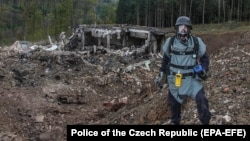
Deep Background: The challenge -- and something that is being looked into right now -- is if there is a similar ruling concerning the GRU. And that can prove tricky. So far, individual member states have officially charged GRU officers, often in absentia, under charges such as espionage or attempted murder -- but not terrorism. According to European diplomats that are familiar with the issue, national prosecutors are restricted to the technical definitions of their respective national penal codes. This means traditional criminal or intelligence-related charges but not terrorism. Look, for example, at the 2014 Vrbetice ammunition depot explosions in the Czech Republic. The country’s prosecutors did name two GRU officers as responsible but Czech law does not allow for a full criminal trial or conviction since the suspects remain in Russia. Or the Salisbury, England, Novichok poisoning targeting the former Russian agent Sergei Skripal and his daughter in 2018. Here, GRU agents (incidentally the same as in Vrbetice) were charged in absentia but for attempted murder and the use of chemical weapons -- not terrorism.
Drilling Down
- Perhaps the two most promising openings for pursuing the GRU as a terrorist organization come from Lithuania. In the first case, it involves an incident in 2024 when incendiary devices were supposed to be planted onto cargo planes bound for the United States and Canada but caught fire in warehouses in Germany, Poland, and the United Kingdom. Lithuanian prosecutors charged 15 individuals in 2025 with terrorism, but these people were GRU-recruited operational proxies rather than direct GRU officers. The question for the legal minds in Brussels to ponder is if this link is strong enough.
- Then there is the ongoing trial in the Baltic state in which six foreign nationals are accused of planning an arson attack in September 2024 targeting a private military supplier in the Lithuanian city of Siauliai that provides support to Ukraine. As in the first case, these people might be just proxies, but the link to GRU is allegedly a strong one, potentially paving the way for a terror designation.
- Even if there is a clear legal pathway to designate GRU as a terrorist organization on the EU level, the question is if there is political appetite to go that far. Unanimity among the 27 EU member states is needed and some might argue that keeping diplomatic channels of communication open is essential as Moscow might retaliate to such a move by targeting European embassies, missions, or even culture houses still in the country.
- The fact that the GRU is already sanctioned by the EU and hence has its assets in the bloc frozen and its leadership under visa ban should be sufficient, according to some Brussels officials. But more hawkish member states believe it is not enough. They note that a formal terror listing covers the entire institution, meaning that every single officer is targeted and therefore closes a loophole in which individuals not yet sanctioned could travel into the EU and operate more easily.
- Another argument put forward as to why the terror listing is necessary is that it opens up the door for European prosecutors and police forces to arrest and convict the local proxy networks, including EU citizens, that tend to carry out hybrid attacks on behalf of the GRU.
- It would also make it easier to issue EU-wide counterterrorism arrest warrants, as GRU operations would be fully integrated into Europol’s European Counter Terrorism Center (ECTC), and would strengthen cross-border intelligence tracking of the organization’s communications and safe houses within the bloc.
Briefing #2: The EU’s Rolling Russia Sanctions Continue
What You Need To Know: The European Union appears poised to continue adding to its Russia sanctions. Having seemingly moved away from big sectoral packages, the current method is to add more visa bans and asset freezes on people and companies on a monthly basis. When EU foreign ministers met on October 12, they formally approved the blacklisting of 1,600 new names, largely from the Russian military industry sector, taking the total number of people and entities sanctioned to over 4,600 since the full-scale invasion of Ukraine in 2022. When the bloc’s foreign ministers meet again on November 16, they hope to add more. A new proposal, seen by RFE/RL, was presented to the 27 member states’ ambassadors in Brussels on October 21.While smaller in scale than the previous blacklisting -- with only 12 individuals and 105 companies proposed so far -- some of the names in the new proposal are of a much higher level. In the previous round, most EU diplomats, when pressed, could not even name a handful of those sanctioned, reflecting their low significance.
Deep Background: Perhaps the most significant person to be newly blacklisted is Tatyana Kim, the founder and CEO of Wildberries, Russian largest online retailer whose warehouses have been a frequent target of Ukrainian strikes in recent months. The sanctions proposal notes that “Wildberries functions as a supply network for the Russian military by facilitating the sale of military and dual-use goods” and adds that “the company has formed a strategic partnership with majority state owned VTB Bank, an entity listed by the European Union.” Businesspeople such as Aleksandr Chachava, who is described as an “entrepreneur,” and Ruslan Baysarov, referred to as “a billionaire,” are also on the list. Chachava is the owner of Russian investment holding company JSC "O23," which holds the biggest stake in Russia’s second-largest e-commerce company Ozon. The document notes that “Ozon serves as a supply network for the Russian military by facilitating the sale of military equipment and dual-use goods.” On top of that he also holds a stake in the country’s biggest IT company Yandex, which “generates substantial revenue for the government of the Russian Federation.” Baysarov is the chairman of JSC Bamtonnelstroy-Most (BTS-Most), a major infrastructure and transport construction enterprise in Russia and has also acquired a controlling stake in BTS-Gold, a significant gold mining company that is already sanctioned by Brussels.
Another interesting name is Sergei Matvienko, a Russian businessman whose mother Valentina Matvienko is the chairwoman of the Federation Council, Russia's upper house of parliament, and already on the bloc’s sanctions list since 2014 for supporting the Russian annexation of Ukraine’s Crimean Peninsula at the time. Sergei Matvienko is proposed for blacklisting for being a shareholder of LLC Megalit-Okhta Group, one of Russia’s largest real-estate developers, which according to the text “acts as a major fiscal contributor to the budget of the Russian Federation.” He is also listed for his ownership of the Russian construction company LLC Parameter that “specializes in the collection, treatment, and repair of wastewater and sewage systems, working primarily with major clients on governmental contracts.” Other people on the list include managers of vessels transporting Russian oil as well as businesspeople involved in the Russian energy sector.
Drilling Down
- Among the entities, there are several smaller and medium-sized Russian banks, including several regional ones -- a clear strategy as the major Russian financial institutions have already been targeted. Many of them are being sanctioned for offering loan-repayment grace periods to members of the Russian armed forces, especially those involved in the war against Ukraine.
- There are also numerous companies on the suggested blacklist that control or own Russian oil refineries with the proposal stating that “the energy sector, in particular the oil sector, is a sector providing a substantial source of revenue to the Russian government.”
- Perhaps the most interesting aspect of the entities listed is how many of them are non-Russian. The EU has gradually started to target firms in other countries that it believes are aiding the Kremlin, and this is one of the most ambitious attempts yet.
- Several companies from the United Arab Emirates (UAE) are proposed for sanctioning. The EU sets out that these companies, often through shell companies, manage “vessels that transport crude oil or petroleum products originating in Russia or exported from Russia and practice irregular and high-risk shipping practices.”
- Two companies registered in the Seychelles are also proposed for targeting on the same grounds. In addition, several Chinese companies based in Hong Kong are included; they are either purchasing Russian oil or own multiple vessels already sanctioned by the EU for transporting Russian oil and petroleum products.
Looking Ahead
Look out for the EU-Canada summit in Montreal on October 29-30. The meeting comes as the pair seeks closer ties, with European Commission President Ursula von der Leyen having earlier in the year floated the still-undefined idea of offering Canada “associate membership” of the EU. That idea might not have much political mileage as such a thing doesn’t yet exist and Ottawa might also not have much interest, but Canada could instead join the EU’s Erasmus student mobility program and its Galileo satellite navigation system.
That's all for this week!
Feel free to reach out to me on any of these issues on X @RikardJozwiak, or on e-mail at jozwiakr@rferl.org.
Until next time,
Rikard Jozwiak
If you enjoyed this briefing and don't want to miss the next edition subscribe here.