

Accessibility links

Breaking News

Wider Europe

Welcome to Wider Europe, RFE/RL's newsletter focusing on the key issues concerning the European Union, NATO, and other institutions and their relationships with the Western Balkans and Europe's Eastern neighborhoods.

I'm RFE/RL Europe Editor Rikard Jozwiak, and this week I am drilling down on one issue: the upcoming EU summit, with a focus on Ukraine, Russia sanctions, and EU enlargement.

please wait

No media source currently available

0:00 0:11:49 0:00

The Briefing: The EU’s October Summit -- Sanctions, Enlargement, And Financing Ukraine

As European Union leaders gather in Brussels on October 15-16, the main media focus will most likely be on the almighty EU budget battle as the 27 prime ministers and presidents make their first real stab at finding a consensus for the next long-term EU budget for 2028-2034.

They will fail, as summits are already planned for November and December to potentially seal the deal. But there is no guarantee that they will strike an agreement then either, as the draft proposal of 1.6 trillion euros ($1.78 trillion) is dividing northern “frugals,” who want more cuts, and the rest, who want the budget to increase or at least stay the same.

The fight over cash in Brussels tends to be the fiercest and most drawn-out, and will divert much of the EU’s attention away from the bigger international issues confronting the bloc, such as the war in Ukraine and even its own process of admitting new members.

Yet, the draft EU summit conclusions, seen by RFE/RL, still offer some hints about what the bloc hopes to do on a number of foreign policy issues in the coming months.

Financing Ukraine

There was a sudden political storm brewing in both Brussels and Kyiv when Ukrainian officials began warning in early September of a military funding shortfall of as much as $27 billion.

Much confusion ensued as various other numbers were cited, and Ukrainian and European officials started studying what the issue was and whether the 90 billion euros ($100 billion) that the EU had agreed to lend Kyiv earlier in the year for 2026 and 2027 -- with 45 billion euros earmarked for each year -- would need to be restructured, notably by bringing forward some of the money allocated for 2027.

EU sources familiar with the discussions told RFE/RL that the changing estimates of Ukraine’s needs reflect the rapidly evolving situation. They explained that the cost of the military equipment Ukraine intends to purchase is rising, as are expenditures on military personnel salaries and compensation payments for the families of fallen soldiers.

However, through national budget reallocations and financial support from other international partners, Kyiv has been finding ways to cover its most urgent needs.

This was also confirmed in the draft EU conclusions, which note that the European Council “welcomes the ongoing disbursements to Ukraine from the EUR 90 billion Ukraine Support Loan for 2026 and 2027, including the recent disbursements of EUR 5.34 billion. It welcomes the fact that the means to cover Ukraine’s budget and defense needs for 2026 have been identified.”

But this is not the end of the story.

While 2026 is covered for now, EU diplomats believe that Ukraine will use up the remaining 45 billion euros in the first half of 2027, meaning that the gap avoided this winter will likely reappear a year later. That means the EU will have to find more money, as the bloc’s next long-term budget, which is expected to include more funding for Ukraine, won’t kick in until 2028.

It is therefore very possible that the discussion about using the billions in frozen Russian assets held in the bloc will come into play again at some point. This definitely won’t happen at this week’s summit, but the issue could return to the agenda at the summits scheduled for November and December and is almost certain to resurface early next year.

Symbolic Sanctioning And Estonian Embarrassment

The draft summit conclusions mention that “the European Union remains determined to further increase pressure on Russia so that it stops its brutal war of aggression and engages in meaningful negotiations towards peace. The European Council welcomes the recent adoption of the 21st sanctions package and of a substantial number of further listings of individuals and entities.”

Despite what initially looks like a straightforward call for more sanctions on Moscow, there is a subtle but important difference here.

In previous years, and at earlier summits, EU leaders have consistently pushed for further measures, meaning additional sanctions packages. But after the difficulties that dogged the 21st round of sanctions, which were only approved after a lot of wrangling in July, it is clear that the bloc is inching away from adopting new economic sanctions and is instead now essentially just adding more names to its blacklist.

And while the headline figure of almost 1,600 new listings, officially approved on October 12, sounds impressive -- marking the largest-ever addition to the EU sanctions list -- those targeted are hardly household names. In fact, they all belong to Russia's domestic military-industrial complex, which has hardly any assets in the bloc to begin with.

But not everything has been plain sailing, even with these seemingly straightforward listings.

Embarrassingly, Estonia, a sanctions hawk, asked for one company and one person to be removed from the originally proposed list seen by RFE/RL. The entity was the Solikamsk plant, which exports rare earth materials and the individual was its CEO, Ruslan Dimukhamedov.

With most of the company’s EU exports going to Estonia, the Baltic state confirmed that it had pushed the bloc not to sanction it.

In a statement given to RFE/RL, the Estonian EU representation noted that “the company provides NPM Silmet, which is based in Estonia, with strategically important materials for Europe. European industries who are reliant on NPM Silmet include electric vehicle manufacturers, wind turbine producers, and the electronics, automotive, and aviation sectors across the European Union.”

The statement also noted that “NPM Silmet is actively looking for alternative sources for the materials it imports from Russia. Estonia will revisit listing the Russian company and person next year.”

The whole affair illustrates how even the most ardent supporters of Ukraine in the EU have national economic interests tied to Russia that they simply won’t compromise on, making a mockery of the bloc's push for tougher sanctions on the Kremlin.

Visas For Russians

While traditional sanctions policy appears to be taking a backseat for now, the issue of restricting more Russians from entering the EU is gaining traction in Brussels.

The EU is still working on banning Russians who have fought in Ukraine from entering the bloc on Schengen tourist visas, with the draft summit conclusions calling for “the swift implementation of the measures concerning Russian ex-combatants.”

This is the most obvious sign that even Mediterranean countries like France, Italy, and Spain, which rely heavily on tourism, are moving closer to agreeing to measures that could require Russian applicants to submit military service documents when applying for Schengen tourist visas in the future.

Interestingly, the text also mentions the need for “reviewing and tightening visa requirements and policy regarding Russian nationals.”

According to EU officials, this means work is also underway to restrict the territorial validity of Russian tourist visas, so that visa holders would no longer be allowed to travel freely throughout the Schengen zone but would instead have to remain in the country that issued their visa.

There is also a push to stop recognizing non-biometric Russian travel documents, including diplomatic and service passports.

When it comes to Russian diplomats already in the EU, efforts are also afoot to restrict their movements. Currently, Russian diplomatic and consular personnel in EU countries are generally only required to notify authorities when traveling to another member state, but the proposal would introduce a requirement to obtain prior authorization from the country they intend to visit.

A limit on how long Russian diplomatic personnel can remain in their host countries is also under consideration, as European counterintelligence services are keen to curb long-established spy networks, in which diplomats stationed in one place for extended periods often play a key role.

The Clock Is Ticking For Montenegro

This week will be hailed as yet another momentous one for EU enlargement, with Albania set to close another EU accession chapter on October 13, the same day that Moldova and Ukraine are due to open talks on a whopping 17 chapters, bringing their total to 24 out of 33, after overcoming yet another initial Hungarian red light.

Perhaps the most interesting country to watch now, however, is the absolute frontrunner Montenegro, which is entering a crunch period in its quest to become the EU's 28th member state by 2028.

The draft EU summit conclusions note that “the European Council welcomes the ongoing work on drafting the accession treaty with Montenegro and notes the intention of the Council Presidency to reach an agreement on the provisional closure of all negotiating chapters by the end of this year, based on the implementation of the corresponding reforms by Montenegro.”

This sounds promising, but not everything is going swimmingly.

The drafting of the accession treaty, which the European Commission and Podgorica are hoping to have fully negotiated by spring and signed by the summer, is not progressing quickly enough so far.

The working group dealing with the drafting is still meeting only once a week in Brussels. By now, meetings should be taking place more frequently, suggesting that not all EU member states are equally keen to accelerate Montenegro's accession process.

The goal of closing all chapters by the end of the year also seems to be hanging by a thread.

Yes, the country closed talks on three chapters on October 12, taking its “tally” to 21 out of 33, but those chapters had already been slated to be closed in September.

There had also been hopes of closing another four chapters this month, but that now looks unlikely to happen before November.

Croatia is behind most of these delays, as it still has a lot of bilateral scores to settle with its smaller neighbor.

On transport policy, for example, Zagreb initially raised concerns about “cabotage,” the right of a transport company from one EU country to provide services in another, amid fears that cheaper Montenegrin truckers would undercut Croatian competitors. That issue has since been resolved, but Zagreb is now raising concerns about the way Montenegro’s maritime agency operates.

Most of the disputes, however, concern historical issues, which would normally be addressed under Chapter 31, covering foreign policy. But with Montenegro yet to close that chapter, these disputes threaten to spill over into negotiations on other chapters as well. Worryingly, talks on closing Chapter 31 haven’t even begun.

The Croatian demands include several issues stemming from the Yugoslav wars of the 1990s.

Take, for example, the Zoran Gopcevic swimming pool in the Montenegrin city of Kotor. Zagreb is demanding that the facility be renamed, as Gopcevic was a guard at the Morinj camp during the conflict, where hundreds of Croatian prisoners were held in inhumane conditions and even subjected to torture.

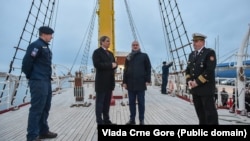
Then there is the issue of the “Jadran,” a three-masted sailing ship built in 1933 that was historically based in the Croatian coastal city of Split and which Zagreb wants returned to Croatian control. When the Yugoslav wars broke out in 1991, the “Jadran” was in Montenegro, where it has remained ever since, with Podgorica claiming that the ship's presence on its territory at the time of Yugoslavia's dissolution gives it legal ownership.

On top of this, there are also land and maritime border disputes between the two countries and discussions over billions of dollars in war reparations, which could slow down the accession talks even further.

That's all for this week!

Feel free to reach out to me on any of these issues on Twitter @RikardJozwiak, or via e-mail at jozwiakr@rferl.org.

Until next time,

Rikard Jozwiak

If you enjoyed this briefing and don't want to miss the next edition subscribe here.
Welcome to Wider Europe, RFE/RL's newsletter focusing on the key issues concerning the European Union, NATO, and other institutions and their relationships with the Western Balkans and Europe's Eastern neighborhoods.

I'm RFE/RL Europe Editor Rikard Jozwiak, and this week I'm drilling down on two issues: the EU's new enlargement strategy and the EU's game plan to keep Russia (and Belarus) out of sports.

please wait

No media source currently available

0:00 0:12:48 0:00

Briefing #1: The EU’s New Enlargement Strategy

What You Need To Know: The European Commission is on October 6 presenting its long-awaited pre-enlargement strategy, outlining how a potentially bigger European Union in the future could function. The draft document, seen by RFE/RL, will be debated for the first time when EU leaders meet in Brussels for a summit on October 15-16 and will be a jump-off point for the potential changes that need to be made as candidate countries are approaching membership. Perhaps the most controversial ideas in the document concern the diluted EU membership that newcomers would experience in the event that some of these proposals indeed become rules. In many ways, it reflects the fears in some EU capitals of taking in poorer, unprepared countries with diplomats privately talking about the need to “avoid another Hungary” -- a reference to the many rule of law issues that faced Budapest under Viktor Orban.

Deep Background: Though not explicitly spelled out, the strategy is written with the four current front-runners -- Albania, Moldova, Montenegro, and Ukraine -- in mind. With Montenegro still aiming to be EU member 28 by 2028 and the other three hoping to join shortly thereafter, the document argues that enlargement is “not only about preparing candidate countries to join the Union. It is equally about preparing the Union to welcome new Member States while strengthening its capacity to deliver.” Most of the 16-page paper is dedicated to classic Brussels discussion points that either are already happening or will never see the light of day as EU member states struggle to enact them. In the latter category, the European Commission is repeating its long-held belief that more decision-making in the club, notably in foreign policy, should move from unanimity to qualified majority voting (55 percent of member states representing at least 65 percent of the total EU population). But the document concedes that this very move requires unanimity and hence would stumble on the same obstacle as all previous efforts to make changes.

In the former category, the idea of candidate countries gradual integration into the EU in various areas is already under way. Key examples are Moldova and Ukraine, which are already in the EU’s “Roam Like at Home” cell data program, and the non-EU Western Balkan countries, which are on track to join the same scheme. Or take the Single Euro Payments Area (SEPA), which several EU hopefuls recently became part of or soon will be.

Drilling Down:

  • What is new in the paper -- and would make any new EU addition something of a second-tier member -- are the proposed safeguard measures. Essentially, there are three new ideas spelled out here. Firstly, the text notes that “new Member States would undertake, for a limited period, not to oppose Council decisions requiring unanimity.” This would mean that a newcomer cannot exercise a veto on, for example, most foreign-policy issues, such as sanctioning Russia. This limited period could stretch up to 15 years.
  • The text further explains that “new member states could also undertake not to prevent an otherwise existing consensus in the European Council. Such commitments would apply not only to sectoral policies but also to cross-cutting institutional matters, including decisions relating to future enlargements.” Though not explicitly stated, there is a fear in Brussels that new member states would block EU membership for neighboring candidate countries, often in order to extract some bilateral concessions, which is not exactly an uncommon practice to date. This is what Slovenia did over land and maritime border disputes when Croatia was negotiating its EU entry, delaying Zagreb’s membership by nearly a year. Unsurprisingly, Croatia is currently putting on the brakes when it comes to Montenegro’s accession talks, blocking the closing of several key accession chapters to put maximum pressure on Podgorica in numerous areas of policy.
  • The second proposal in the paper is even more contentious. (We know that because, for a long time, it was the only part in the text that was in parentheses, meaning that it wasn’t settled internally within the European Commission until the very last moment.) The passage concerns the length of legal safeguards, which act as a sort of "phased-in probationary system" for new members in order to protect existing EU economies. Most of these are safeguards in the fields of economics, the internal market, and home affairs and essentially mean that a new member either isn’t fully participating yet or that it easily can be suspended from aspects of cooperation if the country is backsliding politically. These safeguards are normally there for three years, but the European Commission is pushing for them to remain up to 10 years.
  • That is not the only thing. The European Commission wants additional safeguards. The third, new proposal is “a temporary institutional safeguard clause.” This would kick in if there is “a particularly serious breach” of common EU values and would include “the temporary suspension of specified rights deriving from membership, such as voting rights in the Council.” This is essentially the EU’s famous nuclear option, known as Article. 7. Both Hungary and Poland were previously under the Article 7 procedure even though their voting rights were never stripped. The two countries were protecting each other, as the move to take away their voting rights required consensus.
  • What the European Commission now is proposing is that voting rights for fresh members could be removed for a while by a simple qualified majority, which is substantially easier to achieve than unanimity. The rule, however, would not apply to current members, meaning that democratic backsliding in an older member would be more difficult to punish.


Briefing #2: Europe’s Game Plan To Keep Russia (And Belarus) Out Of Sports

What You Need To Know: When European Union foreign ministers meet in Luxembourg on October 12 , they will have an initial discussion on how to address the slow but steady return of Russian and Belarusian athletes in various international sport competitions. The reason is essentially two-fold. Firstly, to find a common position after the International Olympic Committee (IOC) earlier in the summer decided to provisionally lift the suspension of the Russian Olympic Committee (ROC) -- a move that essentially can lead to athletes representing Russia at the 2028 Los Angeles Summer Olympics instead of participating as neutrals. (The same decision on Belarusian athletes came earlier in the spring).

The move is also seen as a way to avoid any “nasty surprises” in this field, as one EU diplomat recently put it, referring to a similar dilemma in the cultural sphere where the European Commission was caught off guard when the Venice Biennale allowed Russia to reopen its national pavilion at the prestigious art exhibition. The move eventually led to Brussels cancelling a 2 million euros grant for the period 2025-2028 for the Biennale and also offered some lessons for the future. One is to keep a close eye on other financial contributions. The European Commission has already begun reviewing all EU program funding that goes to European sports federations. And while there isn’t too much direct money going into this area from the EU budget, there is plenty that goes into the field indirectly via cohesion funds, which is money transferred to the bloc’s poorest regions to catch up economically. Normally, most of this cash goes to the building of roads and other big infrastructure projects but member states sometimes use this money to refurbish sports facilities.

Deep Background: But money is the nuclear option here. Now, the focus is to get all member states on the same page and to make sure there is proper outreach worldwide to counter Moscow’s and Minsk’s return to global sport. For the former, the aim is to simply avoid a potentially embarrassing situation in which one EU member state refuses to host a competition because of Russian participation while another member state doesn’t have the same qualms. So far, no such moment has occurred yet. But it is trickier with other non-EU European countries, for example, Turkey and Serbia, which don’t align with the bloc’s general sanctions policy on Russia. If these two countries get to host lucrative sports events, the fear in Brussels is that EU members will complain that they're missing out.

When it comes to global outreach, it partly depends on how strong Europe is both when it comes to athletic prowess and sponsorship deals from European companies. But don’t underestimate Russia’s outreach in the so-called “global south,” which, according to one EU official with knowledge of the issue, successfully sells a narrative of Europe being neocolonial, controlling, and politically inconsistent, while letting Israel compete in major tournaments. So, Europe may be losing, even though the final whistle hasn’t yet been sounded. The IOC decision in early July came after the ROC delivered on its promise to close regional sports bodies set up in occupied Ukrainian territories. But the decision isn’t a total welcome to Russian officials, who remain banned from attending events and there is still no final decision on allowing national flags, colors, or anthems. Crucially, individual sports federations have the final say whether to keep the ban in place or not. Some, such as the international federations overseeing equestrian, volleyball, and ice skating moved immediately to welcome back the Belarusians and Russians after the IOC decision. Bodies for aquatics, fencing, and gymnastics had lifted their bans shortly before the IOC decision, anticipating the change of rules. Crucially, however, big -- and for Russia, symbolic -- federations such as athletics, chess, ice-hockey, and soccer remain reluctant to change so far.

Drilling Down:

  • European officials say that Russia has been successful in using“salami tactics,” in which they argue that children should be able to compete with national flags in any sport and then gradually lifting the ban in higher and higher age categories.
  • European officials are adamant that they don’t want a total ban on Russian athletes competing. They would prefer Russian athletes to compete under a neutral banner, with some proof that those athletes aren’t supporting Moscow's war against Ukraine.
  • There are some tools European officials can use, but they are largely centered around competitions in Europe, not worldwide. One idea is tweaking the EU’s vast sanctions framework on Russia, which has been imposed since the full-scale invasion of Ukraine in 2022. There are already plenty of bans on European services doing business with Russia, for example, the prohibition to offer IT services. The idea now is that any services related to sport could be added to the sanctions framework. While this would not prevent Russian teams from competing in international tournaments going forward, it would at least ensure that European nations aren’t funding Russian sports. The move would need the unanimity of all 27 member states, and, given that it has become harder to agree on more restrictive measures on Moscow in recent months, this may not fly
  • Then there is the whole issue of visas for Russian athletes entering the EU to take part in sports competitions. The issuance of visas to Russians has already become a hot topic in Brussels, as several countries are pushing to ban Russian ex-combatants from entering the bloc on tourist visas. The travel of Russian athletes could get caught up in a similar discussion.
  • One of the reasons why the ban on the issuance of tourist visas for former Russian soldiers hasn't been adopted so far -- apart from Mediterranean countries such as France, Italy, and Spain raking in money from Russian tourism -- is that the various checks that European consulates in Russia need to carry out are already considered too long. With fewer staff at the consulates, many of them Russian, the idea that staff will now have to check previous military service could be a nonstarter. The Russian state has also threatened Russian staff with legal action if they ask about such documentation.
  • Checking athletes traveling to events in the EU-- and whether they support Russia’s war -- should be easier, because there are far fewer of them than the millions of tourists seeking to enter the bloc.


Looking Ahead

It's European Parliament plenary week in Strasbourg and the chamber will, on October 7, debate the move by Georgia's ruling Georgian Dream party to ban several opposition parties. The following day, lawmakers will vote on a nonbinding resolution on the issue, which most likely will call on Brussels to impose targeted sanctions on leading Georgian politicians. That's something that there isn’t consensus on among EU member states.

That's all for this week!

Feel free to reach out to me on any of these issues on X @RikardJozwiak, or on e-mail at jozwiakr@rferl.org.

Until next time,

Rikard Jozwiak

If you enjoyed this briefing and don't want to miss the next edition subscribe here.

Load more

​
XS
SM
MD
LG