

Welcome to Wider Europe, RFE/RL's newsletter focusing on the key issues concerning the European Union, NATO, and other institutions and their relationships with the Western Balkans and Europe's Eastern neighborhoods.
I'm RFE/RL Europe Editor Rikard Jozwiak, and this week I am drilling down on two issues: Croatia’s demands before giving the green light to Montenegro’s EU accession and Georgia’s growing irrelevance in Brussels.

Briefing #1: Croatia’s Many Demands On Montenegro Ahead Of Potential EU Membership
What You Need To Know: Montenegro’s hopes of finishing its European Union accession talks by the end of the year and joining the club by 2028 have taken a hit after its neighbor and the most recent country to join the bloc, Croatia, presented its final eight demands to Podgorica and fellow EU member states.
Croatian officials said that they had communicated them to Montenegro during the summer, and in early October they circulated a paper in Brussels, seen by RFE/RL, titled “Outstanding Issues Between Croatia And Montenegro.”
The document states that “certain unexpected unilateral actions by the Montenegrin authorities have rekindled historical tensions and unnecessarily strained bilateral relations, risking the erosion of broad political support for Montenegro’s accession in Croatia.”
Not surprisingly, many of the issues hark back to the breakup of Yugoslavia in the 1990s and matters that remain unresolved, with the text stating that “Croatia sincerely wishes to turn the page on this painful chapter of shared history and build a forward-looking relationship with Montenegro. Yet mutual trust and genuine, lasting reconciliation cannot be built without resolving these issues.”
Deep Background: During the EU summit in Brussels on October 15-16, Croatian Prime Minister Andrej Plenkovic also fleshed out what Croatia is still demanding from Montenegro before giving its green light to the country’s EU accession.
While diplomats from many member states told RFE/RL that they have privately expressed annoyance with Zagreb’s position, which they describe as “unhelpful” and coming at the “eleventh hour” when many are keen to get Montenegro onboard, EU leaders were more understanding of Plenkovic’s position -- perhaps suggesting that enlargement isn’t really the top priority of the union after all.
They said that the Croatian leader was “excellent” in communicating what his country wants to see from Montenegro and that he received very little pushback.
This was also reflected in the final EU summit conclusions adopted by the European Council, which brings together the bloc’s leaders. The text states that the council “notes the intention of the Irish Council Presidency to work towards the provisional closure of the remaining negotiating chapters, subject to the implementation of the corresponding reforms by Montenegro.” There was no enthusiastic endorsement or warm welcome, with the emphasis instead firmly on Podgorica delivering on its commitments.
So far, Montenegro hasn’t reacted publicly to the Croatian demands, making it even harder to gauge how serious the situation is and how long it may take to resolve the outstanding issues.
Ireland, which holds the rotating council presidency until the end of the year, is still hoping to close the remaining 12 accession chapters out of the 33 Montenegro needs to become a member, but hardly anyone thinks Dublin will succeed.
A Lithuanian diplomat with knowledge of the file thinks that even Vilnius, which takes over the presidency for the first half of 2027, will struggle to get the talks over the line now.
Drilling Down
- So, what exactly is Croatia asking for? Two of the eight demands concern the Morinj camp, where over 300 Croatian nationals were detained between October 1991 and August 1992, following the occupation of part of the Dubrovnik region by Serbian and Montenegrin forces.
- The first is compensation. The paper states that Zagreb “expects a comprehensive settlement of the issue of compensation for Croatian nationals who were detained and subjected to ill-treatment.” No figure has been mentioned, however.
- The second demand concerns a memorial plaque at the site. The plaque was jointly unveiled by Croatian and Montenegrin ministers in 2022, but the paper notes that Montenegrin nationalist groups have called for its removal and that “a larger metal frame has since been installed around it, apparently to accommodate a removable panel that could conceal the plaque except during official commemorations.”
- The third demand also has indirect links to Morinj. It concerns the name of a swimming pool in the Montenegrin city of Kotor that Zagreb wants to change. It is named after Zoran Gopcevic, a former internationally renowned water polo player, who also served as a guard at Morinj. The paper adds that it is “unacceptable for a sports facility to bear the name of an individual associated with the ill-treatment and torture of Croatian detainees.”
- Another demand involves securing the full “cooperation of the Montenegrin authorities in efforts to establish the fate of 14 Croatian nationals who went missing during the war of aggression against Croatia in the early 1990s”
- Perhaps the trickiest demand is the fifth, which is closely related to the previous one and concerns the prosecution of war crimes. The document notes that “to date, no convictions have been secured on the basis of command responsibility. In the Morinj case, four members of the Yugoslav People’s Army (JNA) were convicted of war crimes by final judgments and received sentences totaling twelve years’ imprisonment. However, these convictions did not encompass crimes committed against civilians detained at the camp.”
- Zagreb is also calling on Podgorica to settle property disputes dating back to the early 1990s involving 51 Croatian families that lived in Montenegro at that time.
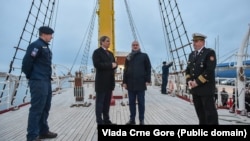
- Then there is perhaps the most publicly prominent dispute -- the potential restitution of the ”Jadran” sailing ship. The three-masted vessel, built in 1933, was historically based in the Croatian coastal city of Split, but when the war broke out, it was in Montenegro, where it has remained ever since. Podgorica maintains that the ship's presence on its territory at the time of Yugoslavia's dissolution gives it legal ownership.
- Finally, Croatia is also calling for “continued and intensified dialogue on the delimitation of the border between the two countries.” According to the document, this should result in a treaty that “formally confirms that Montenegro has no territorial claims against Croatia.”
- Interestingly, the maritime border between the two countries also remains unresolved, but the document does not make clear whether settling that dispute is also a condition for Montenegro's EU accession. Instead, it notes that “once the land border issue has been resolved, Croatia would be prepared to convene regular meetings of the expert and intergovernmental commissions responsible for maritime delimitation, without setting specific deadlines.”
Briefing #2: Georgia Fading Further From Brussels’ Radar
What You Need To Know: If there is one piece of evidence to show how little Georgia matters in Brussels these days, it is surely the debate on the South Caucasus republic held by foreign ministers at their monthly council gathering in Luxembourg on October 12.
Initially slated to be a full discussion point, it was relegated to a short “any other business” (AOB) item on the agenda at the very start of the gathering, with not even all foreign ministers taking the floor.
And the main conclusion of that short discussion was even more telling -- ministers agreed to return to Georgia as a full discussion point, but not until January.
In the meantime, the European Commission will publish its annual enlargement report on November 4, in which it is expected to reiterate last year's assessment that Georgia is an EU candidate country “in name only,” without stripping it of its candidate status.
Deep Background: However, a diplomatic note from the foreign affairs meeting, seen by RFE/RL, shows that many of the member states that took the floor, including Estonia, Germany, Latvia, the Netherlands, and Poland highlighted the deterioration of the political situation in Georgia, including what they described as “democratic backsliding” and growing pressure on civil society. They also noted that the Georgian authorities had not shown any willingness to engage with the EU.
The debate came as the ruling Georgian Dream party was pushing to outlaw five opposition parties, although that specific move was not touched upon in the note.
Another issue absent from the discussion was Georgia’s visa liberalization status, with a decision to be made on the issue in the first months of next year at the latest.
As a direct result of the controversial parliamentary elections in Georgia in the autumn of 2024 and the subsequent deterioration of the political climate, Brussels suspended visa liberalization for holders of Georgian diplomatic passports earlier this year.
The most likely scenario is that the suspension will be extended by another 12 months, or potentially even 24. Extending the suspension to ordinary Georgian citizens, however, is still not being seriously entertained, with many EU member states reluctant to punish the population for the actions of its government, even if the political situation deteriorates further
Still, several EU officials with knowledge of the file, speaking on condition of anonymity, maintain that the EU can’t kick the can down the road forever and that, should Brussels eventually suspend visa-free travel more broadly for any country, Georgia would be the most likely candidate.
Drilling Down
- Another measure that was introduced regarding Tbilisi was the scaling down of political contacts at the EU level (even though member states are still free to bilaterally receive Georgian ministers or make official visits to the country).
- In keeping with that policy, the foreign ministers agreed that Georgia would be invited to a ministerial meeting organized by the bloc on cross-regional security and connectivity in November but not at the highest political level, meaning that a civil servant most likely will represent Georgia.
- What the EU has failed to agree on so far is sanctions, which require unanimity. And judging from the discussions among foreign ministers, as well as an earlier preparatory meeting of EU diplomats, divisions appear too deep for the bloc to agree anytime soon on restrictive measures targeting Georgia's political leadership.
- According to the diplomatic note, Croatia, Greece, Portugal, and Slovakia stressed the importance of keeping “channels of communication open” with Tbilisi to ensure Georgia remains “anchored to the EU.” Bulgaria, Hungary, Italy, and Slovakia also emphasized the same message in the preparatory meeting.
- During the ministerial meeting, Sweden asked the EU’s diplomatic corps, the European External Action Service (EEAS), to revisit an earlier sanctions proposal targeting the Georgian judiciary, which had handed down what Brussels viewed as “disproportionate” sentences against anti-government protesters.
- Stockholm also urged the EEAS to propose new restrictive measures. Whether this will happen remains unclear, however, given the apparent lack of unanimity among member states.
- Sweden is not alone in calling for more sanctions. During the preparatory phase, Germany, Ireland, and Poland also suggested sanctions as part of “a dual track” approach, under which human rights abuses should be punished with sanctions but that the EU should also be pragmatic and seek cooperation on “issues of mutual interest,” such as regional security, connectivity, and the fight against organized crime.
Looking Ahead
The European Commission will publish its new “Arctic Strategy” on October 20. Among other things, the document is calling for greater European icebreaker capacity, increased investment in Greenland -- including a submarine cable connecting the giant island with mainland Europe -- and the establishment of an EU polar research hub.
That's all for this week!
Feel free to reach out to me on any of these issues on X @RikardJozwiak, or via e-mail at jozwiakr@rferl.org.
Until next time,
Rikard Jozwiak
If you enjoyed this briefing and don't want to miss the next edition subscribe here.