


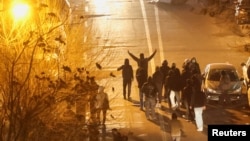
For years the European Union has failed to achieve unanimity from its 27 member states to put Iran's Islamic Revolutionary Guards Corps (IRGC) on its terrorist list. Tehran's deadly crackdown on anti-government protesters over the past two weeks, however, may have finally changed that.
The bloc is now weighing more asset freezes and visa bans against individuals responsible for the crackdown on Iranian protesters, and the measures could potentially be ready by the time the bloc's foreign ministers meet in Brussels on January 29.
No sectoral sanctions are expected, but there has been talk that the decision to add the IRGC to the terrorist list -- meaning certain IRGC officials could be arrested if they set foot in an EU member state -- would be largely symbolic.
"Time for action: The EU should list the IRGC as a terrorist organization and impose targeted sanctions on human rights violators and those enabling repression through shutting down communication channels," Dutch Foreign Minister David van Weel said in a statement on January 12.
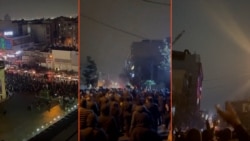

Reuters has reported that around 2,000 Iranians have been killed in protests that erupted late last month in Tehran's markets amid spiraling inflation and a free fall in the currency. The unrest since has broadened into a countrywide anti-government movement.
Anouar El Anouni, an EU spokesman for foreign affairs, told reporters on January 12 that the discussion among member states "has been ongoing under confidential rules as per established procedure."
What Are The EU's Current Sanctions Against Iran?
The EU's current sanctions on Iran can roughly be divided into three categories -- and they already target the IRGC in various ways.
The oldest, from 2011, concerns human rights violations and consists of roughly 230 sanctioned individuals, including members of the IRGC and some 40 entities such as branches of that organization as well as state broadcaster Press TV and the country's so-called morality police.
Apart from asset freezes and visa bans, there is also a general prohibition against selling dual-use goods or providing various financial services to Tehran. This sanctions regime, which is up for renewal in April, is likely to be used again by Brussels in the coming weeks.
Then there is a second type of sanctions related to Iran's export to Russia of drones that have been used in Moscow's full-scale invasion of Ukraine. Here some 20 people and 20 organizations are targeted, including shipping companies, the Iranian airlines, the IRGC's naval branch, and other military outfits linked to the organization.
The third and final sanctions are also the most substantial as they relate to Iran's nuclear program.
These were reimposed in September 2025 in a so-called snapback, with Iran deemed to be in violation of the Iran nuclear deal (also known as Joint Plan of Action, JCPOA) agreed by the international community in 2015 to limit the country's nuclear program.
These measures are largely sectoral and target the country's oil and gas sectors and its banking system. This leaves few sectors left for Brussels to target in future sanctions. And the snapback hits a lot of businesses affiliated with the IRGC.
So while the IRGC as a whole isn't yet sanctioned by the EU, various branches and members of it are.
Adding the IRGC to the EU's terrorist list would therefore largely be symbolic. There are currently 22 organizations on that list, including the Directorate for Internal Security of the Iranian Ministry for Intelligence and Security, another outfit with links to IRGC.
While many EU member states are in favor of listing the IRGC as a terrorist group, to date there has been no consensus.
When the issue was debated previously, then EU foreign policy chief Josep Borrell noted that EU capitals needed a prior court ruling, in any EU member, to classify the outfit as such.
Since then, a Dusseldorf court in 2023 linked an attack on a synagogue to the IRGC, even though there is still some debate in Brussels as to whether this is a sufficient legal basis.
But that's not the only potential obstacle. There are political ones, as well. EU officials to whom RFE/RL has spoken under condition of anonymity say there is also hesitation to list an organization that is officially a state entity due to fears this could harm diplomatic relations.
And while the JCPOA is dead for now, there is still hope that it could be resuscitated in some form. Contacts, including within the IRGC, would be needed.
Finally, there are also large Iranian diasporas across Europe with families still in Iran, whom EU member states don't want to endanger in case there is any retaliation from Tehran.
This is also why many EU member states are reluctant to reduce the number of Iranian diplomats at various embassies around the bloc. While most EU member states did this in a coordinated manner regarding Russian officials a few years ago, there is currently no imminent decision to do the same with Iran.
In a January 12 letter to members of the European Parliament seen by RFE/RL, chamber President Roberta Metsola, however, announces a decision to "ban all diplomats, staff of diplomatic missions, government officials, and representatives of the Islamic republic of Iran from entering any premises of the European Parliament."
"The people of Iran can continue to rely on this Parliament for support, solidarity, and action," she added.