




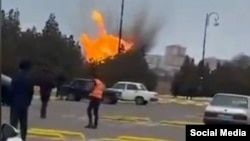
Drones launched from neighboring Iran have struck Azerbaijan's Nakhchivan autonomous region, injuring two people, according to Azerbaijan's Foreign Affairs Ministry. One drone struck Nakhchivan Airport on March 5, damaging the facility. A second drone landed near a school in the Shekerabad area, the ministry said.
President Ilham Aliyev said that "Iran committed an act of terror against the territory of Azerbaijan, against the state of Azerbaijan" with the attack.
"Iranian officials must provide an explanation to the Azerbaijani side, an apology must be offered, and those who committed this terrorist act must be held criminally liable," Aliyev said during the meeting of the Security Council.
The Azerbaijani Foreign Ministry condemned the strike, saying it would only increase tensions in the region linked to the ongoing conflict involving Iran, Israel, and the United States Iran's ambassador to Azerbaijan has been summoned to the ministry in Baku to explain the incident.
"Azerbaijan reserves the right to respond," the ministry said.


Iran has denied the drone attack on Azerbaijan.
"The Islamic republic of Iran, while respecting the sovereignty of all countries, especially Muslim and neighboring countries, denies the launch of drones by the armed forces toward the Republic of Azerbaijan," the General Staff of the Armed Forces said in its statement.
Iran’s Deputy Foreign Minister Kazem Gharibabadi told the Azerbaijani pro-government media outlet Anewz.tv that the Islamic republic is "not targeting neighboring countries."
He added that Iran would only take action if there are military bases in the region being used to launch attacks against the country.
Azerbaijan is one of the main oil suppliers to Israel, while Israel has been a key defense partner for Baku for years. Many in Azerbaijan see Israel as a reliable ally that supplied critical military equipment during the country's campaign to regain control of the Nagorno-Karabakh region from Armenia.
Turkish Foreign Minister Hakan Fidan discussed Iranian drone attacks in the Nakhchivan exclave during a phone call on March 5 with his Azerbaijani counterpart, Jeyhun Bayramov, according to Reuters and Turkish media.
Beyond historic and cultural ties, the 2021 Shusha Declaration commits Turkey and Azerbaijan to consult and take joint action if either country believes its independence, sovereignty, territorial integrity, or security is under threat from a third state.
During the Karabakh War with Armenia, Turkey strongly backed Azerbaijan politically and supplied military equipment, although Baku has consistently denied that Turkish forces took part in combat.
Being a NATO member and sharing a border with Iran, Turkey has reportedly been a target of Iran.
NATO air defenses destroyed an Iranian ballistic missile fired toward Turkey, Ankara said on March 4.
Iran denied firing a missile toward Turkey.
"Right now, Iran has no reason to strike Azerbaijan, because neither Azerbaijan nor Turkey has been part of the war," Rauf Mirgadirov, an independent analyst based in Europe, told RFE/RL.
"This drone attack on Nakhchivan airport is either an accident or a sign that there is larger escalation in the region," he said.
Despite its trade and defense ties with Israel, Azerbaijani officials have repeatedly said the country will not allow its territory or airspace to be used by any country to launch military operations against neighboring Iran or any other state.
"There are millions of Azerbaijanis living in Iran, and Tehran would not want to provoke them."