




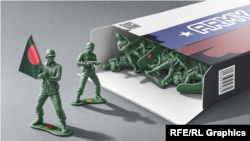
Twenty-two-year-old Razan Hossain was promised a construction job in Russia. Instead, he found pain and death on the battlefield in Moscow's war against Ukraine.
Hossain and his family had hoped for a better future when the high-school graduate boarded a plane in Dhaka, Bangladesh, on May 7 alongside 30 fellow countrymen.
His father was ill and the prospect of making the good wages promised by recruiters had lured him to leave his homeland.
Those hopes were shattered within days.
Instead of joining a construction crew, Hossain found himself at a frontline Russian military camp, where he was handed an automatic rifle and a large supply of ammunition.
He, along with several fellow countrymen, were then ordered -- with almost no training -- to push ahead of Russian units as they advanced toward the front lines.
Families and individuals in Bangladesh interviewed by RFE/RL say they were initially recruited for civilian jobs but were later sent to combat zones.
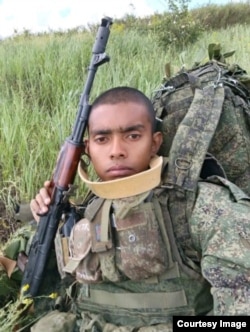
Hossain is among the few Bangladeshis who managed to return home from the war after surviving severe injuries to his legs that have left him needing crutches to walk.
“Twenty of my fellow countrymen were killed in drone strikes right before my eyes,” Razan told RFE/RL, confirming recent reports that many Bangladeshis have been moved to the front -- sometimes with deadly results -- in Russia's war against Ukraine.
Instead of a bit of financial security, "everything is lost," he quickly adds.
Razan's story also backs up accusations from the United Nations and many rights groups who have accused the Kremlin of luring foreign nationals to Russia on promises of work, only to use them as fodder on the front lines of a war they didn't seek to join.
Estimates from intelligence sources and war monitors say Russia is struggling to replenish its forces amid alarming casualties numbering by several estimates at more than 1.5 million since the full-scale invasion was launched in February 2022.
A UN report last month went as far as accusing Russia of recruiting foreign nationals from at least 29 countries in some instances through “deception” and by committing “trafficking" and other violations of human rights.
"The [UN Human Rights] Commission has now found evidence that nationals from 29 countries across continents have been recruited into the Russian armed forces in coordination with agents operating around the world," it said in the report.
"The victims, all men, were enlisted in the Russian armed forces through deception and fraud. They were lured to the Russian Federation by agents exploiting their vulnerabilities and enticing them to accept false offers of civilian employment that appeared lucrative, genuine, and credible."
Russian authorities have consistently denied any allegations of deceptively or illegally recruiting foreign nationals. They say all foreigners fighting alongside its forces do so entirely voluntarily through formal military contracts.
Construction Job Offer
Hossain, who is from Bangladesh's southwestern Jhenaidah district, says his story started when a recruiting agency called Jabale Noor offered him employment in Russia.
With his family's financial situation dire, he says he wasted no time accepting the offer. His family sold land to arrange for the visa and travel expenses -- around 1 million Bangladeshi taka (roughly $8,000.)
He says the recruiting agency offered him, along with 30 other young men, 75,000 rubles (roughly $930 ) a month to work at a construction job.
They landed in Moscow on May 7 and were immediately sent to a war zone hundreds of kilometers away, he said.
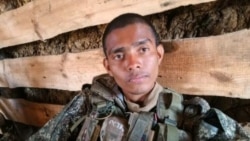
There, a group of 30 Bangladeshis was divided into three groups, Hossain said, with each sent in a different direction with a different Russian military unit.
“I was recruited as an electrician helper and had all the necessary legal documents for the job. But they forced me to fight,” he said.
On June 14, Razan was wounded in a drone strike. Instead of transporting him to a hospital to tend to what were severe injuries, the commander of his unit refused and only administered minimal first aid.
"I was deprived of food and beaten when asked for proper treatment.... My lower body was burnt and I had lost hearing, but they did not pay any heed," Hossain, who returned to Bangladesh in late August after receiving help from a sympathetic doctor and the Bangladeshi Embassy in Moscow, added.
Foreign Nationals Fighting For Russia
Rights groups say Russia has scoured countries far and wide for young men it can lure from home. As part of its pitch, Moscow dangles money and other potential benefits, they say.
In May 2023, Russian President Vladimir Putin signed a decree simplifying Russian citizenship for foreign nationals who sign contracts for military service in Russia's Armed Forces.
Amnesty International says it conducted interviews at two Ukrainian prisoner of war camps between 2024 and 2026 that found individuals from Brazil, Colombia, Cuba, Egypt, Sierra Leone, Sri Lanka, Somalia, and South Africa who had all been recruited to fight for Russia.
“Amnesty’s research demonstrates how Russia’s Armed Forces are bolstering their ranks with economically vulnerable foreign nationals and using them as cannon fodder in the war of aggression against Ukraine," said Agnes Callamard, Amnesty International’s secretary-general.
“Building on pre-existing exploitative migration pathways and abusive practices towards migrants and refugees in Russia, recruiters have developed a system of coercion, fraud and deception, including false promises of civilian or non-combat employment, to enlist foreigners in the military.
"Once victims sign the paperwork, often in a language they do not understand, military commanders restrict their movements, deploy them to the front lines with minimal preparation, and threaten those who seek a way out,” Callamard said.
Bangladesh, a country where one-fifth of its 176 million people live in poverty, is used to sending workers abroad.
For example, estimates say that around 5 million Bangladeshis live and work in the Middle East, making Bangladesh the second-largest source of migrant workers in the region after India, with Pakistan ranking third.
Some families also send their children abroad to take advantage of offers for education.
The family of Asif Faijay Nayan said they sent their son to Moscow after getting an offer for him to attend medical school in Moscow. But first, he had to serve four months in the war.
His mother, Firdaus Nigar, told RFE/RL that his tour of duty was to end October 15. Before that date they heard regularly from him. Since then, nothing.
“His colleague has contacted me to tell me my son is safe, but our concern will not go away until we hear his voice,” she said, adding that others have told her her son is “sick and in hospital.”
Data from Bangladesh’s Bureau of Manpower, Employment, and Training’s Overseas Employment Platform show that a total of 7,449 Bangladeshis were issued employment clearances in Russia between January 1, 2025 and October 27, 2026.
A joint investigation by the Bangladeshi-based nongovernmental organizations Fortify Rights and Truth Hounds in March indicates that at least 104 Bangladeshis were recruited in the Russian military and at least 34 were killed.
Dhaka-based journalist Mohammad Jamil Khan told RFE/RL that Bangladeshis recruited through local agencies typically receive six-month Russian work visas.
When those visas expire, he explained, the workers are given two options: sign a new contract to join the Russian military and have their visas renewed, or leave the country usually having made less than they spent to get there.
The Dhaka-based NGO BRAC claims Russian authorities seize passports and phones from the Bangladeshi migrants who were then forced to sign “voluntary service agreements” before their deployment to military sites.
It has called on the government to look into the thousands of Bangladeshis still in Russia to stop more from being forced to fight.
“The government needs to find out how many are still working there, how many have become involved in the war and how many are still alive,” Shariful Islam Hasan, director of BRAC’s Migration Program, told RFE/RL.
RFE/RL contacted the Bangladeshi Foreign and Interior ministries regarding the number of Bangladeshis, both documented and undocumented, in Russia and the nature of their jobs, but received no response.
Enemy Bait
Bangladeshi authorities, meanwhile, say they are investigating the situation, while confirming that at least 17 men who arrived in Russia in early May were killed on their first day of deployment to the war.
Last month, they arrested two men suspected of trafficking at least 30 Bangladeshi citizens to Russia with promises of high-paying jobs. A search for another two, Kyrgyz-Russian nationals, who worked with recruiters Jabal-e-Noor, RS International, and TS Overseas Limited, is still under way.
No charges have been filed against any of the three recruiters.
Meanwhile, Mohammad Asaduzzaman, head of Bangladesh’s Special Response Battalion (SRB), in October accused the Russian military of using Bangladeshis as bait to locate the enemy positions.
“Russian forces determined their next course of action after the Bangladeshis fell victim to a [Ukrainian] drone attack,” he told journalists of the attack Hossain said he survived.
Hossain says that while his life has been devastated -- he can't walk without help and can't work because of his state of health -- he was lucky to return.
Many relatives of those killed are demanding Russian and Bangladeshi authorities help recover and repatriate the bodies of their loved ones who remain missing.
Firoza Khatun told RFE/RL that her son, Yasin, went to Russia after being recruited to work for a company in September 2024.
Three months later, he told his family that he was headed to the front lines of the war.
Khatun said she spoke with her son on March 25, 2025, before all communication between them stopped.
A week later, one of her son's colleagues said Yasin was dead. Further contacts with other Bangladeshi colleagues, she said, confirmed he died on March 27.
“His body is still in Russia,” said Khatun.
“Our last wish is to bury my son’s body at our own home in Bangladesh in accordance with religious rituals…but we are helpless.”

