




Israeli and Lebanese representatives will meet in Washington next week, a State Department official said hours after Israeli Prime Minister Benjamin Netanyahu called for talks with Lebanon, where a heavy Israeli bombardment targeting Hezbollah militants has shaken the two-week US-Iran cease-fire deal.
"We can confirm that the Department will host a meeting next week to discuss ongoing cease-fire negotiations with Israel and Lebanon," the official told RFE/RL on condition of anonymity on April 9.
The Israeli strikes, which Lebanon's Health Ministry says killed more than 303 people on April 8, threatened to upend the temporary truce and upcoming talks between US and Iranian officials in Pakistan, which brokered the cease-fire agreement.
"In light of Lebanon's repeated requests to open direct negotiations with Israel, I instructed the cabinet yesterday to start direct negotiations with Lebanon as soon as possible," Netanyahu said in a statement.
"The negotiations will focus on disarming Hezbollah and establishing peaceful relations between Israel and Lebanon."
Shortly before Netanyahu’s statement, Lebanese President Joseph Aoun said that “the only solution to the situation in Lebanon is to achieve a cease-fire between Israel and Lebanon, followed by direct negotiations between them.”
Reuters cited a senior Lebanese official as saying Lebanon had spent the last day pushing for a temporary truce to allow for broader talks with Israel. The official said that no date or location had been set and that Lebanon needed the US as a mediator and guarantor of any agreement, Reuters reported. Netanyahu had rejected an offer for direct talks with Lebanon in March.
The US and Iran reached the two-week cease-fire agreement late on April 7, just hours before a deadline set by US President Donald Trump. But a dispute over whether the deal includes Lebanon has heightened tension and clouded prospects for progress.
Lebanon Dispute
Iran says the truce includes Lebanon. The US and Israel say it doesn't, and Netanyahu said in a social media post earlier on April 9 that Israel would "continue to strike Hezbollah wherever required, until we restore full security to the residents of the north," referring to the part of Israel that borders Lebanon. The US and Israel consider Hezbollah a terrorist organization.
The US-Iran cease-fire agreement was also strained by the situation in the Strait of Hormuz, a crucial artery for ships carrying oil and gas from the Persian Gulf to global markets. There is no sign Iran has fully lifted its blockade of the strait, which has caused the worst disruption to global energy supplies in history.

A statement attributed to Iran's supreme leader, Ayatollah Mojtaba Khamenei, and read out on state TV on April 9, said Iran “will definitely bring the management of the Strait of Hormuz to a new stage,” but did not provide details.
“Iran is not seeking war but will not forfeit its rights,” it said.
Tehran said there would be no deal as long as Israel was striking Lebanon. In a post that came hours after Netanyahu's, Iranian parliament speaker Mohammad Baqer Qalibaf said Lebanon was "an inseparable part of the cease-fire." He added that "violations carry explicit costs and strong responses."
Iranian President Masud Pezeshkian called the April 8 strikes on Lebanon a "blatant violation of the initial cease-fire agreement" and said "the continuation of these actions will render negotiations meaningless."
Qalibaf is expected to lead Tehran's delegation, along with Foreign Minister Abbas Araqchi, in Pakistani-mediated talks in Islamabad. Vice President JD Vance is to lead the US delegation.
Several countries have expressed concern the issue of Lebanon and the Israeli bombardment threaten to unravel a deal that suspended the war after more than five weeks of fighting, which began with US and Israeli air strikes on Iran on February 28.
"Israeli actions are putting the US-Iran cease-fire under severe strain. The Iran truce should extend to Lebanon," the European Union's top diplomat Kaja Kallas said on April 9.
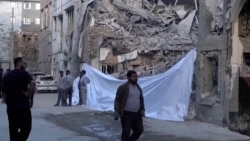


"Hezbollah dragged Lebanon into the war, but Israel's right to defend itself does not justify inflicting such massive destruction," she said.
Also on April 9, French Foreign Minister Jean-Noel Barrot said Israel's attacks "undermine" the US-Iranian agreement, while British Foreign Secretary Yvette Cooper called for the cease-fire to include Lebanon.
A Russian Foreign Ministry statement said Sergei Lavrov had stated during a call with his Iranian counterpart that the deal "extended to Lebanon."
On April 9, US media outlet NBC news cited an unnamed senior US administration official as saying Trump asked Netanyahu in a phone call a day earlier to scale back Israel’s strikes in Lebanon to help ensure the success of the Iran negotiations, and that Israel agreed “to be a helpful partner.”
Later in the day, the Israeli army warned it was striking Hezbollah launch sites in Lebanon after stating that the militant group could expand launches targeting Israel.
'Legitimate Misunderstanding'
Vance, during a visit to Hungary, said on April 8 that he believes there was a "legitimate misunderstanding" about the terms of the truce announced the night before.
"I think the Iranians thought that the cease-fire included Lebanon, and it just didn't," he said, adding that "neither us nor the Israelis said that that was going to be part of the cease-fire."
Meanwhile, Trump has said that American forces will remain in place "in, and around, Iran" until a "real agreement" is reached.
"Despite all of the fake rhetoric to the contrary - NO NUCLEAR WEAPONS and, the Strait of Hormuz WILL BE OPEN & SAFE," he added.
So far, shipping through the strait, one of the world's most vital arteries for transit of oil, gas, and other critical commodities, remains almost entirely paralyzed.
Official Mourning In Iran, Lebanon
In Tehran, the authorities appeared to take advantage of the lull in fighting to stage official events to mourn the death of Supreme Leader Ayatollah Ali Khamenei, who was killed in an air strike on February 28.
State TV showed mass crowds on the streets, with Iranian flags and large portraits of Khamenei. Owing to the war, a state funeral has still not been held.
Khamenei's son, Mojtaba, was appointed his successor on March 8 but has still not been seen in public. This may be for security concerns, following a series of targeted killings of senior leaders, but it has also prompted speculation about his health amid reports that he himself was badly injured.
Lebanon is also observing an official day of mourning following the Israeli strikes the previous day. Ahead of a cabinet meeting, Lebanese Health Minister Rakan Nassereddine said 203 people were killed in the April 8 air strikes, and more than 1,000 people were wounded.
UN Human Rights Chief Volker Turk has said the "scale of the killing and destruction in Lebanon today is nothing short of horrific." The Red Cross said it was "outraged by the devastating death and destruction" across Lebanon.

Minimal Hormuz Traffic
Early on April 9, Iran's hard-line Islamic Revolutionary Guards Corps (IRGC) announced alternative routes for ships traveling through the strait citing the risk of sea mines in the main zone of the waterway.
"All ships intending to transit the Strait of Hormuz are hereby notified that in order to comply with the principles of maritime safety and to be protected from possible collisions with sea mines...they should take alternative routes for traffic," state media quoted the IRGC as saying, while providing instructions for an alternative entry and exit routes.
Earlier, a senior Iranian official said ships navigating the strait still required IRGC permission to pass.
Prior to the war that began with US-Israeli air strikes on February 28, ships moved freely through the strait without the need for coordination with Iran.
According to data from maritime monitor Marine Traffic, four ships passed through the waterway on April 8.
It added that “hundreds of vessels remain in the region, including 426 tankers, 34 LPG carriers, and 19 LNG vessels, many of which had been effectively stranded during the disruption.”
Media reports suggested that shippers were awaiting more clarity before resuming transit.



