




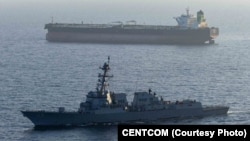
WASHINGTON -- The US Navy's blockade of Iranian ports, now in its third week, has stopped almost all of the country's maritime trade, including key oil exports. But it has also ratcheted up tensions between the two sides as they hold sporadic peace negotiations.
RFE/RL spoke with former US Central Command (CENTCOM) Communications Director and retired US Army Colonel Joe Buccino on April 27 to discuss the escalating situation and the strategic "staring contest" now defining the region.
Colonel Buccino also served as a spokesman for Secretary of Defense James Mattis during US President Donald Trump's first term and is the author of When Every Word Counts: How to Earn Trust, Command Attention, and Communicate Clearly in Any Situation.
RFE/RL: How would you describe the current US naval posture in the Strait of Hormuz, and what does the situation tell us about where this conflict stands right now?
Joe Buccino: It's a bit of a stalemate. Both sides feel like they have leverage, and I think both sides are right to feel that way. It seems the Trump administration does not feel time pressure; they don't feel a need to cave on any of their objectives at the moment. Iran probably feels the same way.
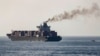
RFE/RL: We're seeing reduced traffic through the strait, with only limited vessel movement. There are also reports that Iran is allowing some ships through under specific conditions, even demanding payment in its own currency. How do you interpret that?
Buccino: Iran feels they have control of this critical body of water and that they can maintain it for the coming months. They will continue to use this as leverage over the Trump administration.
In Tehran's view, they are adding economic, psychological, and economic warfare pressure. They are claiming there are mines in the strait, although we don't really know if they remain, where they are, or what kind they are.
It is an interesting snapshot into how Iran intends to continue adjudicating this war.
RFE/RL: From a strategic standpoint, how central is the strait to Iran's leverage, and how does the United States factor that into its planning?
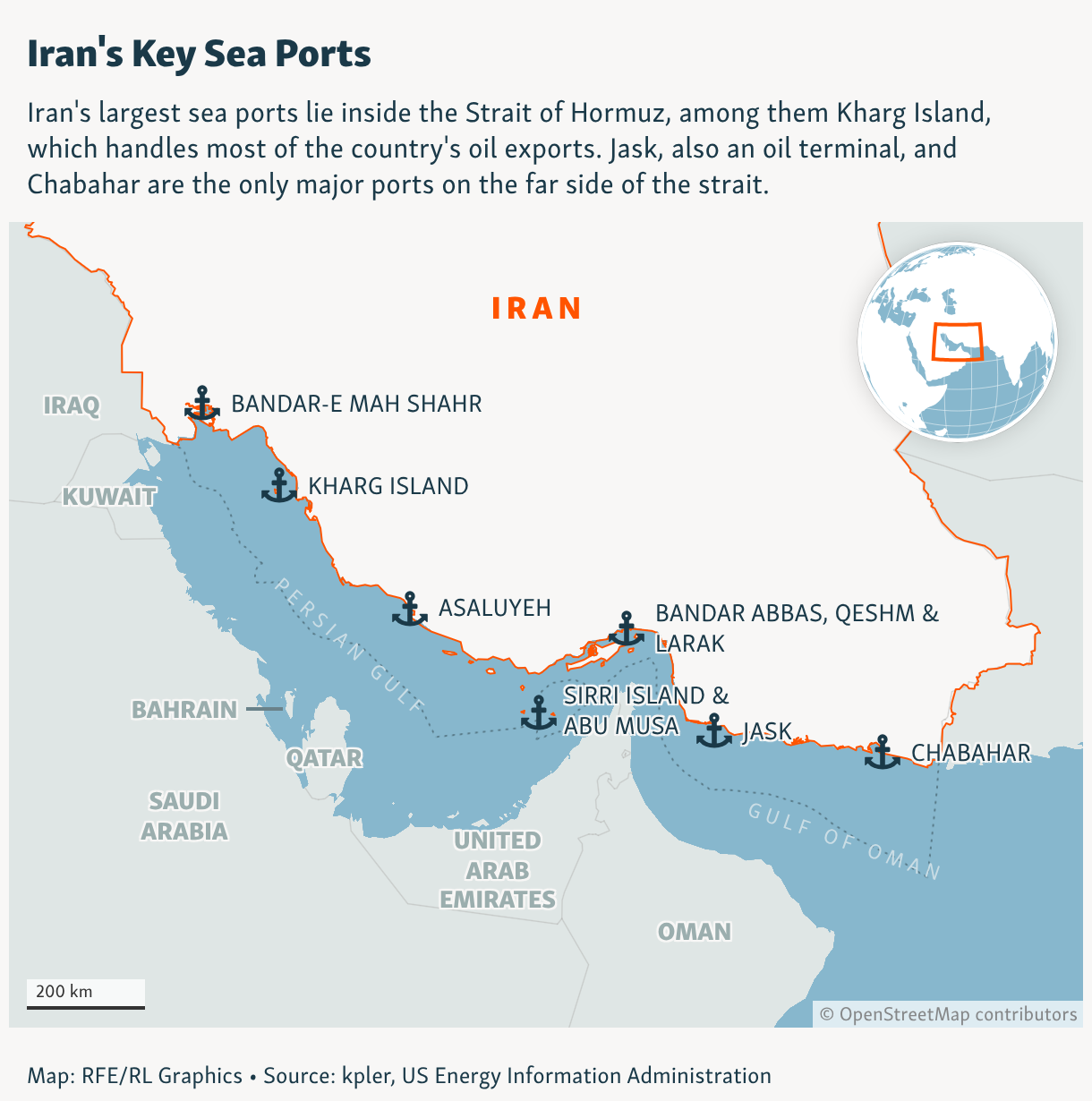
Buccino: When this conflict began in late February, the strait was open. Now it is effectively closed, and that shift matters globally.
Iran understands this creates economic pressure far beyond the region; oil markets, global trade, and energy security are all affected. At the same time, the US has deployed significant naval power, including three carrier strike groups -- more than at any point in the region since 2003. What you have now is essentially a staring contest: each side waiting to see who yields first.
RFE/RL: Is time working in favor of the United States or Iran?
Buccino: Both parties feel like time is on their side. Iran is looking at US domestic politics: the oil prices in the US and Europe, the polls, and the fact that we are five months away from the midterms. All of that goes into their calculus.
Meanwhile, Trump has been clearer than ever that he doesn't feel this pressure to move quickly. He feels he has the opportunity to deliver a "knockout blow" regarding Iran's nuclear capability. That has always been critical in his mind. Outwardly, at least, he isn't feeling the pressure of the clock.

RFE/RL: How are Iran's low-cost capabilities shaping US naval operations? What are commanders most focused on in protecting forces?
Buccino: The risks in the Strait of Hormuz often come from weapon systems that do not cost very much.
Think about drifting mines; these are WWI-style "dumb" mines. They aren't moored to anything; they just drift on the surface. We don't know where they are, and Iran doesn't either. They blend in with debris, wood, and fishing equipment.
Then you have the "three guys in a truck" scenario: coastal firing points shooting drones that cost only a few thousand dollars. They fly so low to the water that they are hard to pick up on radar. By the time you see them, they are on top of you.
Despite our cutting-edge assets, these are great risks. But we are publicly committed to holding this blockade until Iran opens the strait and agrees to discontinue its uranium enrichment.
RFE/RL: A recent US pilot rescue mission deep inside Iran drew significant attention. What lessons from such operations apply to the current situation?
Buccino: It demonstrates that we can move Special Forces and Marine assets into the actual territory of Iran to provide force protection.
If you think about an operation to remove enriched uranium from the country, that would require massive resources -- ground forces, overhead cover, and earth-moving equipment -- all under fire. That rescue operation proves we have the capacity to do this through the coordination of Central Command and Special Operations.
RFE/RL: Iran is also engaging internationally, including with China, Russia. How much does that relationship matter here?
Buccino: If any country has outside influence, it's probably China, though even that is limited. There is talk of China sending its newest air defense systems to Iran, which could identify an F-15, something Iran currently cannot do.
RFE/RL: Russian President Vladimir Putin met with the Iranian foreign minister on April 27, and reports indicate he "received a message" from the new supreme leader, Ayatollah Mojtaba Khamenei. Does that signal anything important?
Buccino: There is a reason you haven't seen the ayatollah or even heard his voice lately. He is likely two miles underground, under concrete, communicating via slips of paper. It is hard to get information to him, and hard to get decisions out.
The Iranian leadership is fragmented between the Islamic Revolutionary Guards Corps (IRGC), the parliament, and the mullahs. There is a massive time lag because you have to wait for word back from Mojtaba Khamenei.
I was never under the illusion this would take a few weeks. The regime's priority is protecting the ayatollah, and that complicates any potential negotiations.
RFE/RL: If tensions escalate further, what indicators are you watching for?
Buccino: I'll be looking to see if we move on Kharg Island. To me, that is the natural progression.
We've already "softened" the island by destroying most of its air defense systems. We have the 82nd Airborne Division in theater ready to conduct an aerial assault to seize the oil. If you seize that oil, you hurt the regime's ability to pay and resupply the IRGC.
If the IRGC stops getting paid and runs out of ammunition, they might start putting down their weapons. That is where you deliver the knockout blow. We are a long way from that -- we are still hoping for a negotiated end to the uranium program -- but if we reach that goal, this will all have been worth it.

