




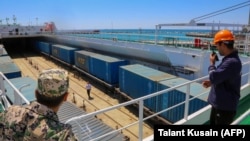
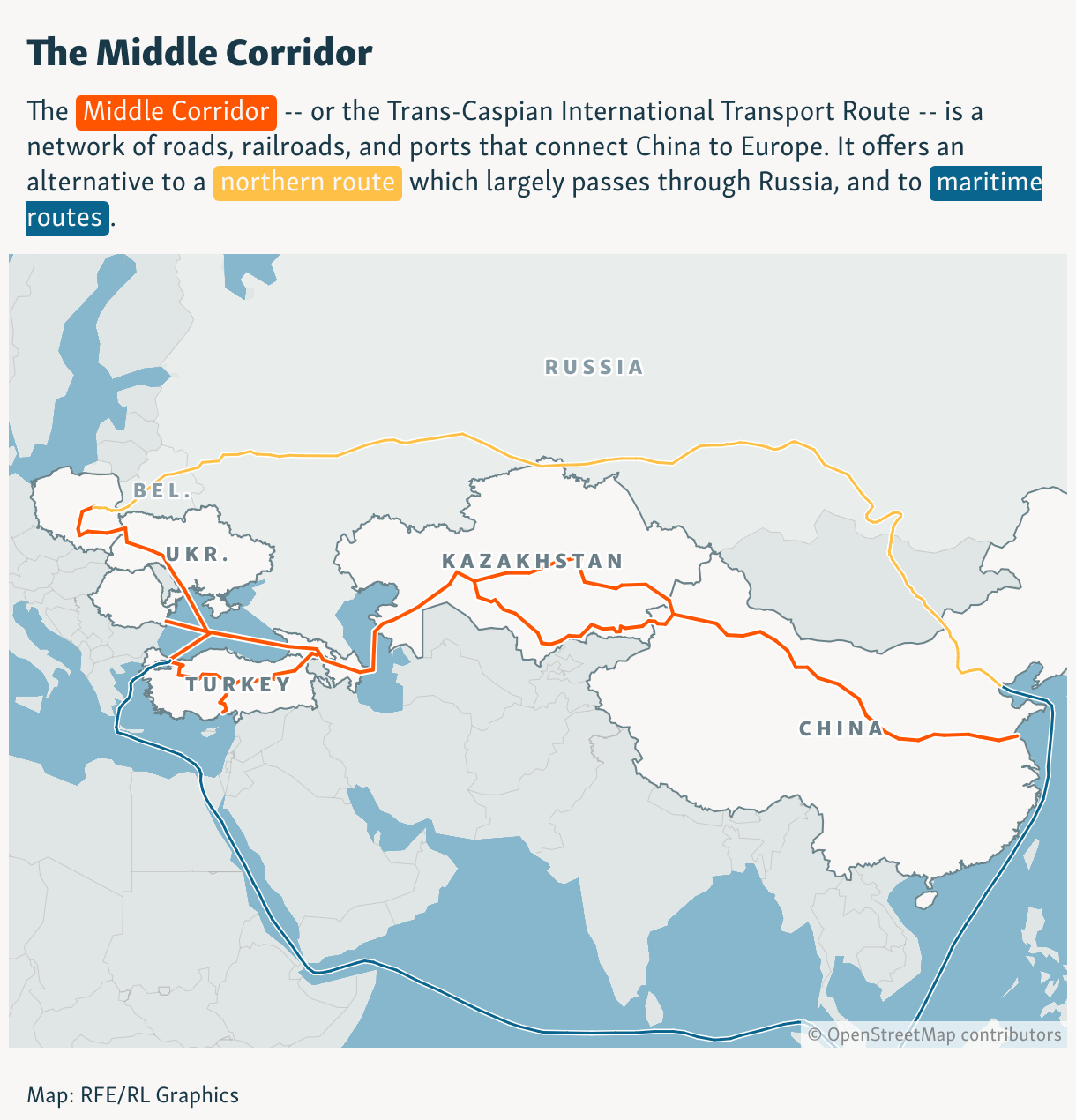
While diplomatic efforts struggle to stabilize access to the Strait of Hormuz amid tensions between the United States and Iran, Eurasian trade is increasingly being redirected toward overland alternatives, with the Trans-Caspian Transport Route, also known as the Middle Corridor, emerging as a key diversification route in Eurasian logistics.
The World Bank described the Middle Corridor back in 2023 as a strategically important but structurally constrained route. While geopolitical fragmentation driven in part by Russia's war in Ukraine has increased the demand for alternative corridors, the World Bank emphasized that the corridor's long-term viability requires coordinated investment, the removal of infrastructure bottlenecks, and improved cross-border customs and transport procedures.
To address these roadblocks, the World Bank and its partners on April 14–15 committed $3.3 billion to strengthening key missing links along the corridor, including $1.9 billion for Turkey's Istanbul North Rail Crossing and a $1.4 billion investment in the reconstruction of Kazakhstan's Karagandy–Zhezkazgan highway.
On the same day that this was announced, Turkish Vice President Cevdet Yılmaz underscored the importance of such investment at a meeting in Astana.
"The Northern Corridor [through Russia] has become unpredictable due to geopolitical tensions. The southern route is pushing the limits of its capacity," he said. "This situation has made the Middle Corridor not an alternative but a mandatory choice."
Dosym Satpayev, director of the Risk Assessment Group in Almaty -- an independent think tank analyzing political risks, corruption, and foreign policy processes in the region -- says that Russia's war in Ukraine and the resulting sanctions deepened global dependence on maritime chokepoints such as the Strait of Hormuz. but the current crisis has potentially long-term consequences for global trade.
"Even if the Strait of Hormuz is reopened, I believe that the image of it as a stable transport and logistics route has been damaged for many years, if not permanently," Satpayev said. "The same applies to the stereotype that the Persian Gulf and Middle Eastern countries can guarantee stable supplies of energy resources and other goods through the Strait of Hormuz."
Uncertainty is already reshaping global pricing and trade behavior, he added, saying that a "risk premium" will most likely be embedded in prices of oil and nitrogen fertilizers.
"About 25–35 percent of global fertilizer supplies pass through the Strait of Hormuz, and this will inevitably be reflected in final prices. Therefore, many countries will seek to diversify routes regardless of how the situation develops. Most likely, instability will persist for a long time, which means risks will remain high. And this is bad for business, because business needs predictability."

A Region Surrounded By Geopolitical Chaos
A key factor behind the growing appeal of the Middle Corridor, Satpayev says, is the relative stability of the regions it passes through. Despite the conflicts raging nearby, Central Asia and the Caucasus have "demonstrated stability in the conditions of geopolitical chaos."
"This has increased interest in it as a platform for transport and logistics projects," he said. "As a result, the region's status at the global level has risen."
The Middle Corridor suits everyone, he added, except Russia.
"We see that major geopolitical players are seeking to strengthen their positions in the region, primarily in the economic and transport-logistics spheres. China and the European Union are particularly active," Satpayev said.
"The Samarkand summit last year demonstrated the EU's interest in developing the Middle Corridor, including investments in hubs around the Caspian Sea. The United States is also showing interest in the Middle Corridor, as it seeks access to critical materials and rare earth metals in Central Asia.”
However, some analysts caution that the Middle Corridor is not yet capable of fully replacing existing trade routes, especially the northern land route via Russia.
Central Asia analyst Temur Umarov of the Carnegie Endowment for International Peace argues that while geopolitical narratives increasingly favor diversification, the physical and logistical realities of trade still impose clear constraints.
"The Middle Corridor, however interesting and potentially ambitious it may appear, is not yet developed to a level where it can replace the northern flows through Russia," Umarov said. "The issue is not a lack of interest in the Middle Corridor, but the simple fact that it is technically impossible, for now, to reroute the entire flow of goods and energy resources through it instead of the existing northern routes."
He adds that this structural limitation is not only about infrastructure gaps, but about time and scale.
"From a practical perspective, it is still too early to expect the Middle Corridor to absorb full trade volumes. It will require sustained investment, coordination between multiple countries, and years of development before it can operate at the scale of established northern routes."
What Does The Middle Corridor Mean For Kazakhstan?
For Kazakhstan, the significance of the World Bank-backed highway project extends beyond infrastructure financing. It signals the country's growing role as a central transit hub in a rapidly evolving Eurasian logistics landscape, one increasingly defined not only by geography but by geopolitics, risk diversification, and the search for resilient trade routes.
If Central Asian governments manage the process effectively, investments in the Middle Corridor could also translate into tangible benefits for ordinary people in the region, Satpayev maintains.
"Infrastructure such as railways and roads, especially given the size of Kazakhstan, can revive certain regions that are economically depressed," he said. "From the perspective of building hotels, gas stations, services, and maintenance infrastructure, this can create a multiplier effect that gives such regions a second life."
He added that this potential is not automatic but depends on governance and implementation quality.
"There's hope that if this is implemented under the supervision of investors and international organizations financing these projects, it will also to some extent improve the well-being of citizens in our countries."
The Middle Corridor, formally the Trans-Caspian International Transport Route, was established in 2014 by Kazakhstan, Azerbaijan, and Georgia to connect China and Europe via Central Asia, the Caspian Sea, and the South Caucasus, with onward links through Turkey. For years, it remained secondary to the Russian-led northern route.
The corridor is supported by a mix of multilateral lenders such as the World Bank, EBRD, and ADB, alongside EU funding initiatives and major state-led investments from Kazakhstan, Azerbaijan, Georgia, and Turkey, with China acting as a key trade driver through its Belt and Road connectivity.

