




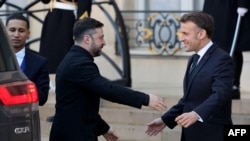
Officials from more than 30 Western countries -- the so-called Coalition of the Willing -- that support Kyiv in its war against Russia want security guarantees for Ukraine that include "binding commitments" for the country "in the case of a future armed attack by Russia in order to restore peace."
A draft statement, seen by RFE/RL, from a meeting in Paris on January 6 that includes the officials and Ukrainian President Volodymyr Zelenskyy adds that "Ukraine's ability to defend itself is critically important for ensuring the future of Ukraine's and Euro-Atlantic collective security."
"We confirmed that ensuring the sovereignty and lasting security of Ukraine shall be an integral part of a peace agreement, and that any settlement will have to be backed up by robust security guarantees for Ukraine," the statement, which is subject to change, says.
"Both the Coalition partners and the United States will play a vital and closely coordinated role in the provision of these security guarantees."
The meeting was called amid an intense flurry of diplomacy to fine tune a peace proposal aimed at ending Europe's largest and deadliest conflict since World War II.
US President Donald Trump's chief negotiators Steve Witkoff and Jared Kushner are also attending the meeting, though Secretary of State Marco Rubio is unlikely to come despite some hopes in European capitals that he would come to the French capital.
The draft statement is the most defined wording the allies have given on military pledges to secure Ukrainians after any peace deal is reached with Moscow.
It says support for Ukraine by the allies would include a US-led cease-fire monitoring and verification mechanism, support for Ukraine's armed forces, a multinational force for Ukraine, and "binding commitments to support Ukraine in the case of a future armed attack by Russia in order to restore peace."
"These [binding] commitments may include the use of military capabilities, intelligence and logistical support, diplomatic initiatives, adoption of additional sanctions," the draft says.
European officials have told RFE/RL that there is "a renewed sense of urgency" after a meeting over the weekend of national-security advisers and a gathering of military planners on January 5.
The draft gives no specifics on troops for any multinational force but some officials have said the number that is floating around in various European capitals is that the force will consist of 15,000-20,000 troops, while others hope the level will be closer to 30,000 working under the motto "safe sea, sky and land."
The bulk of the troops are expected to come from France and the United Kingdom, which would lead the land and air component, while Turkey has indicated it would be in charge of securing transport lanes in the Black Sea.
Most European officials RFE/RL has been in contact with believe the likely deployment would be in Western Ukraine to back up and train Ukrainian troops.
Unresolved Questions
While the outlines of a Western presence in Ukraine are taking shape, there are still several question marks to sort out, including the rules of engagement and US security guarantees.
One European diplomat admitted that one issue that still hasn't been resolved is how to respond to a potential Russian attack. "We are essentially still discussing whether we will return fire or run," he said.
When it comes to US security guarantees, both Brussels and Kyiv are increasingly optimistic that Washington will provide "a solid backstop" even though it is still not clear yet exactly what shape or form this will take.
European officials told RFE/RL on condition of anonymity there could be US boots on the ground in a noncombat role observing the cease-fire.
But the coalition also hopes Washington will still provide "back-office support" such as logistics and intelligence.
In November 2025, Trump pressed Zelenskyy to accept a 28-point peace proposal that many saw as heavily favoring Russia.
Ukraine and its European allies -- led by Britain, France, and Germany -- scrambled to develop a counterproposal, eventually putting forward a 20-point plan that took in more of Kyiv's interests, especially on security guarantees and territorial integrity.
In his meetings with the Europeans, Zelenskyy is likely to press the need for security guarantees -- from Europe but also in conjunction with desired solid assurances from the United States as well.
Thorny Issues
Ukraine's chief negotiator Rustem Umerov recently asserted that "most of the positions -- 90 percent of the peace plan -- have already been agreed, work continues on the details."
These details, expected to be discussed in Paris, include the thorny issue of territorial concessions with Ukraine pushing the line of contact to be frozen or for the entire Donbas region to become a demilitarized zone.

Another issue is the ownership of the Zaporizhzhya nuclear power plant with Kyiv dismissing the idea of Ukraine and Russia running it together, preferring that the United States steps in to sell energy from it to Moscow instead.
Few in Brussels, however, are thinking that Russia would agree on any of these issues with the assessment that the Kremlin still feels it is winning on the battlefield.
Russian President Vladimir Putin has said several times in recent weeks that Moscow will achieve the goals of what it calls its "special military operation" either by agreement or force.
With that in mind, the EU is separately preparing a fresh round of sanctions, the 20th since the full-scale invasion nearly four years ago, which is likely to be presented to its member states for approval later in January.