




US President Donald Trump will determine what constitutes "unconditional surrender" by Iran in the face of US-Israeli bombardment, the White House said on March 10, amid questions about how long the war may last.
White House spokesperson Karoline Leavitt's comments came on what US Defense Secretary Pete Hegseth warned would be the "most intense day of strikes inside Iran," and in the wake of a statement by Trump that the campaign would end "very soon."
"Ultimately, the operations will end when the commander-in-chief determines the military objectives have been met, fully realized, and that Iran is in [a position of] complete and unconditional surrender – whether they say it or not," Leavitt told reporters.
On March 7, Trump wrote on his Truth Social platform that there would be "will be no deal with Iran except UNCONDITIONAL SURRENDER!"
Trump is "not claiming that the Iranian regime is going to come out and say it themselves," Leavitt said, adding that he "will determine when Iran is in a place of unconditional surrender when they no longer pose a direct and credible threat to the United States and our allies."

At a new conference and in interviews with multiple media outlets on March 9, Trump made several remarks that suggested the war could end soon. The comments eased concerns on financial markets, partially reversing a steep drop in share prices the previous day and pushing the price of oil down after a sharp rise.
Uncertainty persisted, however, and Hegseth telegraphed a day of heavy strikes on March 10. He said the objective is to destroy Iranian missiles and its military production capabilities, as well as to destroy Iran's navy.

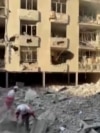

Reports on social media described attacks early on March 10 as more intense and broader in scope than previous attacks, with explosions reported in cities including Tehran, Karaj, Isfahan, Zanjan, Tabriz, Arak, Shahinshahr, Bushehr, Bandar Lengeh, and Qeshm.
Daily US and Israeli air strikes against Iran began on February 28, with Tehran responding by spraying drones and ballistic missiles around the Gulf region, sparking concerns about a broader war breaking out and driving the global price of oil through the key $100 a barrel level.

At a March 10 news conference, Hegseth said Iran's retaliatory strikes are waning, and General Dan Caine, chairman of the Joint Chiefs of Staff, said the Pentagon was looking at a range of options if it is tasked with escorting ships through the Strait of Hormuz, which has been effectively shut by the conflict.
The shipping lane is a chokepoint for global oil and liquefied natural gas transport. The war has forced oil and gas producers to halt shipping for more than a week, and Tehran has said no Gulf oil will pass through the waterway.
On March 10, Trump warned in a social media post that if Iran has placed any mines in the Strait of Hormuz "and they are not removed forthwith, the Military consequences to Iran will be at a level never seen before."
"If Iran does anything that stops the flow of Oil within the Strait of Hormuz, they will be hit by the United States of America TWENTY TIMES HARDER than they have been hit thus far," Trump said in a separate post.
Caine said the United States has carried out strikes against more than 5,000 targets in the first 10 days of the campaign, including against more than 50 naval ships.
"They're [Iranians] fighting, and I respect that, but I don't think they're more formidable than what we thought," Caine said.
At least 1,700 people -- including military members -- have died in Iran, according to the HRANA human rights group, since joint US-Israeli strikes began on February 28.

Along with the length of the campaign, another question is whether the US and Israel will take action against Mojtaba Khamenei, whom Iranian clerics chose to replace his father, Ayatollah Ali Khamenei, who was killed in strikes on the first day of the operation, as supreme leader.
Trump had called for a US say in the selection of a new leader, dismissed Mojtaba Khamenei as "unacceptable" for the role, and on March 9 called his selection "a big mistake." He did not say what the US and Israel might do about it and declined to answer when asked if the new leader had "a target on his back."

