


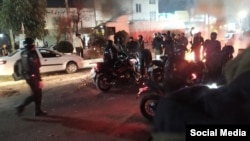
US President Donald Trump has voiced support for demonstrators braving brutal suppression from security forces in Iran amid protests over the country's economic woes that have resulted in several deaths and dozens of arrests.
The protests -- one of the biggest challenges to the Islamic republic's leadership in years -- began in Tehran on December 28, sparked by the collapse of the Iranian currency's exchange rate with the US dollar and inflation soaring to 52 percent. The unrest subsequently spread to multiple regions.
State-controlled media and international rights groups have reported several deaths and dozens of injuries in clashes between demonstrators and security forces, although government-linked news agencies have blamed what they called "rioters" for the violence.
Iranian authorities have yet to confirm the reports, and RFE/RL's Radio Farda could not independently verify them.
"If Iran [shoots] and violently kills peaceful protesters, which is their custom, the United States of America will come to their rescue," Trump wrote in a post on Truth Social on January 2.
"We are locked and loaded and ready to go," he added in comments that drew an immediate reaction from Tehran.
Iranian 'Bluffs'
"Trump should know that US interference in this internal matter would mean destabilizing the entire region and destroying America's interests," Ali Larijani, the secretary of Iran's Supreme National Security Council, wrote on X.
"The American people should know -- Trump started this adventurism. They should be mindful of their soldiers' safety," he added.
His comments were followed by a post from Ali Shamkhani, a senior adviser to Iran's Supreme Leader Ayatollah Ali Khamenei, who wrote that "Iranians know [the] US 'rescue' record well, from Iraq and Afghanistan to Gaza. Any intervening hand...will be cut off."
Saeed Bashirtash, an exiled Iranian activist, told RFE/RL's Radio Farda that such "threats to react are more like bluffs."
"Iranian people welcome Trump's warning, because they will feel they face less threat when they take to the streets. It's very positive [because] the Islamic republic will be very careful about killing people," he said.
Another Iranian exile, veteran dissident Mehran Barati, told Radio Farda that despite the defiant language, there were "cracks inside the regime including Islamic Revolutionary Guards Corps (IRGC), army, and political leadership. If the US was planning to do something, they might consider that the current situation is the best possible timing."
The inflamed language comes just six months after a 12-day war in June, when Israeli and US jets pounded Iranian nuclear and military sites.
Trump welcomed Israeli Prime Minister Benjamin Netanyahu at his Mar-a-Lago residence in Florida on December 29, when he suggested he would back new Israeli strikes against Iran's ballistic missile program.
In comments sent to Radio Farda on January 2, a State Department spokesperson said Washington would "continue to put maximum pressure on the regime."
Anger At Funerals
Amid the ongoing turmoil, videos circulating online on January 2 appeared to show the first funerals of people killed in clashes with security forces.
In one such video from a desert location consistent with terrain in Kuhdasht, in Iran's western Lorestan Province, unrest and clashes are visible, which are said to be related to efforts by mourners to drive away security forces.
Another video showed what was said to be a funeral in Marvdasht, Fars Province, where crowds were chanting "I will kill the one who killed my brother" and "Death to Khamenei."
The Fars news agency, which is close to the IRGC, reported two people had been killed at protests in the city of Lordegan in the southwest, noting also clashes with security forces.
It also reported three people were killed and 17 injured in Azna, a town of 48,000 people in Lorestan Province.
Norway-based human rights group Hengaw also reported deaths in Lordegan, saying security forces had opened fire on protesters, killing two and wounding several. The group also said a protester was killed in Isfahan Province in central Iran on December 31.
"Protests took place in several areas of Lordegan, including Municipality Square and in front of the government building. Demonstrations were met with violent repression, including the use of tear gas and live ammunition by law enforcement forces," the group said.
Hengaw later added that it had verified the identities of at least 10 people who were killed in the protests and is aware of 80 others who have been arrested in Iran over the past six days.
The Tasnim news agency, which is affiliated with the IRGC, said at least 30 people had been arrested in Tehran for "disturbing public order." Arrests were also reported in other provinces.
The unrest appears to be the most serious challenge to Iran’s theocratic government since the "Women, Life, Freedom" protests erupted following the September 2022 death of 22-year-old Iranian-Kurdish student Mahsa Amini while in police custody over a dress-code violation.
Iranian President Masud Pezeshkian earlier tried to defuse the protests, promising "new decisions" to improve the economic situation.
This has done little to temper the anger of Iranians, reeling from the collapse of the rial currency that is trading on unofficial markets at around 1.4 million to the dollar, compared with around 800,000 a year ago.
Official exchange rates are better but unavailable to many Iranian individuals and businesses.
"The recent protests reveal one clear reality: Many Iranians have decided that the current establishment must end -- at any cost and as soon as possible -- before the country they love is further destroyed," Shirin Ebadi, who was awarded the 2003 Nobel Peace Prize for her efforts to bring democracy and safeguard human rights in Iran, told Radio Farda in a phone interview on January 1.
On January 2, more than a dozen prominent Iranian civil activists announced their support for the protesters in a joint statement, also saying the latest protests in the country are about more than currency rates.
"We stand alongside the people to reclaim the right to freedom, justice, human dignity, and sovereignty over our own destiny," said a statement posted on the X page of 2023 Nobel Peace Prize laureate Narges Mohammadi, who was arrested during a memorial ceremony in the northeastern city of Mashhad last December.
"Any violence against the people constitutes direct participation in a crime that will be recorded in the historical memory of this land," the statement added.

