

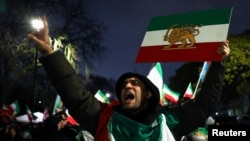
Reeling from massive demonstrations, Iran’s theocratic rulers are scrambling to reclaim the traditional Lion and Sun symbol, which has been embraced by anti-regime demonstrators.
Ali Akbar Salehi, director of the government-run Iranology Foundation, asserted on February 8 that the Islamic republic owns the Lion and Sun symbol -- and condemned its use by "others."
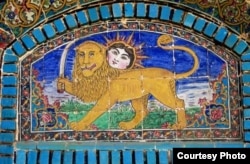
The Lion and Sun has long been one of Iran's enduring national symbols, in use until the country's 1979 Islamic revolution. Its origins trace back to astrology -- symbolizing the sun in the Leo constellation -- but from the 12th century, it became deeply embedded in Iranian art and culture.
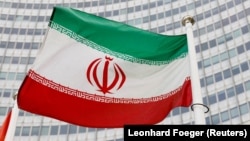
From the 15th century onward, the symbol appeared intermittently on Iranian flags. But after the Islamic revolution, the Lion and Sun was outlawed and condemned as a vestige of the oppressive, Westernizing monarchy. As a replacement, the regime embellished Iran's green-white-red tricolor with four crescents and a sword, surmounted by a diacritic, which formed a stylized representation of the Arabic word "Allah."


Speaking at the First National Congress on Foreign Policy and the History of Foreign Relations, Salehi insisted that the Islamic republic of Iran owns the symbol and said that it had clear religious roots.
'We Gave Them This Lion And Sun'
"The philosophy of the Lion and Sun is from Ali (a close companion of the Prophet Muhammad), God, and religion. We gave them this Lion and Sun, now others are using it, even though it belongs to us," Salehi said.
The "others" Salehi was referring to are the anti-regime protesters who, in recent weeks, have hoisted the Lion and Sun flag in the streets -- a symbol of national pride, secularism, and defiance of theocratic rule.
Protests in Iran erupted on December 28 over economic woes including currency collapse but morphed into anti-regime demonstrations that were met with lethal force, with thousands of people killed.
The Lion and Sun also became a prominent symbol for Iranians abroad demonstrating against the regime. As a gesture of support for the protesters, the social media platform X announced on January 9 that it was replacing the current Iranian flag emoji with the Lion and Sun.
According to Salehi, the Iranian state still has an international legal claim on the Lion and Sun symbol. In 1922, the Red Lion and Sun Society was formed, Iran's equivalent of the Red Cross and Red Crescent humanitarian organizations. And under the 1929 Geneva Conventions, the Lion and Sun was recognized as one of three official emblems -- alongside the Red Cross and Red Crescent -- for safeguarding medical aid.

In the wake of the 1979 Islamic Revolution, Iran swapped its red Lion and Sun for the Red Crescent, in keeping with other Muslim states. The International Red Cross and Red Crescent Federation, however, upholds Iran’s sole legal claim to the traditional emblem and its right to use it whenever it chooses.
Ongoing Debate
Salehi, who has a nuclear engineering background and was once the head of the Atomic Energy Organization of Iran, is no stranger to controversy. Appointed head of the Iranology Foundation in 2025, academics from the University of Tehran wrote an open letter, calling his appointment “inappropriate” because of his lack of expertise.
And this isn't the first time there has been debate about the Lion and Sun. In May 2020, parliamentary deputy Qolam Haydar Ebrahim Baysalami said: “The possibility of returning the red Lion and Sun emblem to Iran is possible through the Foreign Ministry." "The Red Crescent," he added, "is an Ottoman emblem and replacing it with the red Lion and Sun was a historical oversight.”
Six years earlier, in May 2014, Ali Younesi, the senior assistant for ethnic and religious minorities for former moderate President Hassan Rohani, said that the Lion and Sun in the former Iranian flag were "symbols of Ali and Muhammad" and suggested that the motif replace the Red Crescent.
At the time, Younesi's remarks provoked strong reactions from some members of the Iranian parliament. As a response, the hard-line Mashreq news website republished part of a speech by Ayatollah Ruhollah Khomeini, the founder of the Islamic republic, where he denounced the "ill-fated 'Lion and Sun.'"
"The Iranian flag should not be an imperial flag, the emblems of Iran should not be imperial emblems. They should be Islamic emblems," Khomeini said. "The works of the tyrant must go. These are the works of the tyrant.... It should be the works of Islam."