




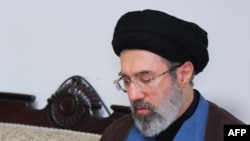
The March 8 election of Mojtaba Khamenei as the new leader by Iran's Assembly of Experts following the killing of Ayatollah Ali Khamenei in a US-Israeli attack marks the first time the son of a supreme leader is succeeding his father in the Islamic republic.
Mojtaba Khamenei has rarely appeared in public and has never addressed an audience beyond seminary classrooms, yet he is widely seen as a shadowy behind-the-scenes force with influence over those closest to the supreme leader's office and Iran's security institutions.
But who is Mojtaba Khamenei, and how did his name become one of the most controversial options for his father's succession?
'Master' Mojtaba
The 56-year-old second son of the late supreme leader has long been described as the "guardian of the gate."
Despite never holding a formal government office, the younger Khamenei has spent two decades at the center of his father's office, the Beyt, coordinating between the clerical establishment and the Islamic Revolutionary Guards Corps (IRGC).
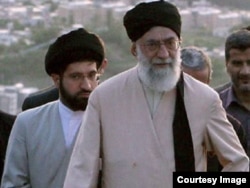
Ali Khamenei once warned domestic critics to refer to his son as only "Agha" -- or "Master."
In 2005, Mehdi Karroubi, a defeated presidential candidate, accused Ali Khamenei of supporting his son Mojtaba during the election campaign for Mohammad Baqer Qalibaf.
Karroubi later revealed that when one of the elders told Ali Khamenei, "Your Highness's son is supporting so-and-so in the election," Khamenei replied, "He is a master, not just the child of a master."
This was the sentence that brought Mojtaba Khamenei's name into Iranian politics for the first time -- not just as one of the sons of the supreme leader but as a political figure in his own right.
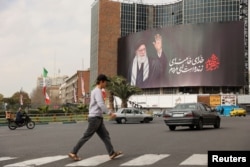
Now, his election as supreme leader of the Islamic republic by the Assembly of Experts, he officially become the center of the shaky power structure of the Islamic republic.
Mojtaba Khamenei is believed to be backed by the IRGC, and his selection represents continuity. Supporters argue his deep intimacy with the security apparatus makes him the most capable of maintaining order during active conflict.
Critics Warn Of 'Hereditary Rule'
However, his elevation risks domestic fury, especially among the core supporters of the Islamic republic. Critics argue a move toward "hereditary rule" betrays the very anti-monarchist roots of the 1979 Islamic Revolution.
"The optics of having a son succeed his father perhaps resembles the optics of a monarchy," Farzan Sabet, a senior research associate at the Geneva Graduate School, told RFE/RL in 2024.
A member of the Assembly of Experts in 2024 insisted the senior Khamenei had opposed the idea of his son taking over in conversations with the assembly.
Furthermore, Khamenei Jr's relatively low clerical rank, Hojatoleslam, remains a point of contention. A news agency affiliated with Iran's seminaries has since 2022 called him an ayatollah, an honorific title reserved for high-ranking clerics.
In 2022, former Prime Minister Mir Hossein Mousavi, who has been under house arrest since 2011, warned that Ali Khamenei was preparing his son to take over, effectively reviving the hereditary succession that the 1979 revolution was meant to end.
"Have dynasties of 2,500 years returned so that a son succeeds his father to power?" he wrote.
In response to these criticisms, the Assembly of Experts emphasized that the appointment of the supreme leader is based on "merit selection."
Recent investigations, including a report by Bloomberg published in late January, detailed a sprawling and secretive real estate portfolio linked to the younger Khamenei, who has been under US sanctions since 2019.
The reports suggest he has successfully maintained and expanded a global network of luxury assets through intermediaries and shell companies.
Mojtaba Khamenei's wife, Zahra Haddad Adel, was also killed in the same US and Israeli strike as her father-in-law, the supreme leader.