




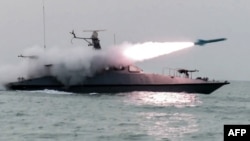
The United States and Israel have largely destroyed Iran's conventional naval fleet in a massive bombing campaign since February 28.
But Tehran's threat to the Strait of Hormuz, one of the world's most important shipping routes, has not diminished. Iran has effectively closed the narrow waterway, through which 20 percent of the world's oil supplies flow, by using asymmetric warfare tactics.
Besides Iran's conventional navy, the powerful Islamic Revolutionary Guards Corps (IRGC), the elite branch of the country's armed forces, has its own naval units that continue to hound and attack shipping in the Persian Gulf.
"While I think the Iranian Navy is largely combat ineffective at this point, the IRGC navy remains able to harass shipping," said Sascha Bruchmann, a military and security affairs analyst at the London-based International Institute for Strategic Studies.
"That maintains a specter of danger that most civilian shipping lines and insurers will find unacceptable," Bruchmann added.
Decimated Navy
The United States has decimated Iran's conventional navy since February 28.
The US military said on March 11 that it had sunk 60 Iranian vessels. Satellite imagery and publicly disclosed military footage suggest most of Iran's naval fleet has been damaged or destroyed.

Iran's two Mowj-class warships, its Alvand-class frigate Sabalan, and the forward-basing ship Makran -- which gave Tehran a limited long-range power projection capability -- are gone. So, too, are hundreds of the fast-attack boats that formed the backbone of the IRGC's naval asymmetric strategy in the Persian Gulf.
On March 4, a US submarine torpedoed Iran's IRIS Dena warship in the Indian Ocean near Sri Lanka as the frigate returned from multinational exercises, with roughly 180 personnel onboard.
It was the first confirmed wartime submarine sinking of a surface warship since Britain sank the Argentine cruiser General Belgrano in 1982 during the Falklands War, highlighting the reach and intent of the American campaign.
But those losses have not reduced Iran's threat to shipping in the Persian Gulf, experts say.
Iranian projectiles struck the Mayuree Naree, a Thai-flagged civilian tanker, on March 11 while it attempted to transit the strait. Photographs from the crew's evacuation showed damage just above the waterline near the stern, a typical signature of explosive-laden surface drones that strike at waterline level.
Iran's Naval Doctrine
Iran changed its naval doctrine after the US Navy sank around half of Iran's conventional fleet in a single day in April 1988. The attack was in retaliation for the mining of a US warship days earlier.
Experts say the incident showed Tehran that symmetrical naval warfare against a superpower was a losing proposition.
What followed was a decades-long pivot toward asymmetric tools such as fast-attack boats, shore-based anti-ship missiles, naval mines, midget submarines, and more recently, unmanned surface vessels (USVs) configured as floating bombs.
Iran institutionalized this split into two separate navies, symmetrical and asymmetrical forces.
The Iranian Navy, as part of the regular military, maintained a conventional fleet for prestige and occasional long-range deployments, including a transatlantic voyage as recently as 2021.
But the real warfighting instrument was the IRGC's navy units, which were purpose-built for harassment and denial operations in the Persian Gulf's shallow, island-cluttered waters, where geography compresses distances and partly neutralizes the advantages of a superior conventional force.
Over the years, the IRGC's naval force has released footage of underground storage facilities housing fast-attack boats, some likely configured as unmanned surface vessels or suicide boats.
It is a tactic used by Ukraine against the Russia's Black Sea Fleet, although experts say the Iranian variants are less technically sophisticated.
"I doubt they could inflict the same kind of damage on US warships that Ukraine could on Russian ships," Bruchmann said, adding the more plausible target is civilian shipping that supplies global oil markets.

US Central Command said on March 10 that it had sunk 16 Iranian mine-laying ships.
But Mohammad Farsi, a former Iranian naval officer, told RFE/RL's Radio Farda that the focus on mines misses the point.
"Any vessel can do it, even the IRGC speedboats currently in the Persian Gulf," he said.
"In my opinion as a naval officer, there is no need for Iran to plant mines in the mouth of the Persian Gulf right now. The reason ships aren't passing through is that companies know the probability of being hit is extremely high."
He pointed to Iranian drone capabilities near the islands of Qeshm, Hengam, and Larak -- positioned close to the main shipping lanes -- as the more immediate threat.