




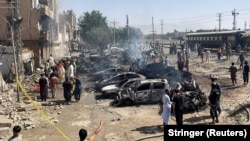
Increasing militant attacks along Iran's border with Pakistan over the past few months by multiple armed groups have stoked fears of further instability in the two countries, both of which are already facing multifaceted threats of sectarian violence in addition to the broader repercussions of the conflict in the Middle East.
Widespread poverty, underdevelopment, and religious discrimination are believed to be the main drivers of violence in the roughly 900-kilometer porous border region inhabited on both sides by mostly ethnic Baluch.
In Pakistan's restive Balochistan Province, Baluch separatists have ramped up their campaign of sophisticated attacks -- including the hijacking of a passenger train in 2025 and the deployment of suicide bombers, including women -- and in Iran's southeastern Sistan-Baluchistan Province a simmering insurgency has intensified since the start of the US war with Iran in February.
Unlike the Iranian Baluch, whose armed struggle is rooted in ethnic and religious discrimination, the insurgency in Pakistan's Balochistan is largely secular and revolves around demands for control over the region's rich natural resources.
The area is also home to two strategic ports: Gwadar on the Pakistani side and Chahbahar in Iran's Sistan-Baluchistan.
Analysts say that militant groups have benefited from the complex nature of Iran-Pakistan relations shaped by sectarian and religious differences, competing foreign policy priorities, and divergent geostrategic interests.
In January 2024, Iran carried out missile and drone strikes inside Pakistan, targeting the anti-regime militant group Jaish al-Adl. Pakistan retaliated with air strikes, saying Iran was sheltering the separatist Balochistan Liberation Army (BLA) and the Balochistan Liberation Front (BLF).
Iran-Based Militant Groups
The Hong Kong-based Silk Road Economic Development Center (SREDC) documented at least 11 attacks during September in Iran's Sistan-Baluchistan targeting Iranian security personnel.
Five more attacks were recorded between October 1 and 8 -- all of which were claimed by the Popular Resistance Front, an anti-regime coalition of Baluch organizations that joined forces in late 2025 comprising Jaish al-Nasr, the Pada Baloch Movement, the Mohammad Rasul Allah Group, and Jaish al-Adl.
Jaish al-Adl, or the Army of Justice, is one of the deadliest militant groups based in Iran. It was formed in 2012 following the execution of Abdolmalek Rigi, an ethnic Iranian Baluch who led the Sunni Salafi jihadist organization Jundullah.
Both Jandullah and Jaish al-Adl claimed to fight for the religious rights of Iranians in Sistan-Baluchestan Province. Because neither group explicitly sought an independent Baluchistan, however, separatists in Pakistan's Balochistan Province view Jaish al-Adl as a proxy of the Pakistani state.
Jaish al-Adl is designated as a terrorist group by Iran and the United States.
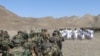
The group is known for its guerilla tactics, including ambushes and the use of remote-controlled explosives targeting the officers and members of Iran's Islamic Revolutionary Guards Corps (IRGC), government figures, as well as Sunni leaders who support the regime.
"Jaish al-Adl is adopting more complex attack patterns resembling those of the BLA and fighters from both groups have used the border region for sanctuary or logistics," said Islamabad-based analyst Iftikhar Firdous.
Pakistan-Based Militant Groups
While religious extremists such as the Islamic State Khorasan Province (ISKP) and the Tehrik-e Taliban Pakistan (TTP) operate in Pakistan's Balochistan Province and account for a number of the 131 attacks recorded in Baluchistan in September, according to the Pakistan Institute for Security Studies, Baluch separatists have gained significant strength in the region over the past few years.
The two factions of the Baluchistan Liberation Army (BLA) -- BLA Jeeyand and BLA Azad -- have expanded their operations from local hit-and-runs to setting their sights on high-value targets in cities as far away as Karachi.
The BLF is the second most-active group that focuses on guerilla ambushes, attacks on infrastructure, and operating specialized units for more sophisticated attacks.
Other smaller separatist groups include the Baluchistan Liberation Guard, the Baluch Republican Army, and the Baluch Nationalist Army.
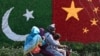
Of those, the BLA and BLF are widely involved in attacks on the Pakistani security forces, as well as targeting Chinese-led projects and workers in the region.
In 2015, China launched the multibillion-dollar China-Pakistan Economic Corridor Project (CPEC), a key component of Beijing's Belt and Road Initiative that includes rail, road, and infrastructure investment across Pakistan -- with a particular focus on the development of the Gwadar Port and the excavation of mineral resources such as gold, copper and coal in Baluchistan.
In November 2018, several separatist groups formed Baluch Raaji Aajoi Sangar to coordinate their attacks against the Pakistani state, which they accused of plundering the region's resources.
Since then, the Baluch separatists have not only intensified attacks on Pakistani security agencies but also targeted Chinese nationals in Baluchistan and the neighboring province of Sindh.
Cross-Border Connections
The Baluch militant groups on either side of the border between Iran and Pakistan have little in common ideologically.
"Unlike the Iranian Baluch groups, whose leadership is coming from religious seminaries and hard-liner Sunni Muslims, the leadership of the Baluch groups in Pakistan's Baluchistan Province is mostly university graduates and secular-minded," said Norway-based researcher Kiyya Baloch.
"There are no linkages regarding their agendas. Rather, often they accuse each other of being used as proxies by Iran and Pakistan because groups such as Jaish al-Adl have their hiding places on the Pakistani side, while some Baluch groups are said to have their sanctuaries on the Iranian side," he told RFE/RL.
Abdul Sayed, a Sweden-based researcher of jihadi movements, said the Iranian and Pakistani Baluch groups may have camps or bases in proximity to one another, but they oppose different states.
"Each side accuses the other of acting as a proxy for its respective opponent," he told RFERL, adding that some of these groups have accused one another of killing their members, as has occurred on several occasions between the BLF and Jaish al-Adl.
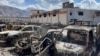
Pakistan and Iran have a history of suspicion regarding border management. The most visible demonstration of those differences was seen when Iran and Pakistan each carried out attacks against targets in the other country in January 2024.
Iran has long accused Pakistan of supporting militants who oppose the regime in Tehran. Following a suicide attack in Iran's Sistan-Baluchistan that killed 42 people in 2009, a senior Iranian official had asked Islamabad to hand over Jundullah leader Regi.
In March 2016, Pakistan announced the arrest of an alleged Indian spy, Kulbhushan Jadhav, from Mashkel area near the Iranian border. The announcement was made just a day before the arrival of the then Iranian President Hassan Rouhani in Islamabad.
Pakistani authorities claimed the agent was operating a network from the Iranian port city of Chahbahar to carry out terrorist acts in Pakistan.
Given the region's complex security dynamics, indirect state involvement cannot be ruled out, Sayed said. "However, no such support has been verified through open-source evidence or publicly acknowledged by either state, leaving allegations of proxy relationships unsubstantiated."
Firdous said that although Iran and Pakistan have increased their coordination since the tit-for-tat strikes in January 2024, these measures have not yet evolved into a sustained and comprehensive strategy.
"Deep mutual distrust persists" due to the presence of Jaish al Adl and BLA/BLF on either side and the "geopolitical competition (Gwadar versus Chahbahar), differing external alignments and the vast difficult-to-control terrain continue to limit deeper operational integration."

