



Sudden Surge In Eye Injuries On January 9, Says Hospital Director
A report by the head of Tehran’s Farabi Hospital describes a massive influx of patients with eye injuries on January 9.
On January 25, the semi-official ISNA news agency published an account by Qasem Fakhrayi, the head of Iran’s largest ophthalmology facility.
According to him, in the days leading up to January 9 about 55 patients with eye injuries caused by pellet impacts from other cities had been referred to the hospital.
However, on January 9 -- coinciding with a second day of mass protests after former crown prince Reza Pahlavi had urged people to take to the streets -- the number suddenly surged to around 1,000 patients, to the extent that nearly 200 of the injured were transferred to other hospitals.
Maryam Sabbaghi, the head nurse at Farabi Hospital, said that due to the overwhelming number of eye-injury cases, not only were all beds occupied, but the hospital was forced to borrow stretchers from another medical facility and place patients in hallways.
These official figures were released despite the Islamic republic’s longstanding practice of withholding precise statistics related to protests.
The practice of firing pellet rounds at protesters’ faces and eyes began in 2022, during the height of the “Woman, Life, Freedom” protests, and has left dozens of young protesters blinded.
While Iranian authorities have put the official death toll from the protests at just over 3,000, human rights sources say the true number is far higher.
On January 25, Time magazine, citing two senior officials at Iran’s Health Ministry, said that the death toll could exceed 30,000, with the majority of deaths occurring on January 8–9, when the government’s crackdown on nationwide protests reached its peak.
Tehran Allows Businessmen To Access Internet ‘For 20 Minutes A Day’

The head of the Iran–China Chamber of Commerce, says Tehran has been permitting businessmen to use the Internet under official oversight for short periods each day.
“Holders of commercial cards are allowed to use the Internet for up to 20 minutes a day under the supervision of a monitor,” said Majidreza Hariri, who added that it “in no way meets the needs of traders.”
The Islamic republic has imposed a nationwide Internet shutdown in Iran, preventing news from being transmitted outside the country and blocking protesters’ ability to communicate -- a measure that is now in its third week and seems likely to continue.
Hariri said the limited Internet access for merchants was “certainly not acceptable” for conducting business, and was “only enough to check a few emails.”
The digital blackout, which is causing millions of dollars in daily losses to business owners and to the country’s economy, continues even though the latest wave of protests initially began over economic grievances, with merchants among the first groups to join the demonstrations.
While the government initially portrayed itself as sympathetic to traders and people in need, its policies in recent weeks have not only restricted people’s ability to earn income but have also led to rising prices of essential goods.
Ali Hakim-Javadi, the head of Iran’s Computer Trade Organization, said on January 25 that the “direct impact of the Internet shutdown” was between 20 and 30 trillion rials per day, or roughly $18-28 million at the current free-market rate.
Teachers Council Names Dozens Of Students Killed In Crackdown
The Coordinating Council of Teachers’ Trade Associations has published the names of more than 40 people in a list of students its says were killed in the recent crackdown on protests.
The council, an umbrella body of independent teachers’ unions in Iran, says the list is based on reports from trusted networks and reliable sources, and that it will be updated gradually.
The council has expressed "deep regret and sympathy with the bereaved families" and urged an immediate end to the violence.
It also called for the safety of children to be ensured and for all those arrested during the January demonstrations to be released.
Netblocks, the digital rights watchdog and web connectivity monitor, says that Iran's Internet blackout has now passed 400 hours, although "brief connectivity spikes" give a false impression of a wider restoration and circumvention methods, such as the use of VPNs, is allowing some online communication.
Meanwhile, the US-based rights organization HRANA, whose figures RFE/RL has been regularly citing since the violent crackdown began in Iran, says its confirmed death toll is now 5,459 and the number of fatalities still under investigation is 17,031.
More Than 30,000 People May Have Been Killed In Iran Protests, Says Time Magazine
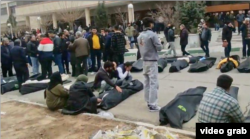
The Iran protest death toll may surpass more than 30,000 people, according to two senior Iranian health officials who spoke to Time magazine.
The report, published on January 25, says the majority of deaths occurred during January 8–9, when the government’s crackdown on nationwide protests reached its peak. Due to intense censorship and a prolonged Internet shutdown, the information could not be independently verified.
The reported figure sharply contradicts the official death toll of 3,117 announced by Iran’s Supreme National Security Council earlier this week, but aligns more closely with international estimates.
The United Nations has suggested significantly higher casualties, and Mai Sato, the UN special rapporteur on human rights in Iran, said on January 22 the number of civilians killed in the crackdown could surpass 20,000 as reports from doctors surface.. Amnesty International has described the killings as being on an “unprecedented scale,” citing live fire, metal pellets, and the obstruction of access to medical care.
According to Time, the scale of deaths during those two days -- following a call by former crown prince Reza Pahlavi urging people to join the protests -- overwhelmed state resources. Officials reportedly ran out of body bags, ambulances were unable to transport the dead, and authorities resorted to using 18-wheel trucks.
These estimates reportedly align with hospital data reviewed by Dr. Amir Parasta, a German-Iranian eye surgeon. According to him, a count gathered by physicians and first responders shows at least 30,304 deaths as of January 23, a figure he cautioned remains incomplete.
Friends Remember A Vibrant University Student Killed During Protest In Tehran
Zahra Bahlolipour, a 23-year-old student in Tehran, was fatally shot by security forces during a protest against Iran's authoritarian regime on January 8. Her university classmates have been posting tributes to a beloved friend known as Raha. Bahlolipour is among more than 5,000 victims reported killed in the state crackdown on the protest movement, but the full scale of the violence has yet to come to light.



Netblocks, a digital rights watchdog and connectivity monitoring organization, says that Iran's Internet blackout is continuing, despite a "brief momentary restoration."
Earlier on January 24, a state-affiliated Iranian news agency said that the country's Internet would be "fully restored" by tonight.
As of January 24, Iran’s near-total nationwide digital blackout -- ongoing since January 8 -- is one of the longest in recent history. Only Sudan’s complete shutdown following its October 2021 coup, which lasted about 25 days, is currently known to have lasted longer.
Teachers Council Publishes List Of Dozens Of Schoolchildren Killed In Crackdown
The Coordinating Council of Teachers’ Trade Associations, an umbrella body of independent teachers’ unions in Iran, has published the names of at least 29 schoolchildren in a list of students its says were killed in the recent crackdown on protests.
The council says it published the names and images of these children on January 24 based on reports from trusted networks and reliable sources, and that the list will be updated gradually.
Previously, some human rights sources, including the US-based HRANA group, said they have managed to confirm the deaths of more than 5,000 people -- including at least 54 children (under the age of 18) -- and that they are still investigating the deaths of nearly 13,000 others.
The US State Department's Persian-language account on X shared a video this morning of President Donald Trump talking to reporters.
When asked if he thought Iranian Supreme Leader Ayatollah Ali Khameini should step down or go into exile, he said 'I don't want to get into that."
"But they know what we're looking for," he added. "There's a lot of killing going on."
He also warned the Islamic republic against seeking to set up other advanced nuclear facilities like those targeted by US strikes in Operation Midnight Hammer in June.