


Iran Sends Message Of 'Defiance' By Picking Mojtaba Khamenei As New Supreme Leader
- By Kian Sharifi
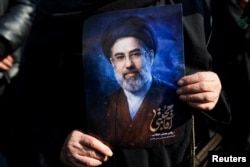
Iran’s choice of Mojtaba Khamenei as the country’s new supreme leader sends an explicit message to the United States and Israel: External pressure, including decapitation, will harden rather than reshape the Islamic republic's leadership, experts say.
Mojtaba Khamenei is the second-oldest son of former Supreme Leader Ayatollah Ali Khamenei, who was assassinated in an air strike on February 28 as the United States and Israel launched an aerial bombardment of Iran. The younger Khamenei is known as a hard-line cleric and his selection by the Assembly of Experts, a clerical body, on March 8 represents continuity.
"The message from Tehran is one of defiance: you kill one Khamenei, we give you another," Ali Alfoneh, a senior fellow at the Arab Gulf States Institute in Washington, told RFE/RL.
At the same time, the choice also revealed a system under acute internal strain, one in which the powerful Islamic Revolutionary Guards Corps (IRGC), the elite branch of Iran’s armed forces and the backbone of the country’s theocracy, has displaced the clerically dominated political establishment as kingmakers in the country of some 90 million people, experts say.
Read more here.
Zelenskyy Says Ukraine Received 11 Requests For Help In Countering Iranian Drones
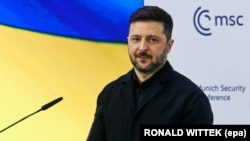
Ukrainian President Volodymyr Zelenskyy said in a post on social media that 11 countries had contacted Kyiv for help in countering Iranian drones as Tehran sends waves of them across the Middle East in retaliation against US-Israeli strikes.
"As of now, there are 11 requests from countries neighboring Iran, European states, and the US," Zelenskyy wrote. "There is clear interest in Ukraine’s experience in protecting lives, relevant interceptors, electronic warfare systems, and training."U
He added that Ukraine was "ready to respond positively to requests from those who help us protect the lives of Ukrainians and the independence of Ukraine" and that some requests had "already been met with concrete decisions and specific support."
NATO Intercepts Iranian Missile Over Turkey; US Orders Adana Consulate Evacuation
NATO has shot down a ballistic missile over Turkish airspace for the second time since the United States and Israeli began their air strikes against Iran at the end of last month.
"NATO has again intercepted a missile heading to Turkey. NATO stands firm in its readiness to defend all Allies against any threat," the alliance said in a social media post on March 9.
It gave no further details.
The Turkish Defense Ministry confirmed the incident, adding that some ammunition fragments landed in empty fields in Gaziantep, a city in southern Turkey near the border with Syria. There were no casualties or injuries in the incident, it added.
Five days earlier, a similar incident occurred with NATO shooting down a missile launched from Iran.
Tehran did not immediately comment on the March 9 incident. It has said previously that it has not explicitly targeted Turkey.
A NATO official, who asked not to be named, told RFE/RL that there was “no indication that Article 4 is being discussed so far” in response to the incident. NATO's Article 4 allows any member state to request consultations with allies if it believes its territorial integrity, political independence, or security is threatened, often serving as an early step for coordinating a response to potential security risks.
Separately on March 9, the US Department of State ordered nonemergency staff and family members to leave the US Consulate General in the city of Adana in southern Turkey due to security risks.
Americans in southeast Turkey have been strongly encouraged to depart the region immediately.
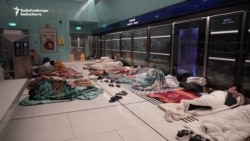
Sleeping In A Tel Aviv Subway Station Takes Its Toll

EU Sees No 'Imminent' Oil Shortage As Crude Prices Soar
The European Union said on March 9 it is in no danger of an oil supply shortage amid possible cuts in production and soaring prices due to the growing conflict in the Middle East.
The benchmark price for crude oil jumped beyond $100 for the first time since Russia launched its invasion of neighboring Ukraine in 2022.
"There is no imminent oil supply shortage in Europe. Per our rules, all member states must have the 90 days emergency stocks," European Commission spokeswoman Anna-Kaisa Itkonen said.
Taking Cover In Tel Aviv
Our correspondent, Ray Furlong, is currently in Tel Aviv. Out reporting this morning, he saw a line of parents with baby strollers entering a public shelter after an alert of an incoming Iranian ballistic missile strike.

Ukrainian Foreign Minister: Ukraine And Iran Are 'Two Theaters Of One War'
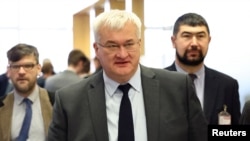
Ukrainian Foreign Minister Andriy Sybiha has warned that "developments in Europe and the Middle East are not isolated from each other."
"The war against the Iranian regime and Ukraine's defense against Russian aggression are two theaters of one war," he wrote on X on March 9.
"The regimes in Moscow and Tehran are inseparable: They are working together, sharing resources, weapons, and technologies. They represent the same threat to Ukraine, Europe, the United States, and Gulf states," he said. "One thing that unites regimes in Moscow and Tehran is that they only understand the language of strength."
Meanwhile, Ukrainian President Volodymyr Zelenskyy announced that Kyiv had sent interceptor drones and a team of experts to the Middle East in response to a US request for support against Iranian drones in the region.
According to The New York Times, citing an interview with Zelenskyy, a Ukrainian team of drone experts traveled to the region to protect US military bases in Jordan.
"As of now, it is too early to speak in detail. Next week, when the experts are on the ground, assess the situation and provide assistance -- since they are coming with the capabilities to assist right away -- we will proceed accordingly. Let us wait for the initial meetings," Zelenskyy wrote on X on March 8.
Azerbaijan-Iran Border Reopens After Drone Incident
According to an Azerbaijani government statement, all types of vehicle traffic across the border between Azerbaijan and Iran resumed in the morning of March 9.
The border is one of the shortest land routes connecting Iran to its ally Russia, and crossings were closed last week after Baku said that an Iranian drone hit the Nakhchivan exclave on March 5.
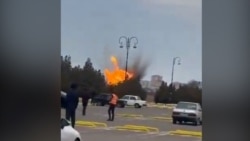
Iranian President Masud Pezeshkian denied the drone strike during a phone call with Azerbaijani President Ilham Aliyev, saying Iran was not responsible for the strike that hit a school and an airport in the autonomous Nakhchivan region.
In a statement released on March 8, Azerbaijan's presidential office said Pezeshkian insisted that "the incident involving the air strike on Nakhchivan had no connection with Iran."
China Says It 'Opposes' Targeting Of New Iranian Leader
China has said that it opposes the targeting of Mojtaba Khamenei, the new supreme leader of the Islamic Republic, by the United States and Israel.
Gao Jiaqun, a spokesman for the Chinese Foreign Ministry, said: "Beijing opposes interference in the internal affairs of other countries under any pretext, and Iran's sovereignty, security, and territorial integrity must be respected."
Posting on X on March 8, the Israeli military said that it would continue pursuing every successor of Iran's slain Supreme Leader Ayatollah Ali Khamenei, who was killed in a US and Israeli attack on February 28.
The same day, US President Donald Trump told ABC News that if the new supreme leader "doesn’t get approval from us, he’s not going to last long."
New Supreme Leader Celebrated, Decried In Tehran
Supporters of the Iranian regime shouted "Allahu Akbar" after Mojtaba Khamenei was named supreme leader, with the cry broadcast from loudspeakers in some parts of Tehran.
At the same time, in areas of Tehran such as the Ekbatan neighborhood, there were shouts and chants decrying the announcement, including "Death to Mojtaba."
Shortly after midnight on March 9, Iran named hard-liner Khamenei to replace his father, the late Ayatollah Ali Khamenei, as supreme leader. Khamenei was killed in a February 28 attack by the United States and Israel.
Mojtaba Khamenei is the third supreme leader in the 47-year history of the Islamic republic.