



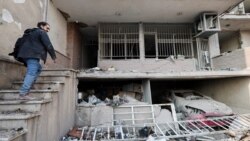
Netanyahu Says 'Heavy Blows' Dealt To Iran
Israeli Prime Minister Benjamin Netanyahu said that almost two weeks of air strikes on Iran have dealt heavy blows to the country's main armed forces, the Islamic Revolutionary Guards Corps (IRGC), and the Basij paramilitary.
Speaking in his first press conference since the start of US-Israeli air strikes on February 28, Netanyahu said one of the main aims of the campaign is to stop Iran from moving nuclear and ballistic weapons projects underground.
He added in the March 12 press conference that the military operation is also aimed "to create, for the Iranian people, the conditions to bring down this regime."
Israeli President Calls For 'Hitting Iran Hard' As Attacks Continue On Both Sides
The exchange of fire between Iran and Israel continued on March 12, with strikes hitting civilian sites in central Israel as its military claimed to have targeted Basij militia checkpoints in Tehran.
Speaking to RFE/RL, Israeli President Isaac Herzog said his country aims to keep up the intense campaign to "remove [Iran's] capabilities" to wage war.
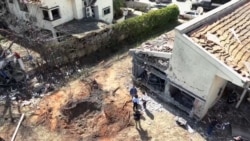

Israeli Army Confirms Targeting Checkpoints In Tehran
The Israeli Army announced on March 12 that the country's air force had targeted checkpoints in Tehran over the past 24 hours.
Israel's statement, which included video footage, said its air force had identified and targeted "Basij unit posts and forces" in several locations in Tehran, killing members of the paramilitary forces.
Israel claimed the attacks are "deepening the blow to the nuclear layers and key infrastructure" of the Iranian regime.
While publishing images and reports of widespread drone flights in the skies over Tehran, Iran's Fars News Agency -- which is close to the Islamic Revolutionary Guards Corps -- reported that Israeli strikes were seeking to target checkpoints of government agents in Tehran.
Fars reported that 10 officers were killed during these attacks.
Saudi Arabia Says Iranian Drones Headed For Shaybah Oil Field Intercepted Again
Saudi Arabia's Defense Ministry said it intercepted three drones headed towards the Shaybah oil field on March 12, the latest in a series of attempts by Iran to strike the facility and disrupt global energy markets as part of its retaliation for US and Israeli air strikes. "Interception and destruction of a drone in the Empty Quarter heading towards the Shaybah field," the ministry said in a post on X. Earlier in the day, the ministry said two drones heading towards the same field were also destroyed. On March 11, Saudi Arabia said it had prevented several drone attacks against the facility, which is crucial to the country's oil production.
US 'Not Ready' To Escort Oil Tankers, Says Energy Chief
US President Donald Trump has said the US Navy may be brought in to help escort ships through the Strait of Hormuz, but US Energy Secretary Chris Wright told CNBC in an interview on March 12 that it may take several more weeks before that is possible.
"It'll happen relatively soon, but it can't happen now,” Wright said in the March 12 interview.
"We're simply not ready. All of our military assets right now are focused on destroying Iran's offensive capabilities and the manufacturing industry that supplies their offensive capabilities."
To read the full report, click here.
Iran's Navy Is Largely Gone. The Threat To The Strait Of Hormuz Is Not.
The United States and Israel have largely destroyed Iran's conventional naval fleet in a massive bombing campaign since February 28.
But Tehran's threat to the Strait of Hormuz, one of the world's most important shipping routes, has not diminished. Iran has effectively closed the narrow waterway, through which 20 percent of the world's oil supplies flow, by using asymmetric warfare tactics.
Besides Iran's conventional navy, the powerful Islamic Revolutionary Guards Corps (IRGC), the elite branch of the country's armed forces, has its own naval units that continue to hound and attack shipping in the Persian Gulf.
"While I think the Iranian Navy is largely combat ineffective at this point, the IRGC navy remains able to harass shipping," said Sascha Bruchmann, a military and security affairs analyst at the London-based International Institute for Strategic Studies.
"That maintains a specter of danger that most civilian shipping lines and insurers will find unacceptable," Bruchmann added.
To read the full report, click here.

Iran To Keep Strait Of Hormuz Closed, Khamenei Says
Iran must continue to keep a key Gulf shipping lane closed, Supreme Leader Mojtaba Khamenei said in his first public comments since being named to succeed his late father, hours after several vessels were targeted in strikes as Tehran looks to choke off oil supplies from leaving the Middle East.
In the statement, which was read out on Iranian state TV by a female presenter on March 12, Khamenei said Iran will continue to seek to strike targets where "the enemy has little experience and will be severely vulnerable."
Iran has been launching air and water strikes at targets across the Middle East in retaliation for US and Israeli attacks that started on February 28, the day his father, Ayatollah Ali Khamenei, was killed in one such bombardment.
To read the full report, click here.
Israeli President Calls Iran 'Empire Of Evil' That Must be 'Hit Hard'
RAMLA, ISRAEL -- Israeli President Isaac Herzog has told RFE/RL that Iran is an "empire of evil" that must be "hit hard" in order to preserve his country's way of life.
Herzog was speaking during a visit to a kindergarten that was damaged by an Iranian ballistic missile in Ramla, just outside Tel Aviv, three days previously.
"Ramla is a historic city. Even Bonaparte, Napoleon, slept in this city," he said.
"It's Jews and Arabs living together, Muslims, Christians, and Jews dwelling together in the most beautiful place. And in order to continue living together, when the empire of evil from Tehran tries to undermine any form of peace and any process of normalization, we have to hit hard at them. We have to remove their capabilities so that there will be a new future for the Middle East," he added.
Asked by RFE/RL if the war could end without achieving regime change in Iran, a war aim that has often been stated by Israeli officials, Herzog waved his hand and walked away with security guards.

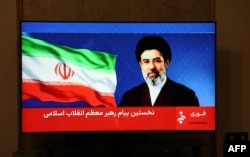
Iran's New Supreme Leader Makes First Statement
In remarks read out by a female presenter from a statement on Iranian state TV on March 12, Iran's newly appointed supreme leader -- Ayatollah Mojtaba Khamenei, son of his predecessor -- makes his first address. The younger Khamenei, however, has not been seen in public since before the US-Israeli attacks that killed his father and other Iranian officials on February 28.
Among other comments, he said:
On the Strait of Hormuz: "The lever of closing the Strait of Hormuz must certainly continue to be used. Studies have been conducted regarding the opening of other fronts where the enemy has little experience and will be severely vulnerable; their activation will take place should the state of war persist and in accordance with strategic considerations."

On the death of late Supreme Leader Ayatollah Ali Khamenei and others in Iran: "I give this assurance to all: We will not relinquish revenge for the blood of your martyrs. The retribution we have in mind is not limited to the martyrdom of the great leader of the revolution alone -- every member of the nation martyred by the enemy constitutes an independent matter for the file of retribution."
"The crime the enemy deliberately committed against the Shajara Tayyiba school in Minab and certain similar cases holds particular standing in this reckoning."
Seeking reparations: "We will extract reparations from the enemy, and if they refuse, we will seize from their assets to the extent we deem appropriate -- and if that too is not possible, we will destroy an equivalent amount of their assets."
Congress To Be Briefed As Probe Examines Iran School Strike, Sources Tell RFE/RL

WASHINGTON -- A final assessment by US military officials of events surrounding a deadly missile strike on an Iranian girls' school will be shared with Congress in the coming days, sources told RFE/RL amid growing reports that the attack was likely launched by the United States.
Evidence is building that the strike may be the result of US forces relying on outdated intelligence, according to two US officials familiar with the matter, though they cautioned that the assessment remains preliminary.
The officials, who spoke to RFE/RL on March 11 on condition of anonymity because the investigation is ongoing, said they could not confirm or deny reports -- which have appeared in The New York Times and Reuters, among other media outlets -- on the faulty intelligence, but they added that early findings point in a similar direction.
The February 28 missile attack hit the Shajarah Tayyebeh girls’ elementary school in the southern Iranian city of Minab, in the Hormozgan province, killing at least 175 people, including 168 children, according to local officials.
Read more here.