



Iranian Lawmaker Warns Ukraine Is Becoming 'Legitimate Target'
Iranian lawmaker Ebrahim Azizi, who heads the Iranian parliament’s National Security Commission, warned on X that Ukraine is becoming a “legitimate target” for providing “drone support to the Israeli regime.”
Iran itself has been supplying drones to Russia that have been widely used in attacks on Ukrainian cities and energy infrastructure since the start of Moscow’s full-scale invasion in 2022.
Israeli Defense Minister Says Iran Campaign Will Continue 'As Long As Necessary'
Israeli Defense Minister Israel Katz said the US–Israeli military campaign against Iran was entering a decisive phase and would continue “as long as necessary” to achieve its objectives.
Speaking at briefing alongside senior military officials on March 14, Katz said operations were hitting "strategic targets" in Tehran and across Tehran, and were intended to weaken the regime and create conditions for the Iranian public to challenge it.
Katz said the offensive would proceed without a set timetable until Israel and its allies achieve victory in the campaign.
He added that strikes were being conducted systematically against key regime institutions and security forces while Israel monitored developments inside Iran.
Iran Says 56 Cultural Sites Damaged In US-Israeli Attacks
Iran’s Ministry of Cultural Heritage said on March 14 that at least 56 museums, historic buildings, and cultural sites across the country have suffered serious damage in the two weeks since the start of joint US-Israeli attacks.
The ministry said the highest number of damaged sites was recorded in Tehran, with 19, and Kurdistan Province, with 12.
Among the sites listed on the Iranian government’s official account on the social media platform X were Asif Mansion, Salar Saeed Mansion, and Khosroabad Mansion in the Kurdish city of Sanandaj, historic 19th-century Qajar-era residences.
Photographs circulating earlier also showed damage to Golestan Palace in Tehran, a UNESCO-listed royal complex, and Ali Qapu Palace in Isfahan, a landmark Safavid-era palace overlooking Naqsh-e Jahan Square.
In Israel's Medical Bunkers, Doctors Ready To Work 'Indefinitely'
- By Ray Furlong

TEL AVIV – After several twists down a concrete stairwell, a buzzing underground world is revealed. Ambulances unloading patients on gurneys, rows of field-hospital tents, workmen fixing overhead cables, and medical personnel in an array of uniforms.
This is the Sheba Medical Center, the largest hospital in the Middle East, with 11,000 employees, 1,700 doctors, and over 3,000 nurses. And most of it is functioning underground to stay out of reach of Iranian ballistic missiles.
“This place is not a field hospital. This is the hospital. It is just subterranean,” Yardena Koppel, a pediatric doctor, told RFE/RL.
Rattling off a list of departments that are, she said, fully functioning, Koppel added: “Each area is well-oiled and functions within itself. It's something really incredible, something I've never seen before.”
The hospital has moved some operations below ground in Israel’s previous conflicts, but never on such a scale. This location, two stories below ground, is just one of five containing hundreds of patients -- while some sections of the hospital are deemed well-protected enough to keep working in their usual places.
Read more here.
CENTCOM Says It Carried Out 'Large-Scale Precision Strike' On Kharg Island
The US Central Command CENTCOM) says its forces "executed a large-scale precision strike on Kharg Island" on March 14.
"The strike destroyed naval mine storage facilities, missile storage bunkers, and multiple other military sites," CENTCOM said on social media, posting a video previously shared by US President Donald Trump that appeared show explosions on the island
"U.S. forces successfully struck more than 90 Iranian military targets on Kharg Island, while preserving the oil infrastructure," CENTCOM added.
Fire Reportedly Disrupts Oil-Loading At Key UAE Port
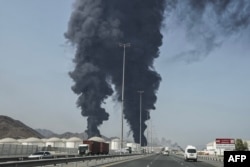
Some oil-loading operations were suspended at the United Arab Emirates’ port of Fujairah, a major refueling hub for ships outside the Strait of Hormuz, after a fire broke out on March 14, industry and trade sources said.
Authorities said the fire started when debris fell during the interception of a drone. No injuries were reported, and civil defense teams were working to contain the blaze, the emirate’s media office said.
Officials did not confirm the reported suspension of port operations.
Earlier, Bloomberg News reported that some oil-loading activities at Fujairah port had been halted following a drone attack and fire.
The Abu Dhabi state oil company ADNOC, which operates in the emirate, did not immediately respond to requests for comment.
With reporting by Reuters
Bombing Of Several Military Sites Reported Around The City Of Tabriz
Hours after the Israeli military warned residents in parts of the city of Tabriz in northwestern Iran, an official from the East Azerbaijan provincial administration confirmed that Israel had attacked “several military sites.”
According to the head of crisis management at the East Azerbaijan provincial governor’s office, the Israeli military bombed “a private industrial facility in western Tabriz, a production unit in the Akhula area, and several military centers around the city,” the state-aligned Mehr news agency reported.
He did not provide further details.
The official also reported that five people were injured in the attacks.
Iranian Activists: 'No To War And No To The Islamic Republic'
Hundreds of Iranian academic, civil, cultural, and political activists have issued a statement condemning both the Islamic Republic’s policies and the US and Israeli military attacks on Iran, which they described as “contrary to recognized principles of international law.”
Some 350 signatories called for an immediate halt to the war.
They wrote: “From our perspective, as supporters of ‘No to war and no to the Islamic Republic,’ this war -- like all destructive wars -- is an absolute evil that brings neither democracy nor security and prosperity for the people.”
The activists criticized the Tehran government's policies that they said -- “through the suppression of citizens’ rights, the killing of protesters, hostility toward the West, calls for the destruction of Israel, regional adventurism, and support for proxy forces -- have no connection to the national interests of Iranians.”
They also urged support for peace initiatives and diplomatic efforts to end the conflict.
Rights Group Says More Than 4,700 Casualties Reported In Iran War
The US-based Human Rights Activists News Agency (HRANA) says the first two weeks of the war in Iran have resulted in at least 4,765 casualties, including both deaths and injuries, according to data compiled from field reports and verified sources.
The figure includes 1,298 civilian fatalities, among them at least 205 children, and 654 civilians injured, while the status of other casualties is classified as military or unspecified.
HRANA said 5,480 attacks were recorded in various parts of Iran since the conflict began on February 28, affecting all 31 provinces and at least 209 cities.
The group also reported widespread damage to civilian infrastructure, including 20 hospitals, 36 schools, and 98 residential areas.
The UN refugee agency (UNHCR) estimates that the fighting has displaced about 3.2 million people across Iran, while 203 individuals have been arrested by security forces in connection with the conflict, according to HRANA.
The rights organization said figures represent minimum confirmed numbers and could rise as verification continues.
Is The US Considering Seizing Iran's Kharg Island?
- By Kian Sharifi
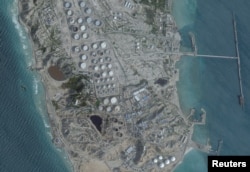
Iran's Kharg Island, the country's main oil export outlet, could be a target for the United States, experts say, in a move that could cut off the revenues that sustain Tehran's sanctions-hit economy.
But the possible capture of the tiny island in the Persian Gulf, which handles around 90 percent of all Iranian oil exports, would mark a major escalation in the US-Israeli war on Iran. It is also unlikely to land a fatal economic blow to the Islamic republic, experts say.
Axios reported on March 7 that the US administration has discussed capturing Kharg, on which Iran has heavily depended to export its oil since facilities on the island were built in the 1960s. The island's deep-water berths can accommodate supertankers that move oil in bulk.
A source close to White House told The New York Post that capturing the island "is not so much a matter of if but when, given its critical nature to the outcome of the war."
Read Kian Sharifi's analysis, which was published earlier this week, here.