



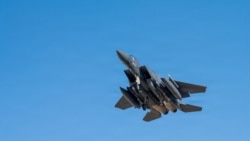
Iran-US Contacts Likely Ongoing Despite Public Denials, Says Analyst
Speaking to Current Time, political analyst Anton Penkovsky said contacts between Iran and the United States are likely continuing despite public denials by Tehran.
"Despite the fact that Iran denies the existence of any contacts with the American side and claims that negotiations are conducted through intermediaries, I think it is obvious to everyone that contacts do exist in one form or another," he said. "Iran is pursuing this information strategy purely for domestic political reasons, so as not to appear weak to its internal audience, especially given that social tensions in Iran remain quite high."
He said talks appear deadlocked over several core issues:
"Even if the parties have agreed on a large number of points, the main problems remain in three areas. The first is the scope of restrictions on Iran’s nuclear program, including the dismantling of Iran’s nuclear infrastructure and the transfer of all nuclear materials to the United States -- a position on which the United States has insisted and, apparently, is not willing to make concessions or compromises. For Iran, this is a matter of sovereignty and strategic deterrence against its enemies in the region."
"The second issue is the missile program and support for allied groups -- proxy forces in the Middle East -- which primarily pose a threat, and which are, in essence, Iran’s main instrument of influence in the region. For the Iranian authorities, it would be very painful to give up these tools."
"The third point concerns sanctions and security guarantees, which Iran is now bargaining for itself. Iran is seeking the complete lifting of sanctions, but the United States will clearly not agree to this until the very end, until it is fully satisfied with Iran's actions, since sanctions pressure has been one of the main long-term levers of pressure on the Iranian authorities. It is precisely around these issues that negotiations in recent weeks have, by and large, reached a deadlock. One could even say that the decision to carry out strikes and begin military actions was made by the White House because Iran refused to make concessions on the issues listed, at the end of February."
On proposals to shift responsibility for security in the Strait of Hormuz to US allies, Penkovsky said:
"This idea appears quite logical from Washington’s point of view if they want to bring this conflict to a close relatively quickly. However, in practice, it would be a very difficult task, primarily from the standpoint of military infrastructure, since it would entail the need for demining, escorting oil tankers, and protection against direct Iranian or proxy attacks."
Energy Markets Could Take Months To Stabilize After War Ends, Expert Says
WASHINGTON -- Even if hostilities with Iran were to stop immediately, global energy markets will take a long time to recover, Mark P. Mills, executive director of the National Center for Energy Analytics, told RFE/RL.
Speaking during a briefing hosted by the State Department New York Foreign Press Center on March 30, Mills -- who served in the White House Science Office under President Ronald Reagan -- said markets would react quickly to an end in fighting but take longer to return to stability.
"Prices will relax immediately…but the trail to the equilibrium we had before is probably at least six months -- that might be a year…. We're certainly into months, not weeks," he said.
Mills said the current crisis underscores a deeper structural reality: The global economy remains tightly bound to oil. Despite years of investment aimed at reducing dependence on fossil fuels, global oil consumption has remained largely unchanged on a per capita basis since 2000.
"Every product and service is linked to oil," he said, noting that as much as 95 percent of global transportation still depends on it. Even rapid growth in electric vehicles has made only a marginal dent in overall demand.
The conflict has also revived concerns about supply vulnerabilities, particularly in key chokepoints such as the Strait of Hormuz and the Red Sea. In response, countries are already rerouting shipments, tapping strategic reserves, and even reverting to coal in some regions to ease pressure on oil and gas markets.
According to Mills, these emergency measures could buy the world "two to three months" before more severe shortages emerge if disruptions persist.
Beyond the immediate crisis, the longer-term impact may reshape global energy strategy. Governments and investors are increasingly likely to prioritize diversifying oil supply sources -- boosting production in regions such as the United States, South America, and Africa -- to reduce reliance on geopolitically sensitive areas, he said.
Trump Tells Countries To 'Go Get Your Own Oil!'
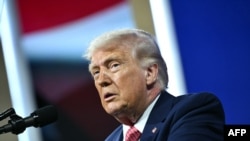
US President Donald Trump has told countries who refused to help the United States unblock the Strait of Hormuz and are now dealing with jet fuel shortages to buy American oil or go to the strategic transit route "and just take it."
In a social media post on March 31, the US leader chided countries such as the United Kingdom for "refusing to get involved" in the US-Israeli campaign in Iran.
"You’ll have to start learning how to fight for yourself, the U.S.A. won’t be there to help you anymore, just like you weren’t there for us," he said. "Iran has been, essentially, decimated. The hard part is done. Go get your own oil!"
Many countries, including close US allies such as Canada, the UK, Germany, and Japan, rejected taking part in keeping the Strait of Hormuz open, though some said they could be part of such an operation once the war with Iran ends.
In a separate post, Trump targeted France specifically, criticizing it for not allowing planes loaded with military supplies and bound for Israel, to fly over French territory. "The USA will REMEMBER," he wrote.
Israeli Military Ready To Continue Operations Against Iran For 'Weeks'
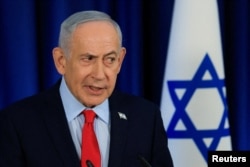
The Israeli military said it is prepared for several more weeks of fighting with Iran, after Prime Minister Benjamin Netanyahu said the war had passed "definitely beyond the halfway point,"
Netanyahu told Newsmax that this referred to progress in military objectives rather than time, and did not provide a time frame.
Military spokesman Nadav Shoshani said the duration of the conflict would be decided by political leaders, but that Israel was "prepared to keep operating for weeks to come."
"We have the targets for that, the munition for that, the manpower for that," he added.
US Secretary of State Marco Rubio also suggested on March 30 that the war could last "weeks" further.
With reporting by AFP
Iran Said It Opened A Drone Factory In Tajikistan. But There's No Sign Of It.
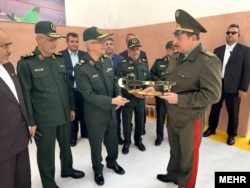
Nearly four years after Iran unveiled a drone factory in Dushanbe, Tajikistan, its operations -- and even its existence -- remain shrouded in uncertainty. Experts and officials question whether the facility ever produced drones or served more as a symbolic gesture of Iranian military influence.
Read the report by Zamira Eshanova and RFE/RL's Tajik Service here .
Huge Explosions In Isfahan As US Targets Iranian Munitions Depot
- By RFE/RL
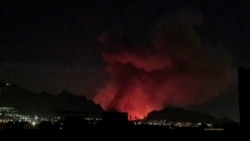
Huge explosions and fires lit up the night sky in the Iranian city of Isfahan which is home to the Badr military air base. The US reportedly used a large number of bunker-busting bombs overnight on March 30-31, with US President Donald Trump sharing video of explosions on his Truth Social platform.

Four Injured In Dubai
Four people were injured by debris from the interception of a projectile that fell on residential buildings in southern Dubai, local authorities said.
"Authorities confirm that they are responding to an incident caused by debris from a successful interception that fell on residential houses in southern Dubai, resulting in property damage and minor injuries to four Asian nationals," the Dubai Media Office said in a post on X on March 31.
It had earlier said that "sounds heard across parts of the city were the result of successful air defense interception operations."
Amnesty Says Deadly Iranian Strike In Israel 'Must Be Investigated As A War Crime'
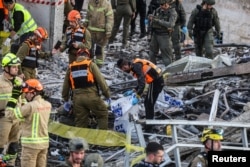
A new report by Amnesty International says an Iranian missile strike on the Israeli city of Beit Shemesh on March 1 that killed nine civilians, including four teenagers, should be investigated as a possible war crime.
The strike -- which hit the Ramat Lehi neighborhood, destroying a synagogue and severely damaging a bomb shelter -- also injured dozens more.
Based on verified social media footage, satellite imagery, and witness interviews, Amnesty concluded that an Iranian ballistic missile was used and found no evidence of a nearby military target.
The closest known military site was located about 3.5 kilometers away, Amnesty said, while senior research director Erika Guevara-Rosas said the weapon used in the strike was "wildly inaccurate and carries a massive warhead, making it completely inappropriate for use in densely populated civilian areas."
Amnesty said that the attack was indiscriminate and therefore violated international humanitarian law. It called for an "independent and impartial investigation," adding that "anyone for whom there is sufficient evidence of responsibility must be prosecuted in a fair trial."
The strike occurred amid escalating regional hostilities following US and Israeli attacks on Iran, with both sides carrying out retaliatory strikes that have caused civilian casualties across the Middle East.
Iran Says It Executed 2 More Individuals Linked To Opposition Group
Iran’s judiciary announced on the morning of March 31, that two more individuals had been executed on charges of “membership” in the People's Mojahedin Organization of Iran (MEK).
The two were identified as Babak Alipour and Pouya Ghobadi. The judiciary accused them of “armed rebellion” and carrying out “terrorist operations.”
On March 30, Mohammad Taqavi Sangdehi and Akbar Daneshvar-Kar were also executed on similar charges.
The MEK is an Iranian opposition group dating to the 1960s that has opposed both the Shah and the Islamic republic. It was previously designated by the United States as a foreign terrorist organization before being delisted in 2012.
In November 2025, Mai Sato, the UN special rapporteur on human rights in Iran, warned that the cases of the men were marked by serious due process concerns, including delayed access to lawyers and allegations of torture, and said imposing the death penalty in such cases would violate international law.
Araqchi Calls Saudi Arabia A 'Brotherly Country' Despite Iranian Attacks
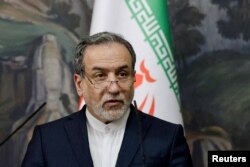
Amid rising regional tensions, Iranian Foreign Minister Abbas Araqchi says he has written to Saudi officials and told them that it is “high time to eject US forces.”
In a post published on X on March 30, he also said that “Iran respects the Kingdom of Saudi Arabia and considers it a brotherly country.”
Araqchi's comments come as the Islamic Revolutionary Guards Corps has carried out retaliatory attacks on the United Arab Emirates and other Arab countries in the southern Persian Gulf, including Saudi Arabia, since the start of the war involving the United States and Israel against Iran.
Following the launch of US and Israeli military strikes, Iran has used missiles and drones to target US bases in several Persian Gulf countries, as well as some civilian locations such as an airport, several hotels in Dubai, and oil and gas facilities.