



Starmer Tells Britain Iran Conflict 'Not Our War'
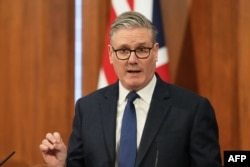
British Prime Minister Keir Starmer addressed the nation on the conflict in the Middle East.
"This is not our war. We will not be drawn into the conflict," he said. "That is not in our national interest. And the most effective way we can support the cost of living in Britain is to push for de-escalation in the Middle East and a reopening of the Strait of Hormuz, which is such a vital route for energy."
"It is now clear that the impact of this war will affect the future of our country," he also said. "So today I want to reassure the British people that no matter how fierce this storm, we are well-placed to weather it and that we have a long-term plan to emerge from it a stronger, a more secure nation."
"Whatever the pressure on me and others, whatever the noise, I'm going to act in the British national interest in all the decisions that I make," he added.
Rubio Sees 'Finish Line' In Iran, Warns NATO Ties Will Be 'Reexamined'
US Secretary of State Marco Rubio said the "finish line" in the war with Iran is in sight, and once the conflict ends the United States will have to "re-examine" its relationship with NATO after a number of European countries declined to support the conflict with Iran.
Rubio said in an interview on Fox News Channel's Hannity show on March 31 that "there are talks going on" to end the war, with the possibility of a "direct meeting at some point."
"We can see the finish line. It's not today, it's not tomorrow, but it is coming," he said, but did not elaborate.
To read the full report, click here.
Australian PM Warns Of 'Economic Shocks' From Iran War
Australian Prime Minister Anthony Albanese delivered a rare speech to the nation on April 1 about the war in the Middle East. The speech comes as the monthlong Iran war has engulfed the Middle East, killing scores, disrupting energy supplies, and threatening to throw the global economy into chaos.
Albanese warned Australians that the "months ahead may not be easy" due to the repercussions of the US-Israeli war with Iran, which began on February 28. In retaliations to strikes, Iran has effectively closed the Strait of Hormuz, a critical chokepoint for global energy shipments, particularly oil and liquefied natural gas.
"The reality is, the economic shocks caused by this war will be with us for months," he said.
"The war in the Middle East has caused the biggest spike in petrol and diesel prices in history. Australia is not an active participant in this war. But all Australians are paying higher prices because of it," he said.
Albanese also announced on March 31 that the government would halve the special tax on gasoline and diesel and waive the cost of using heavy roads for three months to help households cope with rising costs caused by the war.
Australia has its highest fuel reserves in 15 years, but this is still far below the International Energy Agency's 90-day recommendation.
Trump, Starmer Also To Address Their People
Meanwhile, US President Donald Trump was also scheduled to address the American nation about the war with Iran on April 1 at 9 p.m. local time, according to the White House.
British Prime Minister Keir Starmer is also reported to be addressing the nation on April 1 at 10:15 local time, with a focus on concerns about the cost of living as energy prices in the country continue to rise due to the ongoing crisis in the Middle East.
Britain is among the countries that have not joined the United States in reopening the Strait of Hormuz, and this issue has been met with explicit criticism from Trump.
Trump Calls 'Two To Three Weeks' While Iran Again Denies Talks
US President Donald Trump said he expects the war with Iran to wrap up "in two to three weeks."
He made the remarks while signing an executive order at the White House on March 31. He also said that "France and other countries" such as China will have to "fend for themselves" when it come to trying to pass the Strait of Hormuz, which has been effectively closed by Iran in retaliation for US and Israeli strikes on the country that have taken place since February 28.
"We hit them hard. We got rid of a lot of the radicalized lunatics along the strait," he claimed, before saying that "within two weeks, maybe three...we'll leave" the region.
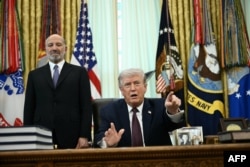
He said that "we are negotiating with them right now," adding that "we've seen regime change, although regime change was not one of the things I had as a goal."
Tehran and Washington have sent mixed messages from both sides about efforts to end the conflict.
Iranian Foreign Minister Abbas Araqchi, in an interview with Al Jazeera that aired on April 1, said that no negotiations with the United States are "ongoing" and Tehran has "not responded" to Washington's reported 15-point proposal to end the war.
"We receive messages from the Americans, some directly and some through our friends in the region, and we respond to these messages whenever necessary," he said. "There is no basis for negotiations [with the US]," adding that, of course, some messages had been exchanged directly with the US special envoy, Steve Witkoff.
Iranian Missiles Strike Israel As Houthis Launch Third Missile
Reports from Israel say 14 people, including an 11-year-old girl, were injured in a new round of rocket attacks on the country on the morning of April 1. The Israeli emergency medical service reported that the injured girl was in critical condition. Israeli police also reported damage to several locations in the center of the country.
The Israeli military had previously said that, for the first time in about 20 hours, it had detected "missiles fired from Iran toward Israeli territory," and air raid sirens had sounded across central Israel.
According to the army's Home Front Command, another warning of rocket fire was issued less than an hour later, prompting a state of alert in large parts of northern and central Israel.

Israeli media reported that the attack used cluster munitions, a type of ammunition that explodes in the air and scatters small bombs over a wide area.
International human rights organizations had previously warned against the use of this type of ammunition in civilian and residential areas.
Meanwhile, the Iran-backed Houthi militia in Yemen say they launched a missile attack on Israel on April 1, simultaneously with Iran and Lebanon's Hezbollah, which is deemed a terrorist organization by Israel and the United States.
This is the third attack of this type by the Houthis since their entry into the Middle East war.
Yahya Saree, a spokesman for the Houthis, claimed in a video statement that they had attacked "sensitive targets" with a barrage of ballistic missiles.
Attacks On Energy Infrastructure Continue Across Gulf Region
Kuwait's state news agency reported on April 1 that "Iranian-backed" drones had targeted fuel tanks at the country's airport. Kuwaiti officials said the airport had been repeatedly targeted in recent weeks and that Kuwaiti airspace had remained closed since February 28.
According to a spokesman for the Kuwait Civil Aviation Authority, the attack on the fuel tanks caused a large fire but there were no casualties.
In Bahrain, a fire at a commercial facility was attributed to "Iranian aggression." Saudi Arabia announced that it had intercepted and destroyed several drones.
Meanwhile, an oil tanker in waters near Qatar was hit by a missile from Iran on April 1, the Qatari Defense Ministry reported. According to the state-owned energy giant QatarEnergy, the crew was unharmed and there was no environmental impact. Earlier, a Kuwaiti tanker was attacked in the port of Dubai.
These attacks come as Iran has threatened to target critical infrastructure, especially energy facilities, in the region after the start of the war with US and Israeli attacks on March 29.
On the evening of March 31, an Iraqi armed group allied with Tehran warned the United States that using Kuwaiti soil for a ground attack on Iran could escalate the conflict into a "full-scale war." Abu Alaa al-Walai, commander of the Kataeb Sayyid al-Shuhada group, announced in a message on X that if Kuwaiti soil is used, the "axis of resistance" will consider this action a violation of the region's security borders and will respond in kind.
Al-Walai also warned, referring to Israel's ground attack on Lebanon, that responses would be based on the principle of "an eye for an eye."
In another development, Saudi Arabia announced on April 1 that it has established bus routes to two airports in the cities of Dammam and Qaisumah for people planning to leave Kuwait.
The US State Department said it was monitoring threats against US citizens in Saudi Arabia and urged them to stay where they are. The US Embassy warned that locations such as hotels, businesses, and educational institutions affiliated with the United States could be targeted and urged citizens to stay away from windows until further notice.
The warning came after the Islamic Revolutionary Guards Corps, which is designated as a terrorist organization by the United States, announced that it would target American companies in the Middle East starting April 1 in response to recent attacks.
Vessel Hit By 'Two Projectiles' At Qatar Gas Hub
The United Kingdom Maritime Trade Operations (UKMTO), a shipping security monitoring group, reported early on April 1 that it had received information about a vessel being struck near Ras Laffan, Qatar's primary hub for liquefied natural gas production.
"UKMTO can confirm the vessel was struck by two projectiles," the group said on X.
The monitor added that source of the projectiles has not yet been identified and remains under investigation, while the crew has been reported as safe.
We are now closing the live blog for the day. We'll be back tomorrow at 7:30 a.m. Central European time to cover the latest events across the Middle East.
Netanyahu Says Israeli Attacks On Iran Will Continue
Israeli Prime Minister Benjamin Netanyahu said military operations against Tehran will continue until "the Iranian terrorist regime is crushed."
"The campaign is not over yet. We will continue until we crush the terrorist regime," Netanyahu said in a televised speech.
His remarks came shortly after Iranian President Masud Pezeshkian announced the "necessary will" in his country to end the war with Israel and the United States, provided that Tehran receives guarantees that the attacks will not be repeated.
"We had to act, and we did," Netanyahu said in a speech on the eve of the Jewish holiday of Passover.
Netanyahu emphasized that despite the continuation of the war, Israel has emerged as a "regional power," saying, "We have remained steadfast in advancing our goals and have changed the face of the Middle East."
Araqchi Says Iran Has Not Responded To US Plan Or Presented Any Conditions
Iranian Foreign Minister Abbas Araqchi said that he continues to receive indirect messages from US special envoy Steve Witkoff but that does not mean "negotiations" are taking place between Tehran and Washington.
Araqchi said in an interview with Al-Jazeera Qatar on March 31 that the messages include "warnings and counterviews" sent via various regional channels.
He stressed that "no negotiations are under way with any specific party" and that "the exchange of messages is taking place within an official framework under the supervision of the government and the Supreme National Security Council."
Araqchi also said Iran has not responded to the United States' 15-point plan and has not presented any proposals or conditions.
Iranian media announced Tehran had put forward five conditions in return, including the withdrawal of American forces from the region, payment of compensation to Iran, and control of the Strait of Hormuz by the Islamic republic.
In another part of his interview with Al-Jazeera, Araqchi said that "Tehran has not yet made a decision on the principle of negotiation, and Iran's conditions for ending the war are completely clear."
"Iran will not agree to a cease-fire and wants a complete end to the war throughout the region," he stated.
He also emphasized that Iran is "prepared for any ground confrontation" and "hopes that the enemies will not make mistakes in their calculations."
Araqchi also maintained that the Strait of Hormuz is "completely open" except to those who are participating in the war against Iran.
According to him, the Strait of Hormuz could be a "passage for peace" and the decision about it is up to the coastal countries.
The Strait of Hormuz, through which about 20 percent of the world's oil and gas exports pass, has been effectively closed by Iran since March 30, when the United States and Israel launched massive attacks on Iran, and its traffic has decreased by 95 percent.
The closure of this strait has caused a sharp increase in energy prices worldwide.
The comments by Iran's top diplomat are the latest in a series of mixed messages from both sides about efforts to end the conflict, which began on February 28.