



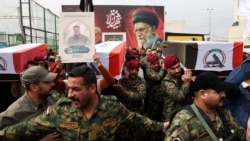
US Government Urges Americans In Iraq To Leave, Citing Threats
The US government has issued a warning to its citizens in Iraq, saying that "Iraqi terrorist militia groups aligned with Iran may intend to conduct attacks in central Baghdad in the next 24-48 hours."
"Iran and Iran-aligned terrorist militias have conducted widespread attacks against US citizens and targets associated with the United States throughout Iraq, including in the Iraqi Kurdistan Region," said the security alert, posted on X on April 2. "They may intend to target US citizens, businesses, universities, diplomatic facilities, energy infrastructure, hotels, airports, and other locations perceived to be associated with the United States, as well as Iraqi institutions and civilian targets."
The alert urged US citizens to leave the country, saying overland routes to Jordan, Kuwait, Saudi Arabia, and Turkey remain open, and that travelers should "expect long delays."
Air Strikes Reported Across Iran
Explosions, casualties, and the activation of air defenses were reported in various parts of Iran late on April 1 and early on April 2 following US and Israeli air strikes.
In Tehran, local media said air defenses were activated against "hostile targets." There were reports of explosions and power outages in parts of the capital.
The Iranian Red Crescent Society announced that in the past 24 hours locations in and around Tehran were targeted by strikes.
The cities of Isfahan, Shahreza, Kashan, Aran and Bidgol, and Najafabad were also reportedly targeted.
The Israeli military announced on the evening of April 1 that its air force had carried out more than 400 attacks on Iranian military infrastructure over the past two days, using about 650 munitions.
According to the military, dozens of targets in Tehran were struck during these attacks, including about 15 weapons production sites as well as parts of the Iranian Defense Ministry.
UAE Says Battling Air Threats
The Defense Ministry of the United Arab Emirates (UAE) announced that the country's air defenses were countering missile and drone "threats" on April 2.
"The UAE's air defenses...are actively engaging in missile and drone threats," the ministry wrote in a message on social media, without giving details about the origin of the missiles.
Since the start of the US-Israeli war with Iran on February 28, the UAE and other Gulf states have been repeatedly targeted by Iranian missile and drone attacks in retaliation.
In a televised address to the American public about the war on April 1, US President Donald Trump declared that the United States would not allow Gulf Arab allies and Israel to be "hurt or defeated" by a war with Iran.
Israel Reports Two Waves Of Iranian Missile Attacks, Several Injured In Tel Aviv
The Israeli Army announced early on April 2 that the country's air-defense systems had responded to two waves of missile attacks from Iran.
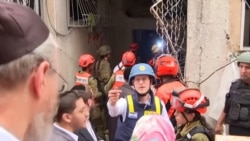
According to Israeli media, the first wave of attacks hit several locations in the center of the country, with at least four people in the Tel Aviv area receiving minor injuries. The police also reported the presence of forces at several locations, with some reports putting the number of locations at up to nine.
Local media also attributed the scattered damage to the use of cluster munitions, which Iran and Israel have previously accused each other of using.
Less than two hours later, the Israeli military reported a second wave of rockets, setting off sirens across large parts of northern and central Israel, but there were no immediate reports of casualties or damage.
Trump: US Will Send Iran 'Back To The Stone Ages'
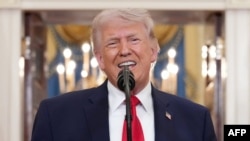
US President Donald Trump on April 1 hailed American forces' "swift, decisive, overwhelming victories" in Iran and said his administration's strategic objectives are "nearing completion," vowing that the military operation will be completed "very shortly."
Still, he signaled no immediate letup of in military action, saying US forces will hit Iran "extremely hard" for the next two to three weeks and that "we are going to bring them back to the Stone Ages, where they belong."
Speaking in a nationally televised address, Trump did not provide a clear exit date for the end of the conflict, which began when the United States and Israel launched air strikes against Iran on February 28. Tehran has retaliated by closing the Strait of Hormuz and firing missiles and drones at Israel and US Gulf Arab allies.
"Tonight, I'm pleased to say that these core strategic objectives are nearing completion," Trump said in nationally televised address from the White House on April 1, his first prime-time address since the start of the conflict on February 28.
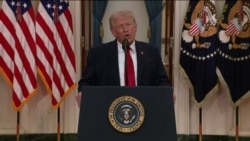

"In these past four weeks, our armed forces have delivered swift, decisive, overwhelming victories on the battlefield -- victories like few people have ever seen before," he said.
"They didn't know what was coming," Trump said, referring to Iran.
Critics have charged that the war is spinning out of control, spilling over throughout the Middle East and causing an energy crisis that is driving up prices worldwide.
Trump defended his actions and said it was the only way to prevent Iran from getting a nuclear weapon, which he insisted would have happened had he not pulled the United States out of the 2015 Iran nuclear deal, known as the Joint Comprehensive Plan of Action (JCPOA), that was agreed with world powers.
The JCPOA provided Iran with relief from sanctions in return for curbs on its nuclear program. Tehran insists that its nuclear program is strictly for civilian purposes.
Trump pulled the United States out of the accord in 2018 during his first term, saying it wasn't strong enough to prevent Tehran from getting a nuclear weapon
Trump said that if Tehran did not agree to a peace deal, the United States would hit all of Iran's electric generating plants.
"We going to finish the job and we are going to finish it fast," he said.
He said the United States does not need the Strait of Hormuz, the crucial waterway through which 20 percent of the world's oil and natural gas supplies pass.
He said that countries that do rely on the passage for their supplies should "build up some delayed courage" and open the strait, which has been effectively closed by Iran.
Read more here.
Former Iranian Foreign Minister Kharazi Injured In Air Strike
Iranian media are reporting that former Foreign Minister Kamal Kharazi was seriously wounded in an air strike that also killed his wife. Kharazi had served as foreign minister from 1997-2005 under reformist ex-President Mohammad Khatami. He is still an adviser to the Iranian government. Iranian media reported that his home in Tehran was targeted on March 31 in a US-Israeli strike. He was badly injured and hospitalized following the attack, media reported.
Pezeshkian Claims Iranians 'Harbor No Enmity' Toward Ordinary Americans
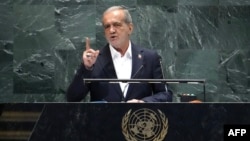
Iranian President Masud Pezeshkian has addressed the American people, saying that Iranians "harbor no enmity" toward ordinary Americans.
In a letter published on April 1, he rejected portrayals of Iran as a threat, calling such claims “neither consistent with historical reality nor with present-day observable facts.”
Pezeshkian also defended Tehran's actions in the ongoing conflict with the United States and Israel, saying that they were a "measured response grounded in legitimate self-defense."
Washington has long maintained that Iran’s nuclear ambitions and regional activities pose a serious security threat, and continues to press Tehran to curb both as a condition for any peace deal.
How Iran's Hormuz Blockade Chokes Global Trade Beyond Oil And Gas
- By Ray Furlong

When an Indian tanker carrying liquefied petroleum gas (LPG) passed through the Strait of Hormuz recently, its progress was followed by excited live TV news coverage .
“Its position was received eight minutes ago. It’s currently at 12.5 knots and is moving at 154 degrees. It’s reported ETA in India is at 9.30 p.m. tomorrow,” reported one journalist, providing running commentary while following a tracker app.
Later, videos showed the ship with a military escort from the Indian Navy in the Gulf of Oman.
The attention was not unwarranted. The war in Iran , and Tehran’s decision to largely close the Strait of Hormuz , have not only stopped supplies of crude oil and liquefied natural gas (LNG). Shipments of a whole range of other vital commodities have also almost completely ground to a halt.
Even if the war ends, markets may not return to normal quickly. Iranian attacks have caused untold damage to industrial infrastructure in the region. Iran is also insisting that it has a “sovereign right” over the strait, though Washington says reopening the waterway is a condition for a cease-fire.
Read more here
Houthis Launch Third Missile Attack On Israel As US Strikes Continue On Iran
The Iran-backed Houthi militia in Yemen said they launched a missile attack on Israel on April 1, simultaneously with Iran. This is the third attack of this type by the Houthis since their entry into the Middle East war. Meanwhile, US-Israeli strikes on Iran continued as the conflict entered its fifth week. Iran also targeted neighboring Kuwait and Iraq with drones.
Iranian President To Release Letter To US Public 'In A Few Hours,' Spokesman Says

Mehdi Tabatabai, a spokesperson for the office of Iranian President Masud Pezeshkian, said in a post on X on April 1 that an important letter to the American people from Iran's president would be released "in a few hours."
He gave no further details in the post.