




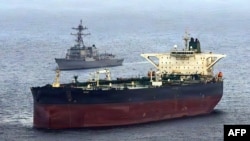
WASHINGTON -- The latest exchange between Washington and Tehran over a proposed path toward de-escalation has raised new questions about what comes next in the growing crisis around the Strait of Hormuz.
US President Donald Trump described Iran's latest response to a US-backed proposal as "totally unacceptable," even as both sides continue to signal interest in negotiations over sanctions relief, nuclear restrictions, and the future of shipping through the strategic waterway.

Analysts in Washington say the standoff is increasingly testing assumptions that diplomacy can move quickly enough to prevent wider economic fallout from the conflict.
So far, financial markets have remained relatively calm despite some choppy moments.
But experts say the relative market stability reflects expectations that negotiations will eventually produce some form of agreement.
"There's pressure on both sides to make some sort of deal," Mark Cancian said during a discussion hosted by the Center for Strategic and International Studies (CSIS) on May 11.
Cancian, a retired US Marine Corps colonel and senior adviser at CSIS who served more than three decades in the military, including during Operation Desert Storm, and Iraq, said the military situation has settled into "a stalemate."
Tehran has attempted to restrict movement through the strait, the waterway for one-fifth of the world's oil and gas, while the United States has maintained pressure from outside the waterway.
Although clashes have remained largely confined to the strait, neither side appears positioned for a decisive breakthrough.
According to Cancian, both Washington and Tehran appear to be exploring possible compromises involving Iran's enriched uranium stockpile, future enrichment activity, and phased sanctions relief.

He noted that the United States seems willing to forgo inspectors on the ground in exchange for physical constraints on enriched uranium.
In the meantime, Cancian said the longer the confrontation continues, the greater the military and economic pressure will become for both sides.
Asia Watching Closely
Although global markets have remained relatively stable, analysts said the economic impact could become more pronounced if disruptions in the Strait of Hormuz continue.
While some cargo traffic does get through, the crisis has already contributed to higher fuel prices -- up roughly 40 percent -- and growing supply concerns in parts of Asia and Europe.
The crisis is being followed particularly closely in East Asia, where several economies remain heavily dependent on Middle Eastern energy imports -- 70 percent for South Korea and 95 percent for Japan.
Victor Cha, who serves as president of the geopolitics and foreign policy department at CSIS and a professor at Georgetown University, said Japan and South Korea are already looking for ways to diversify energy supplies and reduce long-term dependence on Gulf shipping routes, eyeing investments in Central Asia and Africa.
"Both of them, as a result of this, no matter what happens, are going to want to lower their dependence on crude coming out of the strait," Cha said.
He further noted that this shift creates a "geostrategic imperative" for Korea and Japan to improve relationships with Russia, as alternative routes from Central Asia would likely transit the Russian Black Sea coast.
Additionally, both the Japanese yen and South Korean won have hit multi-year lows against the dollar, further straining their economies.
The Iran issue is also expected to loom over Trump's upcoming summit with Chinese President Xi Jinping on May 14-15.
Beijing has remained Iran's primary oil customer, taking roughly 90 percent of its exports last year. US officials may press Beijing to use this leverage to encourage Iranian concessions.
Still, analysts say the immediate issue remains whether diplomacy can move faster than the economic pressures and munitions depletions now building across global markets and military theaters.

