




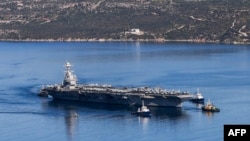
As Iranian and US diplomats concluded a third round of talks in Geneva on February 26 -- described by mediators as a “significant” step toward technical review -- the imminent arrival of the USS Gerald R. Ford carrier strike group in Israel a day later underscored the military brinkmanship shaping the standoff between Washington and Tehran.
The deployment, a massive show of force, serves as a counterweight to the optimistic language surrounding the negotiations.
The juxtaposition of diplomacy and military pressure appears deliberate. According to Mohammad Ghaedi, a lecturer at George Washington University who spoke to RFE/RL’s Radio Farda, US President Donald Trump's administration views the threat of force not as an alternative to diplomacy, but as a mechanism to drive it.

“Even if [these talks] are a last-ditch effort, the United States will not announce it publicly,” Ghaedi said. “That preserves the element of surprise in the event of an attack.”
He added that regardless of whether negotiations collapse, Washington is unlikely to formally declare their end before any potential military action, describing the current naval buildup as a key leverage point.
Ghaedi expressed skepticism about the prospects for a comprehensive breakthrough. While discussions on general principles appear to be advancing, he said a significant gap remains over nonnegotiable details, particularly uranium enrichment levels.
Speaking on February 27, Trump said he was "not happy" with Iran but added that he hadn't yet made a decision on a possible military option, as more talks were expected.
"They’d be smart if they made a deal. No nuclear weapons -- we want no nuclear weapons by Iran and they're not saying those golden words," Trump said.
Fueling speculation, on the same day the United States authorized the departure of nonemergency government personnel and family members from Israel as the carrier group approached.
Separately, US Secretary of State Marco Rubio announced that his department has designated Iran as a state sponsor of wrongful detention -- a newly created label that Tehran is the first ever to receive.
"The Iranian regime must stop taking hostages and release all Americans unjustly detained in Iran, steps that could end this designation and associated actions," Rubio said in a statement.
Speaking aboard Air Force Two, US Vice President JD Vance sought to shape expectations around the administration’s deliberations. While confirming that “potential strike action” is under active consideration, Vance stressed that any conflict would be limited in scope.
“The idea that we’re going to be in a Middle Eastern war for years with no end in sight -- there is no chance that will happen,” Vance told reporters on February 26. He reiterated that the White House prefers a diplomatic outcome but said the final decision depends on Iranian concessions.
Iranian media close to senior officials pushed back.
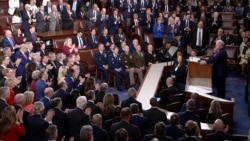
Nour News, affiliated with Ali Shamkhani, a top adviser to Supreme Leader Ali Khamenei, accused Vance of “feeding misinformation” to Congress about the possibility of a limited war in order to justify granting Trump broad authority in the event of a conflict.
Citing recent remarks by Khamenei, the outlet warned that any attack on Iran -- contained or otherwise -- would trigger a broader regional conflict. It said Washington risks a “dangerous miscalculation” by underestimating Tehran’s capacity to escalate, arguing that a surgical strike would not remain limited.
Ghaedi said the use of force would not eliminate Iran’s nuclear expertise and would likely be intended to compel Tehran back to the negotiating table.
“Any military action must ultimately lead to a point where Iran accepts -- through negotiation and agreement -- to forgo high-level enrichment,” he said.