



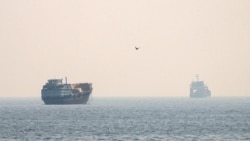

Iran Says Latest Clashes With US In Strait Of Hormuz Have 'Ceased'
Tehran has said armed clashes with US Navy vessels in the Strait of Hormuz have come to an end and that the situation is now calm.
“After a period of mutual fire, the fighting has ceased and the situation is under control,” the Tasnim news agency, which has close ties to Iran's Islamic Revolutionary Guards Corps (IRGC), quoted a military source as saying on May 8.
The report said the latest escalation -- which endangered but did not end the cease-fire now in place -- came after US forces fired on an Iranian-flagged oil tanker on May 6.
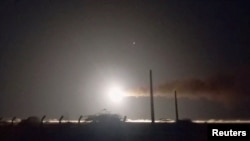
The two sides dispute the nature of the clashes and accuse the other of firing first.
On May 8, US Central Command (CENTCOM) said in a post on X that two more Iranian-flagged tankers were disabled by US forces in the Gulf of Oman as Washington continued enforcing its blockade on vessels entering or leaving Iran.
Talks are under way through Pakistani mediators on a potential peace deal, With US President Donald Trump expressing optimism even as he threatens Iran with massive air attacks if it rejects the US proposal.
US Slaps Sanctions On People, Firms Accused Of Aiding Iran's Shahed Program
The US Treasury on May 8 said it had imposed sanctions on 10 individuals and companies for aiding efforts by the Iranian military to secure weapons and materials used to build Shahed drones.
Included in the list are entities in China and Hong Kong, with the action coming days before US President Donald Trump's planned trip to China for meetings with Chinese leader Xi Jinping.
"The Trump Administration is imposing sanctions on 11 entities and three individuals based in Iran, China, Belarus, and the United Arab Emirates (UAE) involved in Iran’s efforts to acquire or use arms and related material," the Treasury said in a statement.
"Included in today’s actions are several China-based entities providing satellite imagery to enable Iran’s military strikes against U.S. forces in the Middle East," it added.
The Iranian-made Shahed drones provided by Tehran to Russia have been used by the Kremlin's forces for attacks in Ukraine, often hitting civilian targets.
The Treasury said it stands ready to take further economic action against Iran's military-industrial base as part of efforts to prevent Tehran from rebuilding its output capacity and projecting its power in the Middle East region.
The Treasury said it would also act against any foreign company supporting illicit Iranian commerce and could impose secondary sanctions on foreign financial institutions that aid Tehran's efforts, including those connected to China's independent "teapot" oil refineries.

Trump Says Expects Iranian Response To Peace Proposal In Next Few Hours
US President Donald Trump on May 8 said he expects an answer from Tehran to the latest US peace proposal within the next few hours, as hopes again rise that an agreement to end the nearly 70-day war was possible.
"I'm getting a letter supposedly tonight, so we'll see how that goes," Trump told reporters outside the White House on May 8.
Trump and other US officials have often asserted that a deal was close with Iranian leaders to end the war -- which began with US-Israeli air strikes on Iran on February 28 -- only to have talks end without a breakthrough.
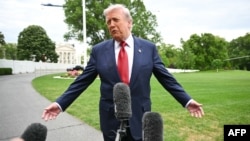
On May 7, Trump said a deal was "very possible," but he also warned Tehran of the resumption of massive air strikes if it did not accept the US proposal.
Leaders in Tehran have said they are studying the latest US plan, reportedly a one-page memorandum that would call for an end to the fighting and the opening of the crucial Strait of Hormuz but leave many key issues -- including Iran’s right to enrich uranium -- until later.
Earlier, US Secretary of State Marco Rubio also said Washington was awaiting Iran’s response to a US proposal aimed at ending the conflict.
"We're expecting a response from them today at some point...I hope it's a serious offer, I really do," Rubio told reporters during a visit to Rome on May 8.
The remarks come after two days of renewed violence in the Middle East, with US forces saying they had disabled two more Iranian-flagged tankers in the Gulf of Oman on May 8 as Washington continued enforcing its blockade on vessels entering or leaving Iran.
In addition, the United Arab Emirates said its air defense systems intercepted two ballistic missiles and three drones launched from Iran, leaving three people moderately injured.
In an X post on May 8, the country's Defense Ministry said that since the start of “blatant Iranian attacks” on the UAE, its forces had intercepted 551 ballistic missiles, 29 cruise missiles and 2,263 drones.

In a potential threat to the current cease-fire, US forces on May 7 said they intercepted and "eliminated inbound threats" and struck unspecified Iranian military sites after Iranian forces launched missiles, drones, and small boats at US Navy vessels in the Strait of Hormuz.
"US forces intercepted unprovoked Iranian attacks and responded with self-defense strikes as US Navy guided-missile destroyers transited the Strait of Hormuz to the Gulf of Oman, May 7," the US Central Command (CENTCOM) said.
Trump later told ABC News that retaliatory strikes against Iran were just a "love tap" and insisted that, despite the action, the cease-fire announced on April 7 was still "in effect" and that negotiations were ongoing.
The semiofficial Fars News Agency reported that parts of Iran's Bahman Port on Qeshm Island in the Strait of Hormuz had been targeted by unknown attackers.
“During an exchange of fire between Iran’s armed forces and the enemy, commercial sections of Bahman Port were targeted,” said Fars, which is close to the Islamic Revolutionary Guards Corps (IRGC).
In Talks With Vance, Qatari PM Urges All Sides To Focus On Diplomacy
Qatari Prime Minister Muhammad bin Abdulrahman al-Thani called for all warring parties to utilize diplomacy and not arms to find an end to the war in the Middle East.
Thani made the remarks following talks with US Vice President JD Vance in Washington, the Qatari Foreign Ministry wrote on X.
During the meeting, the prime minister "stressed the need for all parties to engage with the ongoing mediation efforts, to pave the way for addressing the root causes of the crisis through peaceful means and dialogue, leading to a comprehensive agreement that achieves lasting peace in the region," the ministry said.
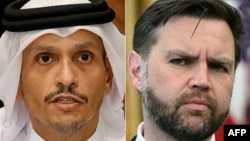
Pakistan has acted as official mediator between Tehran and Washington, but media reports have said the Qataris have been operating behind the scenes to drive to resolve the conflict.
US President Donald Trump on May 8 said he expects a response in the next few hours from Tehran to the latest US peace proposal to end the nearly 70-day war.
Staple Food Prices Soar In Iran As Inflation Hits 'Unprecedented Levels'
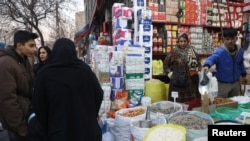
Year-on-year inflation for basic food staples surged sharply in Farvardin 1405 (March 21-April 21, 2026), according to new data from the Statistical Center of Iran.
Amid continuing reports of soaring prices in the country, particularly since the recent war with the US and Israel, “year-on-year inflation for some essential food items reached unprecedented levels," the semiofficial Tasnim news agency reported on May 9.
According to the new data published by Iran's official statistics agency, the price of solid vegetable oil rose 375 percent compared to the same period in the previous year -- the highest jump among food products.
Liquid cooking oil followed with inflation of 308 percent, while imported rice ranked next at 209 percent.
Products with the lowest year-on-year inflation rates included animal butter at 48 percent, powdered milk at 71 percent, and pasta at 75 percent.
With reporting by RFE/RL's Radio Farda
Iranian Foreign Minister Accuses US Of 'Destructive Approach'
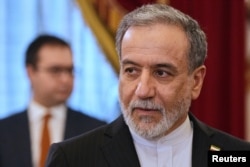
Iran's foreign minister has held a phone call with his Turkish counterpart, during which he criticized what he called Washington's "destructive approach" to "the diplomatic process," Iranian media reported on May 9.
According to the semiofficial ISNA news agency, Araqchi alleged during his conversation with Hakan Fidan that a "recent escalation by American forces in the Persian Gulf and their repeated violations of the cease-fire have increased suspicions regarding the American side’s intentions and seriousness on the path of diplomacy.”
It appears the Iranian official was referring to the continued US naval blockade of Iranian ports and shipping as well as a recent US military attack on two Iranian oil tankers on May 8.
The US military confirmed the attacks, saying that it had prevented the tankers from passing through its blockade.
Araqchi's latest comments come a day after he had accused Washington of opting for a "a reckless military adventure" every time "a diplomatic solution is on the table.”
The foreign minister's attacks on the US government are being highlighted in Iranian media at a time when US President Donald Trump is awaiting Tehran's response to a new proposal aimed at ending the war.
With reporting by RFE/RL's Radio Farda
Iran Says It Will Play At World Cup If Hosts Meet Conditions
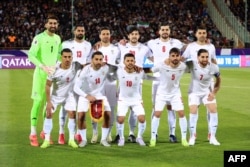
Iran’s soccer federation says that its national team will participate in the 2026 World Cup, but demanded guarantees from co-hosts the United States, Canada, and Mexico amid heightened tensions linked to the conflict in the Middle East.
The football federation’s statement issued on its website comes after Canada denied entry last month to its chief, Mehdi Taj, because of his alleged links to the Islamic Revolutionary Guards Corps (IRGC), which Ottawa designated a terrorist organization in 2024. The United States also designated the IRGC as a terrorist organization during President Donald Trump’s first administration.
Iran’s World Cup participation has been shrouded in uncertainty since the beginning of the US-Israeli war with Iran in late February.
The federation said in its statement that Iran would compete, “but without any retreat from our beliefs, culture, and convictions.”
"All players and technical staff, especially those who have served their military service in the Islamic Revolutionary Guards Corps...should be granted visas without any problems," Taj told state television on May 8.
Taj said Tehran has set 10 conditions for participation, including assurances that players, staff, the national flag, and anthem will be treated respectfully. Iran also requested security guarantees at airports, hotels, and stadiums.
US Secretary of State Marco Rubio said Iranian players would be welcome but warned officials linked to the IRGC may be barred from entering the US.
The president of soccer's world governing body FIFA, Gianni Infantino, has previously said Iran’s group stage matches in the United States will proceed as scheduled.
US President Donald Trump has also said he was "OK" with Iran playing at the world's most-watched sporting event.
With reporting by AFP
Bahrain Arrests 41 Over Alleged Links To Iran's Revolutionary Guards
Bahrain’s Interior Ministry said on May 9 that security forces had dismantled an organization accused of links to Iran’s Revolutionary Guards Corps and arrested 41 suspected members amid heightened regional tensions linked to the conflict in the Middle East.
The ministry claimed it had dismantled the group "in accordance with previous investigations carried out by the prosecutor's office. It said the cases involved "espionage on behalf of foreign entities and sympathy for Iranian aggression."
The Sunni-ruled Persian Gulf kingdom, which hosts a major US military base and has a large Shi'a population, has intensified its crackdown on expressions of support for Tehran since the conflict began. Bahrain was also heavily affected by Iranian attacks in the Gulf launched in response to US and Israeli strikes on Iran.
The arrests come against the backdrop of longstanding tensions between Bahrain’s Sunni-led monarchy and the country’s Shi’a population. Bahrain has repeatedly alleged Iranian involvement in unrest since 2011 anti-government protests led largely by Shi’a opposition groups, which Iran has denied.
Human rights activist Sayed Ahmed Alwadaei told the AFP news agency that authorities had carried out “arrests against some of the country's most prominent Shi'a religious figures,” calling the move “unprecedented.”
Human Rights Watch said in March that dozens had already been detained, while Bahrain last month stripped 69 people of citizenship for expressing support for Tehran.
With reporting by AFP
Tensions Remain High As Washington Awaits Iran's Peace Proposal Response
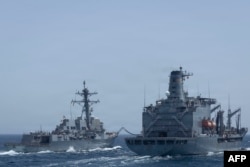
Iran blamed the United States for a recent escalation of skirmishes in the Persian Gulf as Washington awaits a response from Tehran over the latest proposal to end their war.
Senior US officials, from President Donald Trump to Secretary of State Marco Rubio, said on May 8 that Iran’s response to a US proposal aimed at ending the conflict -- which comes as fragile cease-fire efforts continued alongside fresh military incidents in and around the Strait of Hormuz -- was expected within hours.
But as of May 9, there was no word from Tehran on its response other than a tersely worded statement questioning Washington's seriousness in the talks.
Read more here
UK Destroyer Deployed To Middle East For Possible Hormuz Mission
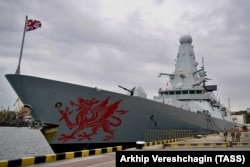
Britain will deploy a Royal Navy destroyer to the Middle East ahead of a planned multinational mission to protect commercial shipping in the Strait of Hormuz, the UK Defense Ministry said on May 9.
A ministry spokesperson said the HMS Dragon was being pre-positioned "ahead of any future multinational mission to protect international shipping when conditions allow them to transit the Strait of Hormuz."
The deployment comes as London and Paris advance plans for a coalition naval mission aimed at restoring freedom of navigation through the vital waterway, which accounted for about a fifth of global oil and gas shipments before the US-Israeli war with Iran erupted in February. Officials from more than 40 countries are understood to support the initiative.
A fragile cease-fire remains in place, but tensions in the Persian Gulf persist. Amid renewed exchanges of fire with Iranian forces in the Gulf, US forces on May 8 struck two Iranian tankers Washington accused of challenging its ongoing naval blockade of Iranian ports,